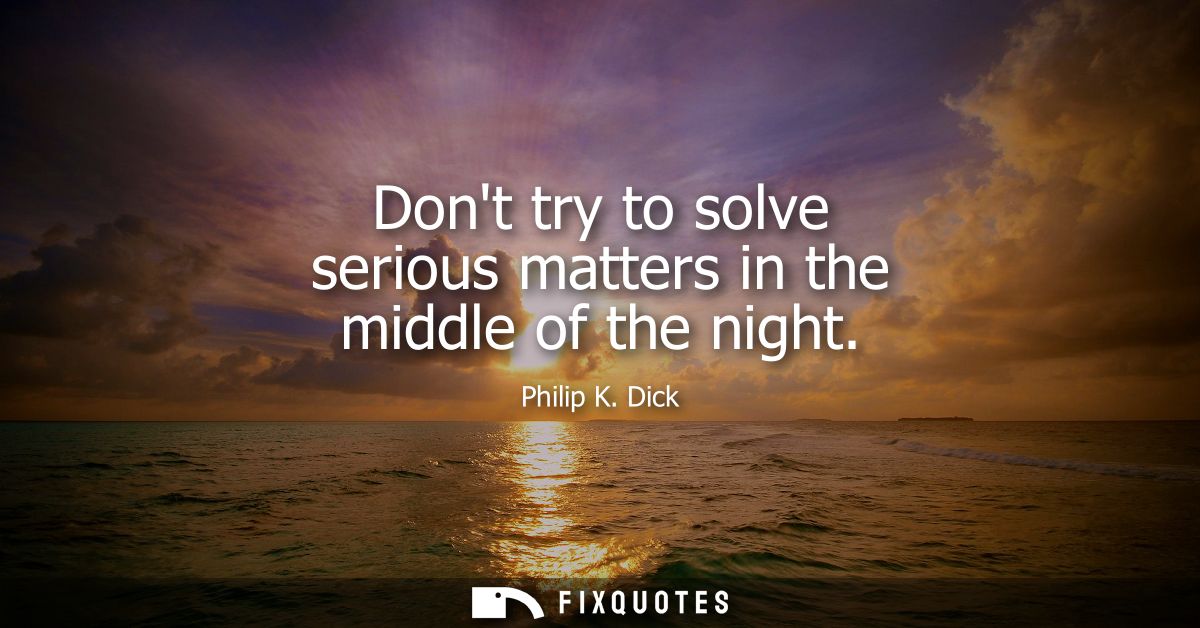
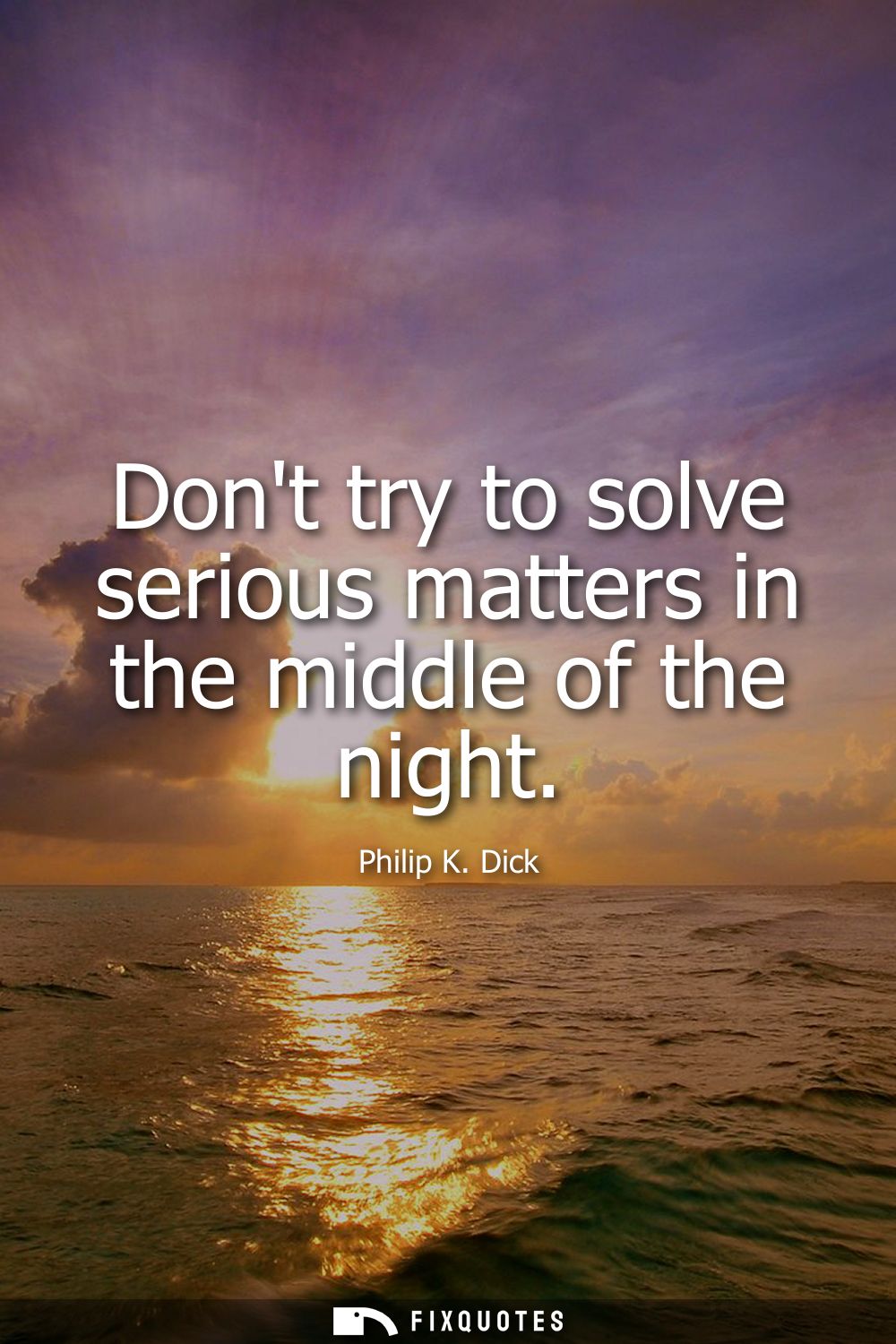
"Don't try to solve serious matters in the middle of the night"
About this Quote
At face value, Philip K. Dick is offering the kind of advice you’d expect from a weary friend: go to sleep, deal with it tomorrow. But PKD doesn’t do mere self-help. He’s diagnosing a cognitive trap he spent his career dramatizing: the mind at 3 a.m. becomes a conspiracy generator, stitching stray sensations into a story that feels urgent because you’re exhausted enough to believe it.
“Serious matters” is deliberately vague, a catchall for the big-ticket anxieties PKD’s characters can’t escape - identity, reality, guilt, God, the state. At night, those topics don’t just loom larger; they mutate. The subtext is that seriousness itself can be a hallucination produced by fatigue, solitude, and overstimulated pattern-recognition. Your brain, running low on resources, compensates by turning ambiguity into certainty. That’s how paranoia feels like clarity.
The line also functions as a quiet rebuttal to a cultural myth: that nocturnal intensity is where truth happens. The romantic image of the genius in the dark, solving life, is replaced by something more Dickian - the suspicion that “insight” can be a side effect of insomnia. In context of Dick’s biography - amphetamines, sleepless stretches, bouts of metaphysical dread - it reads like hard-won harm reduction. Not a denial of big questions, but a warning about the conditions under which they become most persuasive and least reliable.
“Serious matters” is deliberately vague, a catchall for the big-ticket anxieties PKD’s characters can’t escape - identity, reality, guilt, God, the state. At night, those topics don’t just loom larger; they mutate. The subtext is that seriousness itself can be a hallucination produced by fatigue, solitude, and overstimulated pattern-recognition. Your brain, running low on resources, compensates by turning ambiguity into certainty. That’s how paranoia feels like clarity.
The line also functions as a quiet rebuttal to a cultural myth: that nocturnal intensity is where truth happens. The romantic image of the genius in the dark, solving life, is replaced by something more Dickian - the suspicion that “insight” can be a side effect of insomnia. In context of Dick’s biography - amphetamines, sleepless stretches, bouts of metaphysical dread - it reads like hard-won harm reduction. Not a denial of big questions, but a warning about the conditions under which they become most persuasive and least reliable.
Quote Details
| Topic | Decision-Making |
|---|---|
| Source | Help us find the source |
| Cite |
Citation Formats
APA Style (7th ed.)
Dick, Philip K. (2026, January 15). Don't try to solve serious matters in the middle of the night. FixQuotes. https://fixquotes.com/quotes/dont-try-to-solve-serious-matters-in-the-middle-64100/
Chicago Style
Dick, Philip K. "Don't try to solve serious matters in the middle of the night." FixQuotes. January 15, 2026. https://fixquotes.com/quotes/dont-try-to-solve-serious-matters-in-the-middle-64100/.
MLA Style (9th ed.)
"Don't try to solve serious matters in the middle of the night." FixQuotes, 15 Jan. 2026, https://fixquotes.com/quotes/dont-try-to-solve-serious-matters-in-the-middle-64100/. Accessed 15 Mar. 2026.
More Quotes by Philip
Add to List