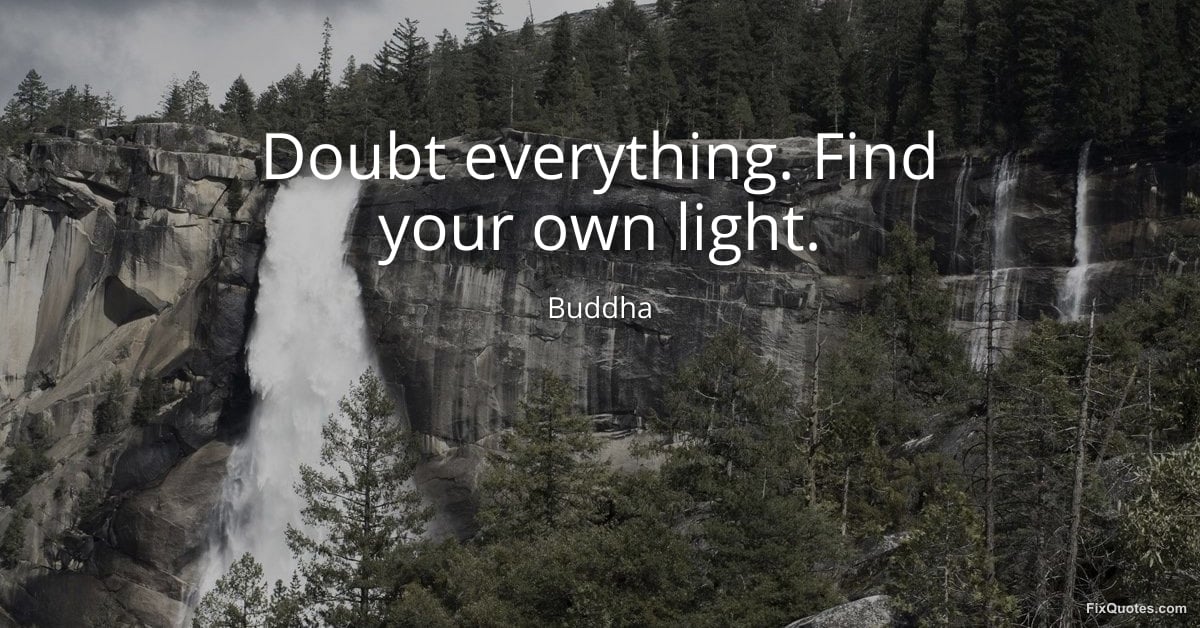
"Doubt everything. Find your own light"
About this Quote
What gives this line its enduring charge is the tension inside it: total skepticism paired with a demand for inner authority. From a figure so often flattened into a mascot for serenity, the sentiment lands almost as a provocation. "Doubt everything" is not nihilism; it is a refusal to outsource truth. Buddha's project was never simple belief. It was disciplined inquiry into suffering, desire, and the habits of mind that keep people trapped inside them.
That matters in context. In the religious world of ancient India, authority came wrapped in ritual, caste, lineage, and inherited doctrine. Against that backdrop, the instruction carries real insurgent force. It loosens the grip of priests, tradition, even the teacher himself. The subtext is radical: no institution, no sacred text, no charismatic master can do the work of awakening for you.
Then the second sentence turns the screw. "Find your own light" does not mean invent whatever truth feels comforting. It points to a harder kind of responsibility. If you strip away borrowed certainty, you are left with the labor of attention: observing your mind clearly enough to see what is real, and living by that insight. The rhetoric works because it offers freedom without indulgence. Doubt is only half the command; the other half is ethical and existential discipline.
That is why the line still resonates in modern culture, especially in an age of algorithmic certainty and branded wisdom. It flatters no tribe. It asks for independence, then makes independence a burden.
That matters in context. In the religious world of ancient India, authority came wrapped in ritual, caste, lineage, and inherited doctrine. Against that backdrop, the instruction carries real insurgent force. It loosens the grip of priests, tradition, even the teacher himself. The subtext is radical: no institution, no sacred text, no charismatic master can do the work of awakening for you.
Then the second sentence turns the screw. "Find your own light" does not mean invent whatever truth feels comforting. It points to a harder kind of responsibility. If you strip away borrowed certainty, you are left with the labor of attention: observing your mind clearly enough to see what is real, and living by that insight. The rhetoric works because it offers freedom without indulgence. Doubt is only half the command; the other half is ethical and existential discipline.
That is why the line still resonates in modern culture, especially in an age of algorithmic certainty and branded wisdom. It flatters no tribe. It asks for independence, then makes independence a burden.
Quote Details
| Topic | Wisdom |
|---|---|
| Source | Help us find the source |
| Cite |
Citation Formats
APA Style (7th ed.)
Buddha. (2026, March 10). Doubt everything. Find your own light. FixQuotes. https://fixquotes.com/quotes/doubt-everything-find-your-own-light-185890/
Chicago Style
Buddha. "Doubt everything. Find your own light." FixQuotes. March 10, 2026. https://fixquotes.com/quotes/doubt-everything-find-your-own-light-185890/.
MLA Style (9th ed.)
"Doubt everything. Find your own light." FixQuotes, 10 Mar. 2026, https://fixquotes.com/quotes/doubt-everything-find-your-own-light-185890/. Accessed 3 Apr. 2026.
More Quotes by Buddha
Add to List