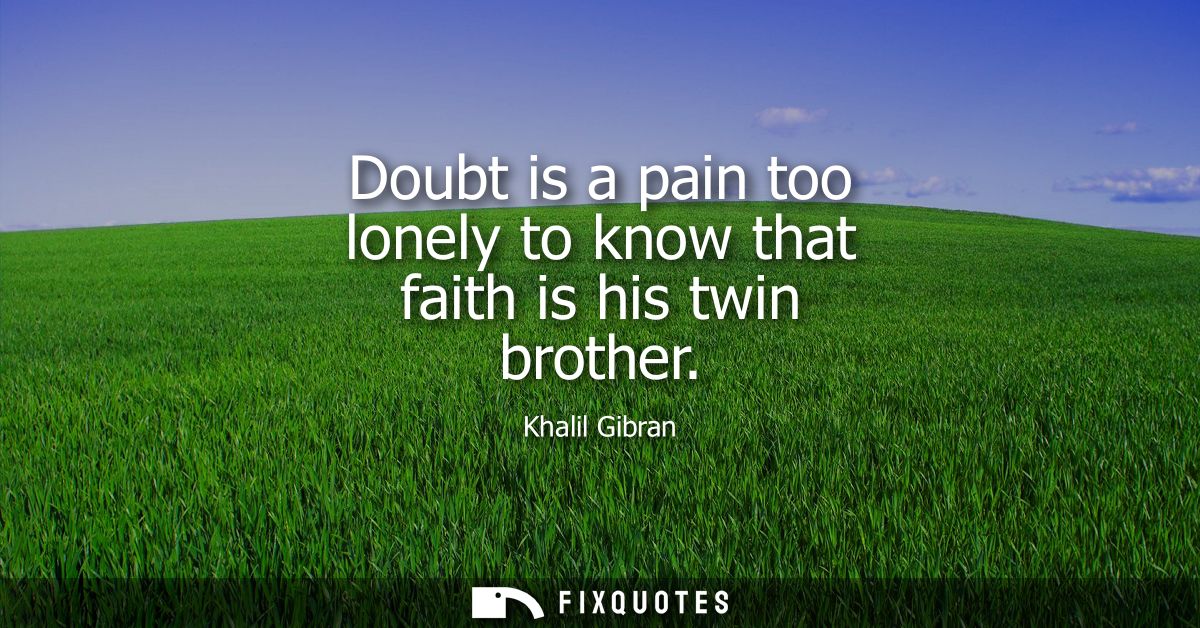
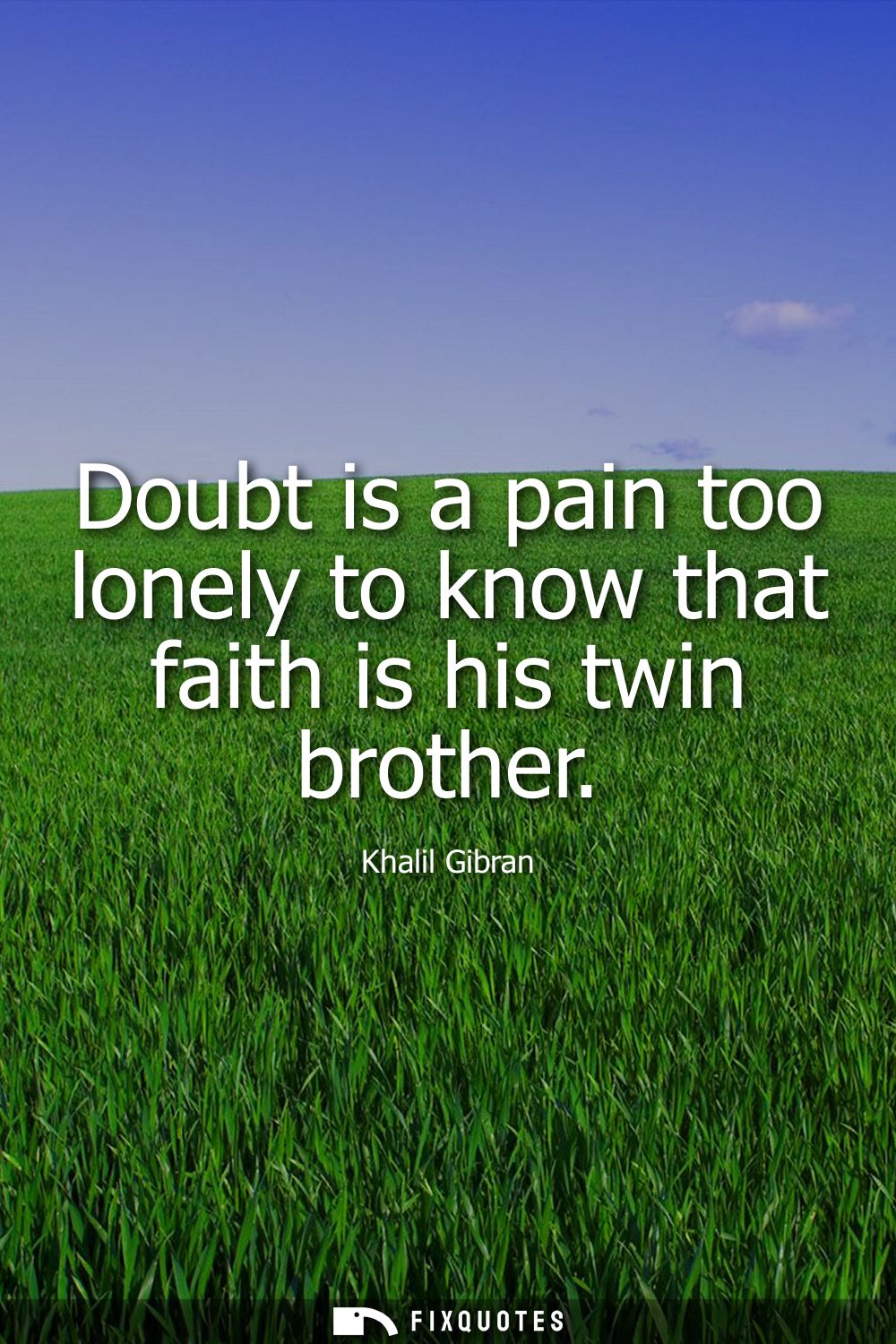
"Doubt is a pain too lonely to know that faith is his twin brother"
About this Quote
Doubt hurts in the specific way isolation hurts: not as a lack of answers, but as a feeling that you are the only one stuck with the question. Gibran’s line flips the usual spiritual hierarchy. Doubt isn’t faith’s enemy; it’s faith’s closest relative, a sibling separated by mood and circumstance. The genius is in the personification: doubt becomes a solitary figure, too wounded to recognize kinship. That “too lonely to know” suggests ignorance isn’t intellectual here, it’s emotional. When you’re alone inside uncertainty, you can’t access the larger pattern that would make your unease feel normal, even necessary.
The subtext is a quiet rebuke to purity culture in religion and self-help alike: the insistence that belief should be clean, unwavering, and publicly confident. Gibran argues the opposite with one familial metaphor. Faith is not the absence of doubt; it’s what doubt can become once it’s held, shared, and given language. Twinhood implies equal origin: both arise from the same human appetite for meaning, the same confrontation with what we cannot prove.
Context matters. Writing in the early 20th century, Gibran straddled immigrant dislocation, a modernizing world, and a literary moment hungry for spiritual vocabulary that didn’t sound like church doctrine. His mysticism meets psychology before psychology had the cultural monopoly on inner life. The line comforts without coddling: it validates doubt’s pain while quietly insisting it belongs to the same family as belief, not outside it.
The subtext is a quiet rebuke to purity culture in religion and self-help alike: the insistence that belief should be clean, unwavering, and publicly confident. Gibran argues the opposite with one familial metaphor. Faith is not the absence of doubt; it’s what doubt can become once it’s held, shared, and given language. Twinhood implies equal origin: both arise from the same human appetite for meaning, the same confrontation with what we cannot prove.
Context matters. Writing in the early 20th century, Gibran straddled immigrant dislocation, a modernizing world, and a literary moment hungry for spiritual vocabulary that didn’t sound like church doctrine. His mysticism meets psychology before psychology had the cultural monopoly on inner life. The line comforts without coddling: it validates doubt’s pain while quietly insisting it belongs to the same family as belief, not outside it.
Quote Details
| Topic | Faith |
|---|---|
| Source | Verified source: Jesus the Son of Man (Kahlil Gibran, 1928)
Evidence: Doubt is a pain too lonely to know that faith is his twin brother. (Chapter/section: "THOMAS , On the Forefathers of His Doubts" (page number varies by edition)). Primary-source placement: the line appears in Kahlil Gibran’s book Jesus the Son of Man, in the section narrated by “THOMAS” titled “On the Forefathers of His Doubts,” immediately followed by: “Doubt is a foundling unhappy and astray, and though his own mother who gave him birth should find him and enfold him, he would withdraw in caution and in fear.” The earliest publication of Jesus the Son of Man is 1928 (commonly cited as the first edition, New York: Alfred A. Knopf). The Project Gutenberg Australia transcription confirms the wording and context but does not preserve original pagination, so a fixed page number depends on the specific printed edition you are verifying. Other candidates (1) The Certainty of Uncertainty (Mark Schaefer, 2018) compilation95.0% ... Kahlil Gibran said , “ Doubt is a pain too lonely to know that faith is his twin brother . " 322 Faith and doubt ... |
| Cite |
Citation Formats
APA Style (7th ed.)
Gibran, Kahlil. (2026, February 9). Doubt is a pain too lonely to know that faith is his twin brother. FixQuotes. https://fixquotes.com/quotes/doubt-is-a-pain-too-lonely-to-know-that-faith-is-32315/
Chicago Style
Gibran, Kahlil. "Doubt is a pain too lonely to know that faith is his twin brother." FixQuotes. February 9, 2026. https://fixquotes.com/quotes/doubt-is-a-pain-too-lonely-to-know-that-faith-is-32315/.
MLA Style (9th ed.)
"Doubt is a pain too lonely to know that faith is his twin brother." FixQuotes, 9 Feb. 2026, https://fixquotes.com/quotes/doubt-is-a-pain-too-lonely-to-know-that-faith-is-32315/. Accessed 3 Apr. 2026.
More Quotes by Kahlil
Add to List