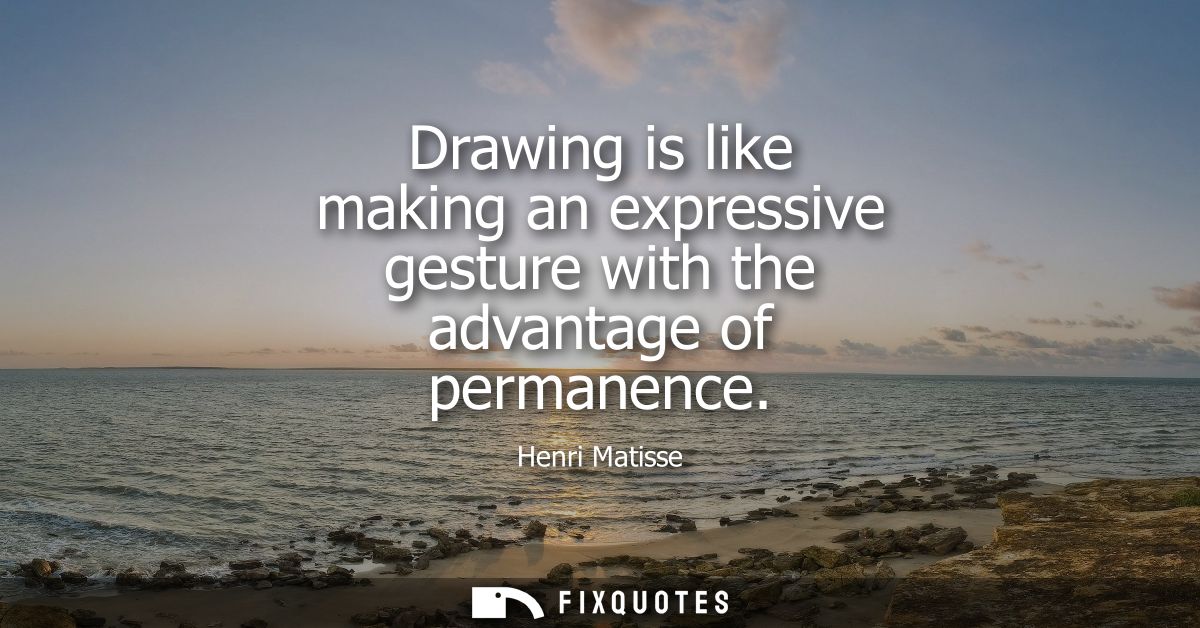
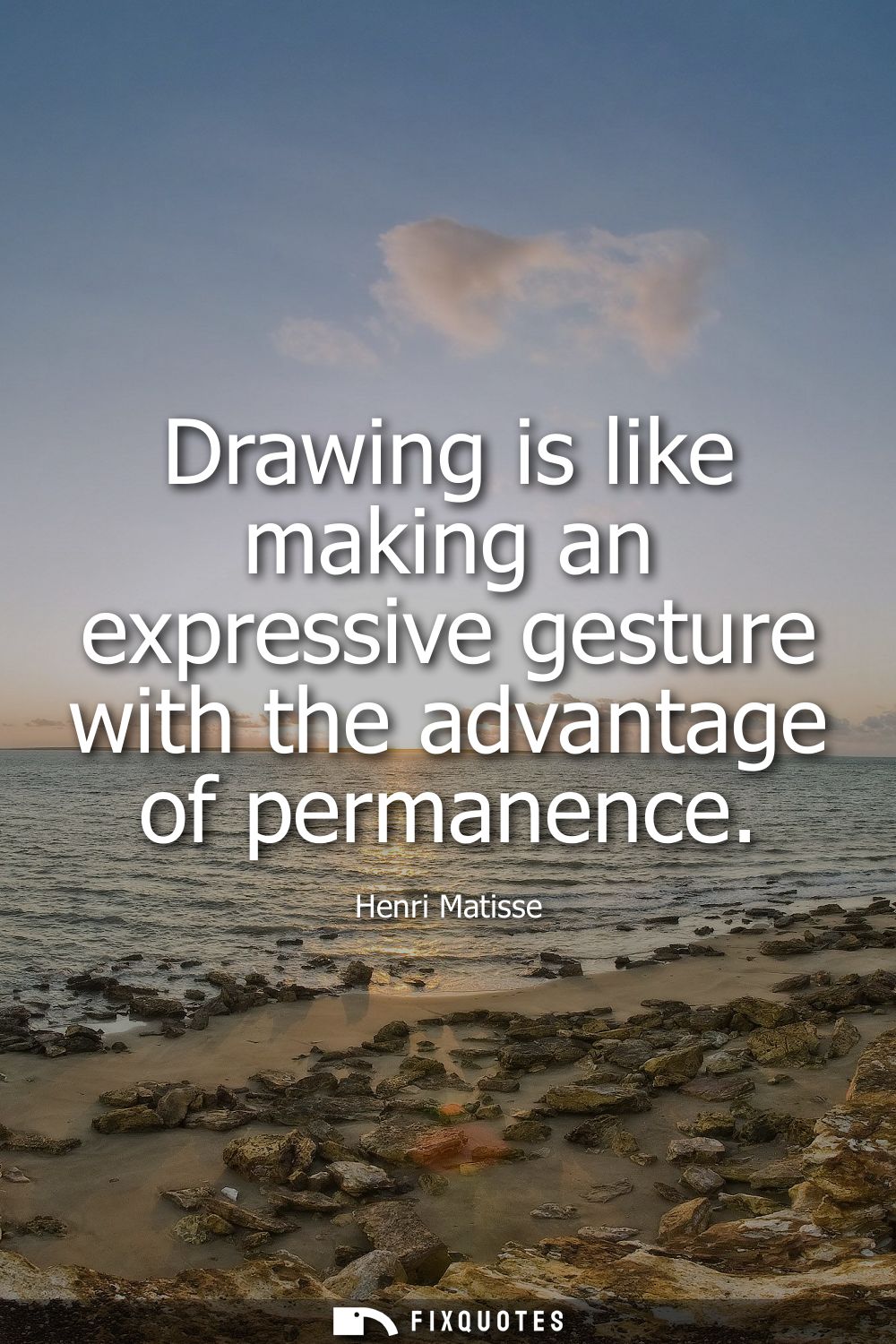
"Drawing is like making an expressive gesture with the advantage of permanence"
About this Quote
Then he adds the twist: “with the advantage of permanence.” A gesture is usually private and perishable; it dies as soon as it’s made. Drawing, for Matisse, steals that immediacy and pins it to paper without embalming it. The subtext is a quiet rebuke to academic traditions that equate seriousness with labor and finish. Permanence isn’t earned through polish; it’s achieved by capturing the living pulse of perception at the instant it happens.
Context matters. Matisse spent decades pursuing line as a carrier of sensation, especially in his later work where economy became a philosophy: the spare contour, the confident cut of scissors in the paper cut-outs, the refusal to “correct” the first honest statement. In a modern culture racing toward reproducibility and mechanical image-making, he insists on the human trace - the record of a body thinking. Drawing becomes proof that spontaneity can last, and that permanence doesn’t have to mean stiffness.
Quote Details
| Topic | Art |
|---|---|
| Source | Help us find the source |
| Cite |
Citation Formats
APA Style (7th ed.)
Matisse, Henri. (2026, January 15). Drawing is like making an expressive gesture with the advantage of permanence. FixQuotes. https://fixquotes.com/quotes/drawing-is-like-making-an-expressive-gesture-with-71225/
Chicago Style
Matisse, Henri. "Drawing is like making an expressive gesture with the advantage of permanence." FixQuotes. January 15, 2026. https://fixquotes.com/quotes/drawing-is-like-making-an-expressive-gesture-with-71225/.
MLA Style (9th ed.)
"Drawing is like making an expressive gesture with the advantage of permanence." FixQuotes, 15 Jan. 2026, https://fixquotes.com/quotes/drawing-is-like-making-an-expressive-gesture-with-71225/. Accessed 5 Mar. 2026.