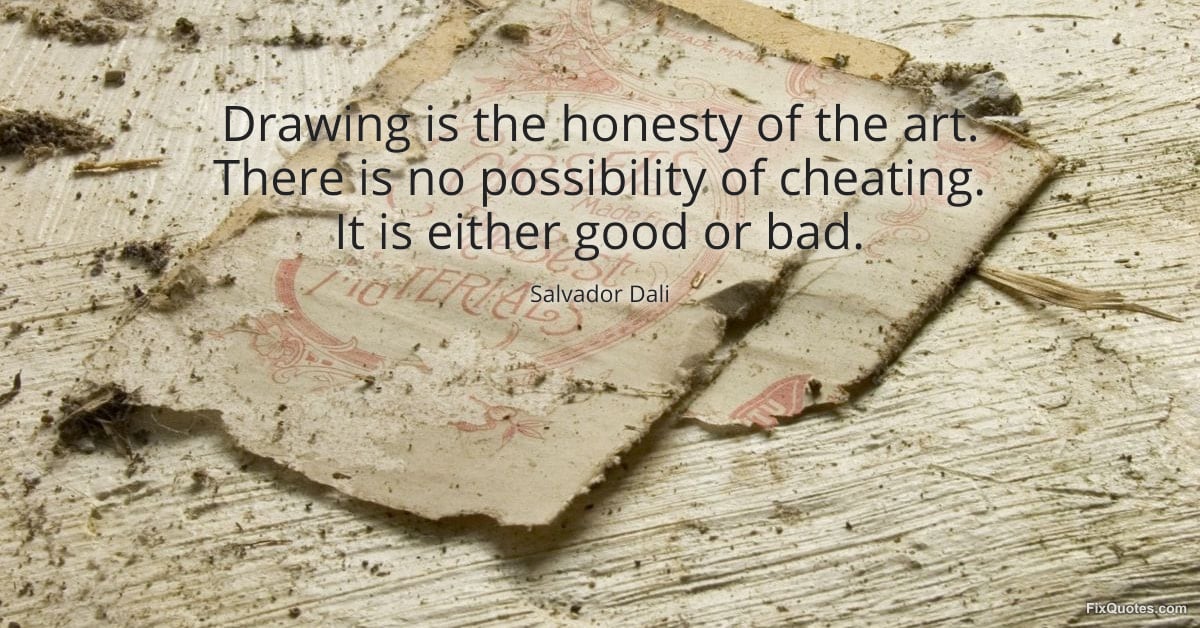
"Drawing is the honesty of the art. There is no possibility of cheating. It is either good or bad"
About this Quote
The intent is partly defensive, even territorial. In the 20th century, when photography, collage, abstraction, and conceptual provocation were all redrawing the border of “skill,” Dali frames drawing as an ethical proof of competence. “Honesty” isn’t about sincerity of feeling; it’s about exposure. A drawing shows its working. You can’t rely on lush color, theatrical subject matter, or clever framing to distract from shaky proportion or indecisive line. The paper becomes a lie detector.
The subtext is also a jab at modern art’s perceived shortcuts: the suspicion that some artists smuggle emptiness in under big ideas. Dali, who cultivated celebrity and controversy as mediums in their own right, knew exactly how easy it is to “cheat” with persona. So he elevates the one arena where persona can’t carry you: the direct encounter between eye, hand, and mark.
And the absolutism - “either good or bad” - is performance, too. It’s Dali wielding a clean binary to cut through a messy cultural argument, making craft sound like moral clarity.
Quote Details
| Topic | Art |
|---|---|
| Source | Later attribution: If Ignorance Is Bliss, Why Aren't There More Happy People? (John Lloyd, John Mitchinson, 2009) modern compilationISBN: 9780307460677 · ID: clxksg4zcZkC
Evidence:
... Drawing is the honesty of the art . There is no possibility of cheating . It is either good or bad . SALVADOR DALÍ Practice by drawing things large , as if equal in representation and reality . In small drawings every large weakness is ... |
| Cite |
Citation Formats
APA Style (7th ed.)
Dali, Salvador. (2026, March 10). Drawing is the honesty of the art. There is no possibility of cheating. It is either good or bad. FixQuotes. https://fixquotes.com/quotes/drawing-is-the-honesty-of-the-art-there-is-no-1665/
Chicago Style
Dali, Salvador. "Drawing is the honesty of the art. There is no possibility of cheating. It is either good or bad." FixQuotes. March 10, 2026. https://fixquotes.com/quotes/drawing-is-the-honesty-of-the-art-there-is-no-1665/.
MLA Style (9th ed.)
"Drawing is the honesty of the art. There is no possibility of cheating. It is either good or bad." FixQuotes, 10 Mar. 2026, https://fixquotes.com/quotes/drawing-is-the-honesty-of-the-art-there-is-no-1665/. Accessed 7 Apr. 2026.