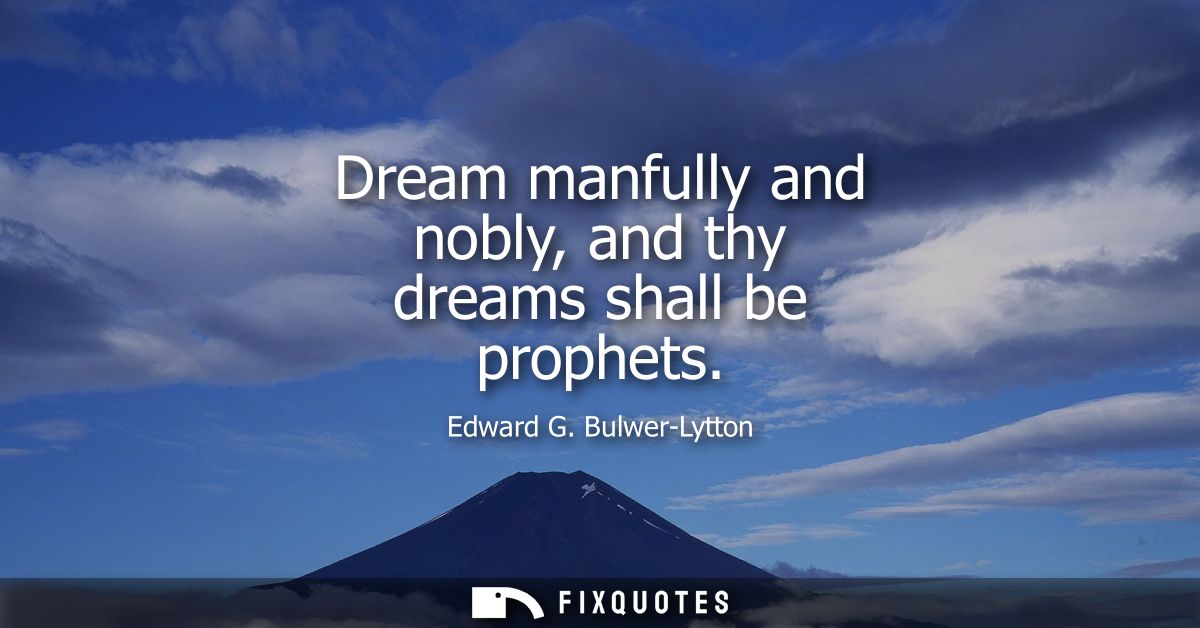
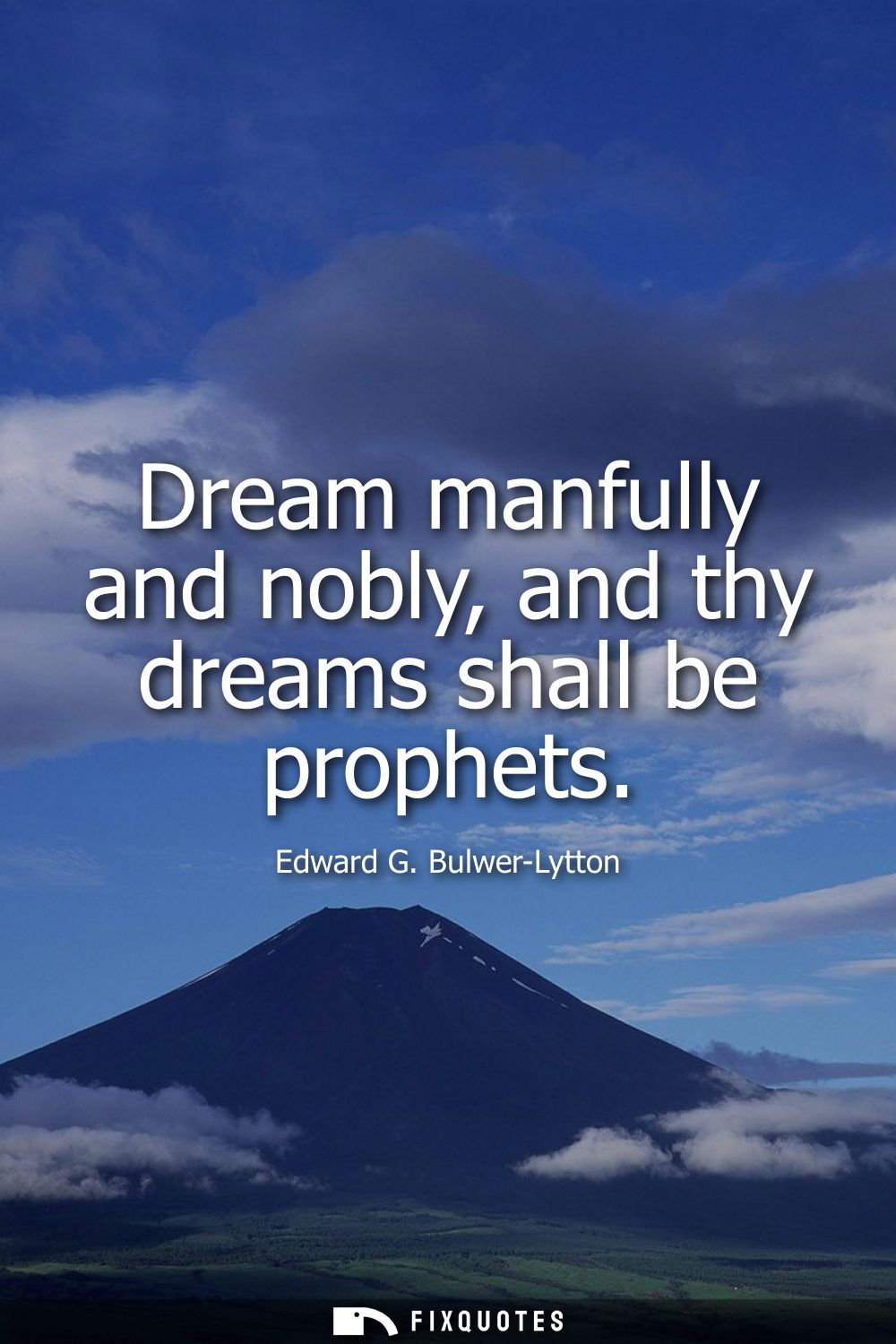
"Dream manfully and nobly, and thy dreams shall be prophets"
About this Quote
“Dream manfully and nobly” is less a gentle nudge toward self-actualization than a Victorian command performance. Bulwer-Lytton, a politician and high-romance novelist, writes in the register of moral instruction: aspiration isn’t private fantasy, it’s civic training. The line works because it flatters and disciplines at once. You’re told your imagination has world-making power, but only if it wears the approved uniform: “manfully” (coded as stoic, brave, self-governing) and “nobly” (coded as classed virtue, duty, restraint). The rhetoric sells agency while narrowing the acceptable forms of desire.
Calling dreams “prophets” is the clever pivot. A prophet doesn’t merely predict; he authorizes. Prophecy dignifies ambition as destiny, turning personal yearning into something that sounds like historical necessity. It’s a motivational slogan with a political edge: if the right people dream the right dreams, the future will obediently follow. That’s a comforting idea in an era anxious about reform, industrial upheaval, and shifting power. It reassures the aspiring middle and governing classes that the coming world can be steered by character rather than chaos.
The subtext is also exclusionary. “Thy” speaks to a specific reader who is presumed educated, morally legible, and male; the future is imagined as the reward for those already positioned to narrate it. Bulwer-Lytton’s intent isn’t to celebrate dreaming in any form, but to conscript it: imagination as a disciplined engine of leadership, not a refuge, not a revolt.
Calling dreams “prophets” is the clever pivot. A prophet doesn’t merely predict; he authorizes. Prophecy dignifies ambition as destiny, turning personal yearning into something that sounds like historical necessity. It’s a motivational slogan with a political edge: if the right people dream the right dreams, the future will obediently follow. That’s a comforting idea in an era anxious about reform, industrial upheaval, and shifting power. It reassures the aspiring middle and governing classes that the coming world can be steered by character rather than chaos.
The subtext is also exclusionary. “Thy” speaks to a specific reader who is presumed educated, morally legible, and male; the future is imagined as the reward for those already positioned to narrate it. Bulwer-Lytton’s intent isn’t to celebrate dreaming in any form, but to conscript it: imagination as a disciplined engine of leadership, not a refuge, not a revolt.
Quote Details
| Topic | Motivational |
|---|---|
| Source | Help us find the source |
| Cite |
Citation Formats
APA Style (7th ed.)
Bulwer-Lytton, Edward G. (2026, January 18). Dream manfully and nobly, and thy dreams shall be prophets. FixQuotes. https://fixquotes.com/quotes/dream-manfully-and-nobly-and-thy-dreams-shall-be-16972/
Chicago Style
Bulwer-Lytton, Edward G. "Dream manfully and nobly, and thy dreams shall be prophets." FixQuotes. January 18, 2026. https://fixquotes.com/quotes/dream-manfully-and-nobly-and-thy-dreams-shall-be-16972/.
MLA Style (9th ed.)
"Dream manfully and nobly, and thy dreams shall be prophets." FixQuotes, 18 Jan. 2026, https://fixquotes.com/quotes/dream-manfully-and-nobly-and-thy-dreams-shall-be-16972/. Accessed 1 Apr. 2026.
More Quotes by Edward
Add to List