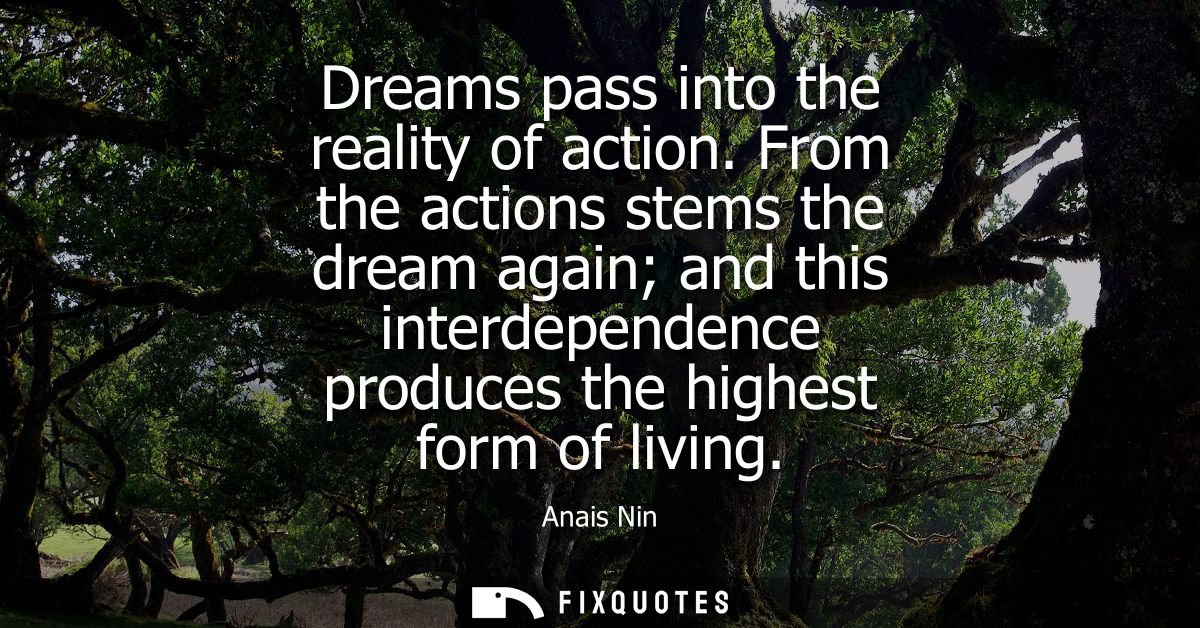
"Dreams pass into the reality of action. From the actions stems the dream again; and this interdependence produces the highest form of living"
About this Quote
The subtext is distinctly Nin: a defense of the private, desire-driven self in a world that pressures women especially to be legible, useful, and contained. Dreams are often coded as indulgent; she recodes them as generative. Action, meanwhile, isn’t framed as duty or moral rectitude. It’s the crucible where the dream proves itself, gains texture, maybe even gets corrected. That “stems” is botanical language, suggesting organic growth rather than heroic conquest.
Context matters. Nin’s diaries and fiction are obsessed with the relationship between erotic interiority, artistic creation, and autonomy. She lived in the crosscurrents of modernism, psychoanalysis, and bohemian experimentation, where “authenticity” could become its own performance. This quote quietly warns against that trap: if your dreams never risk contact with reality, they calcify into self-myth. If your actions never return you to dreaming, you become a machine. The “highest form of living” is the refusal to choose one prison over the other.
Quote Details
| Topic | Meaning of Life |
|---|---|
| Source | Help us find the source |
| Cite |
Citation Formats
APA Style (7th ed.)
Nin, Anais. (2026, January 17). Dreams pass into the reality of action. From the actions stems the dream again; and this interdependence produces the highest form of living. FixQuotes. https://fixquotes.com/quotes/dreams-pass-into-the-reality-of-action-from-the-26501/
Chicago Style
Nin, Anais. "Dreams pass into the reality of action. From the actions stems the dream again; and this interdependence produces the highest form of living." FixQuotes. January 17, 2026. https://fixquotes.com/quotes/dreams-pass-into-the-reality-of-action-from-the-26501/.
MLA Style (9th ed.)
"Dreams pass into the reality of action. From the actions stems the dream again; and this interdependence produces the highest form of living." FixQuotes, 17 Jan. 2026, https://fixquotes.com/quotes/dreams-pass-into-the-reality-of-action-from-the-26501/. Accessed 2 Apr. 2026.