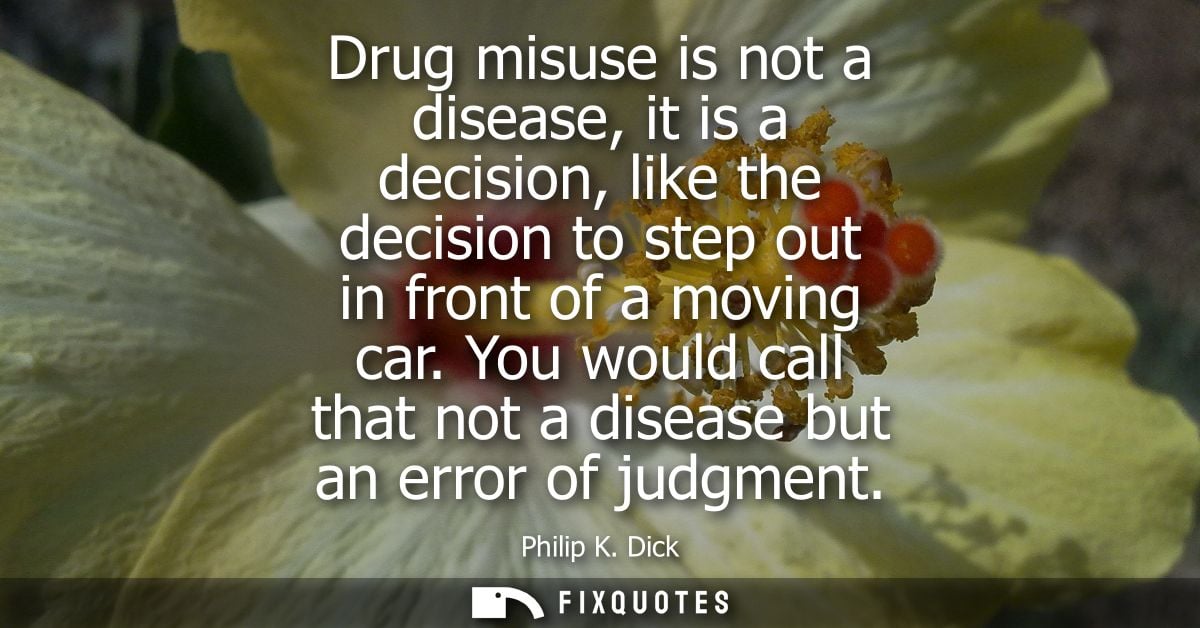
"Drug misuse is not a disease, it is a decision, like the decision to step out in front of a moving car. You would call that not a disease but an error of judgment"
About this Quote
Dick’s line lands like a slap because it refuses the soothing vocabulary that modern culture often uses to launder moral panic into compassion. Calling drug misuse “a decision” is a deliberate counterspell against the disease model, and the moving-car metaphor is chosen for maximum bluntness: you don’t romanticize it, you don’t medicalize it, you don’t treat it as fate. You call it what it is in the instant: a catastrophic choice.
But the subtext is less “addicts are bad” than “systems are hungry for narratives that absolve everyone.” Dick, a writer obsessed with how reality gets edited by institutions, is suspicious of any framework that turns messy human behavior into a tidy diagnosis. “Disease” suggests inevitability, expertise, treatment industries, and a consoling removal of agency. “Error of judgment” drags agency back into frame, uncomfortably, and implies that the culture around the user - peers, dealers, cops, doctors, family - also participates in the conditions that make that error more likely.
Context matters because Dick is not theorizing from a safe distance. His life was threaded with amphetamines, paranoia, and the brutal productivity demands of pulp-era science fiction. That history gives the quote its unnerving edge: it reads like self-indictment as much as indictment of others. The car image also does double duty as science-fictional fatalism: once you step off the curb, physics takes over. The “decision” may be tiny; the consequences are not. That’s why it works: it compresses the whole debate - agency, responsibility, sympathy, prevention - into one irreversible moment.
But the subtext is less “addicts are bad” than “systems are hungry for narratives that absolve everyone.” Dick, a writer obsessed with how reality gets edited by institutions, is suspicious of any framework that turns messy human behavior into a tidy diagnosis. “Disease” suggests inevitability, expertise, treatment industries, and a consoling removal of agency. “Error of judgment” drags agency back into frame, uncomfortably, and implies that the culture around the user - peers, dealers, cops, doctors, family - also participates in the conditions that make that error more likely.
Context matters because Dick is not theorizing from a safe distance. His life was threaded with amphetamines, paranoia, and the brutal productivity demands of pulp-era science fiction. That history gives the quote its unnerving edge: it reads like self-indictment as much as indictment of others. The car image also does double duty as science-fictional fatalism: once you step off the curb, physics takes over. The “decision” may be tiny; the consequences are not. That’s why it works: it compresses the whole debate - agency, responsibility, sympathy, prevention - into one irreversible moment.
Quote Details
| Topic | Ethics & Morality |
|---|
More Quotes by Philip
Add to List