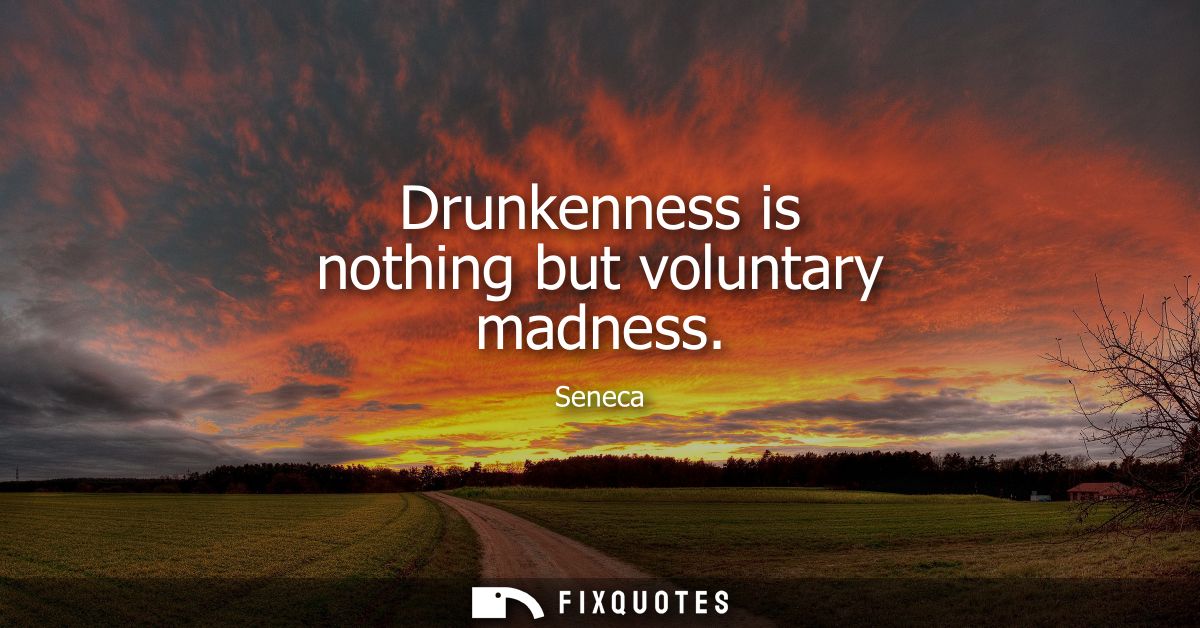
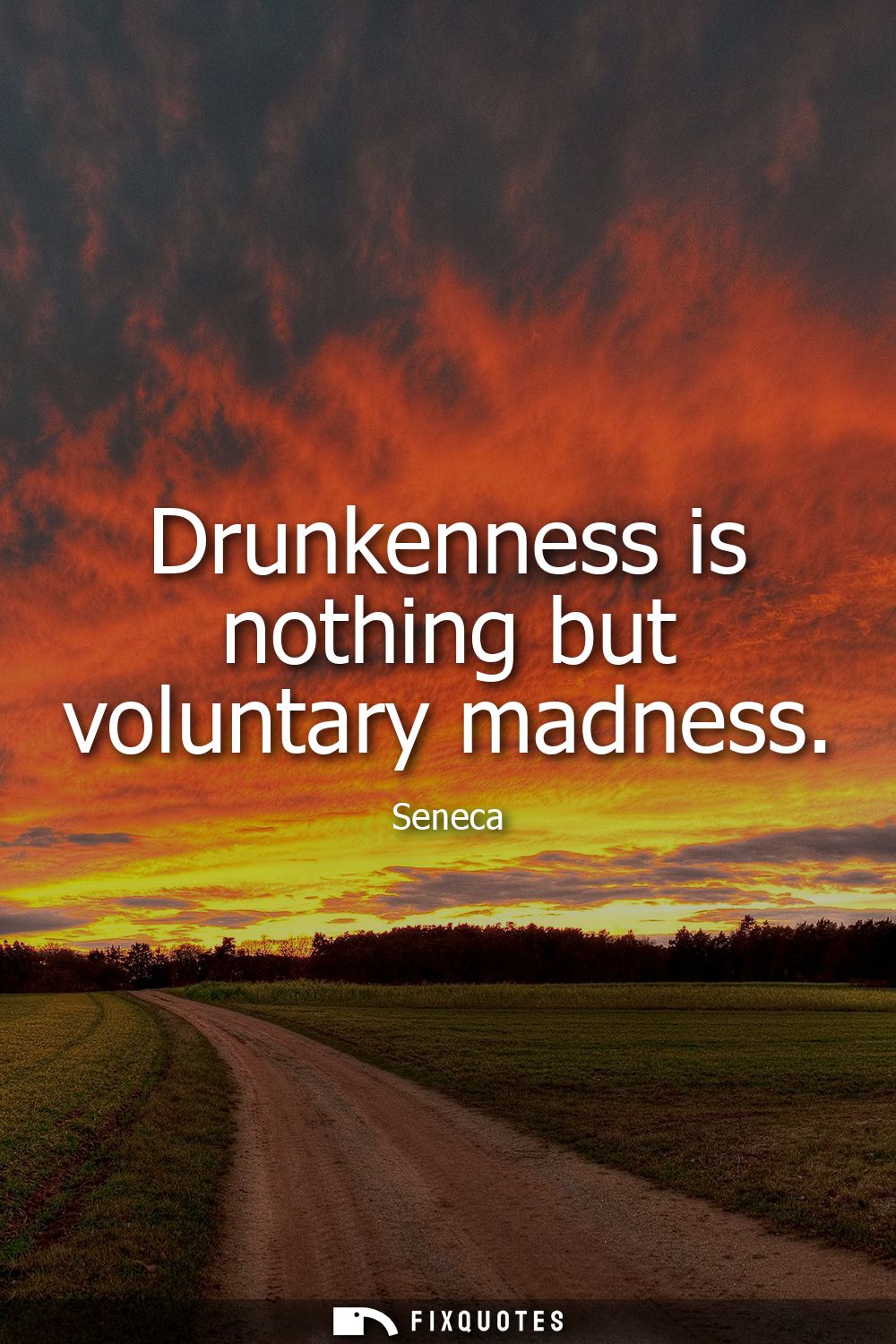
"Drunkenness is nothing but voluntary madness"
About this Quote
Calling drunkenness "voluntary madness" is Seneca doing what Roman Stoics did best: turning a private habit into a public indictment. The line lands because it refuses the cozy modern framing of intoxication as harmless recreation or moral lapse. Instead, it recasts it as a chosen suspension of reason, a temporary self-coup. Madness, in Roman life, carried legal and social implications: diminished agency, threat to household order, unfitness for civic responsibility. Add "voluntary" and the charge sharpens into paradox. If insanity is usually something that happens to you, drunkenness is the version you sign up for.
Seneca writes as a statesman and court insider watching the empire rot in velvet. His Stoicism isn’t retreat; it’s crisis management for the soul under luxury and political terror. The subtext is about control: Rome’s elite prided themselves on gravitas and disciplina, yet their banquets and drinking culture advertised the opposite. By describing drunkenness as madness, Seneca collapses the distance between the respectable senator and the destabilizing lunatic. The drunk isn’t just embarrassing; he’s ungoverned, and therefore dangerous.
The rhetorical move also protects Stoicism’s core claim: vice is not an accident but a decision. You don’t "lose yourself" in wine; you delegate your judgment to it. Seneca’s intent is less temperance-lecture than accountability doctrine: if reason is the only real freedom, then choosing intoxication is choosing captivity, with applause.
Seneca writes as a statesman and court insider watching the empire rot in velvet. His Stoicism isn’t retreat; it’s crisis management for the soul under luxury and political terror. The subtext is about control: Rome’s elite prided themselves on gravitas and disciplina, yet their banquets and drinking culture advertised the opposite. By describing drunkenness as madness, Seneca collapses the distance between the respectable senator and the destabilizing lunatic. The drunk isn’t just embarrassing; he’s ungoverned, and therefore dangerous.
The rhetorical move also protects Stoicism’s core claim: vice is not an accident but a decision. You don’t "lose yourself" in wine; you delegate your judgment to it. Seneca’s intent is less temperance-lecture than accountability doctrine: if reason is the only real freedom, then choosing intoxication is choosing captivity, with applause.
Quote Details
| Topic | Wisdom |
|---|---|
| Source | Verified source: Moral Letters to Lucilius (Letter 83: On Drunkenness) (Seneca the Younger, 65)
Evidence: nihil aliud esse ebrietatem quam voluntariam insaniam. (Letter 83, section 18). This is the primary-source Latin in Seneca’s Epistulae Morales ad Lucilium (Moral Letters), Letter 83 (commonly titled “On Drunkenness”), section 18. A common English rendering is “Drunkenness is nothing but voluntary madness,” which is a close translation of the Latin phrase. The same sentence appears in standard Latin-text postings of the letter and in public-domain English translations (e.g., Gummere) where it is expanded as “a condition of insanity purposely assumed.” Other candidates (1) Bizarre Laws & Curious Customs of the UK (Monty Lord, 2023) compilation95.0% ... Drunkenness is nothing but voluntary madness . " Seneca the Younger Drunk in a Pub It is illegal to be drunk in a... |
| Cite |
Citation Formats
APA Style (7th ed.)
Younger, Seneca the. (2026, March 3). Drunkenness is nothing but voluntary madness. FixQuotes. https://fixquotes.com/quotes/drunkenness-is-nothing-but-voluntary-madness-34369/
Chicago Style
Younger, Seneca the. "Drunkenness is nothing but voluntary madness." FixQuotes. March 3, 2026. https://fixquotes.com/quotes/drunkenness-is-nothing-but-voluntary-madness-34369/.
MLA Style (9th ed.)
"Drunkenness is nothing but voluntary madness." FixQuotes, 3 Mar. 2026, https://fixquotes.com/quotes/drunkenness-is-nothing-but-voluntary-madness-34369/. Accessed 25 Mar. 2026.
More Quotes by Seneca
Add to List