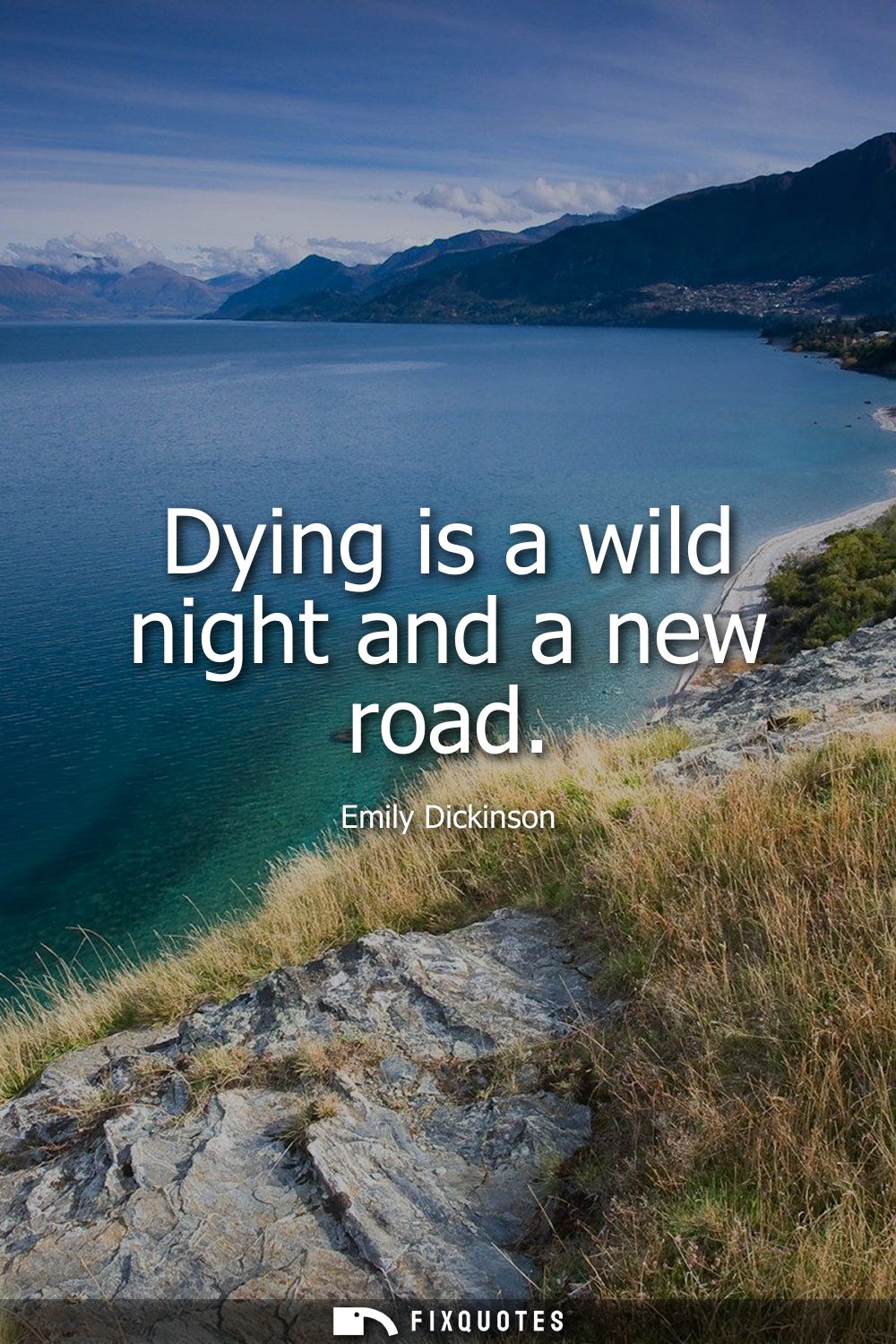
"Dying is a wild night and a new road"
About this Quote
Death arrives here not as a velvet-curtained fadeout but as an after-hours jolt: a "wild night" that kicks the door in, then a "new road" that keeps going. Dickinson’s genius is the pivot from chaos to travelogue. "Wild night" carries the charge of the unsayable: fear, thrill, loss of control, maybe even illicit exhilaration. It’s not the pious hush of nineteenth-century deathbed scenes; it’s weather, appetite, turbulence. Then she snaps the image into something almost practical. A road implies direction, distance, the possibility of companionship or solitude, and the uncomfortable fact that you can’t stay put.
The subtext is Dickinson’s signature negotiation with belief. She grew up in a Protestant culture that offered a mapped-afterlife, complete with moral signage. She resisted easy conversion, and her poems often treat eternity like a hypothesis under pressure. Calling death a "new road" dodges doctrinal specifics while preserving motion. She won’t tell you what’s at the end; she will tell you it’s passage, not punctuation.
It also reads as a private aesthetic manifesto. Dickinson lived physically enclosed, yet her mind kept escaping through metaphor. In that context, death becomes the most radical form of leaving the house. The line works because it refuses either/or: death is terror and possibility, rupture and continuity. Two spare images, no sermon, and the reader feels the floor drop while being invited to walk.
The subtext is Dickinson’s signature negotiation with belief. She grew up in a Protestant culture that offered a mapped-afterlife, complete with moral signage. She resisted easy conversion, and her poems often treat eternity like a hypothesis under pressure. Calling death a "new road" dodges doctrinal specifics while preserving motion. She won’t tell you what’s at the end; she will tell you it’s passage, not punctuation.
It also reads as a private aesthetic manifesto. Dickinson lived physically enclosed, yet her mind kept escaping through metaphor. In that context, death becomes the most radical form of leaving the house. The line works because it refuses either/or: death is terror and possibility, rupture and continuity. Two spare images, no sermon, and the reader feels the floor drop while being invited to walk.
Quote Details
| Topic | Mortality |
|---|---|
| Source | Later attribution: The Gardens of Emily Dickinson (Judith Farr, Louise Carter, 2004) modern compilationISBN: 9780674018297 · ID: tK8nnFJ-KxUC
Evidence:
... Dickinson approximated its opening phrase in a letter to her cousin Perez Dickinson Cowan : " Dying is a wild Night and a new Road " ( l 332 ) . The violent dissolution that is physical death and the shattering alteration of self ... |
| Cite |
Citation Formats
APA Style (7th ed.)
Dickinson, Emily. (2026, February 15). Dying is a wild night and a new road. FixQuotes. https://fixquotes.com/quotes/dying-is-a-wild-night-and-a-new-road-31030/
Chicago Style
Dickinson, Emily. "Dying is a wild night and a new road." FixQuotes. February 15, 2026. https://fixquotes.com/quotes/dying-is-a-wild-night-and-a-new-road-31030/.
MLA Style (9th ed.)
"Dying is a wild night and a new road." FixQuotes, 15 Feb. 2026, https://fixquotes.com/quotes/dying-is-a-wild-night-and-a-new-road-31030/. Accessed 29 Mar. 2026.
More Quotes by Emily
Add to List