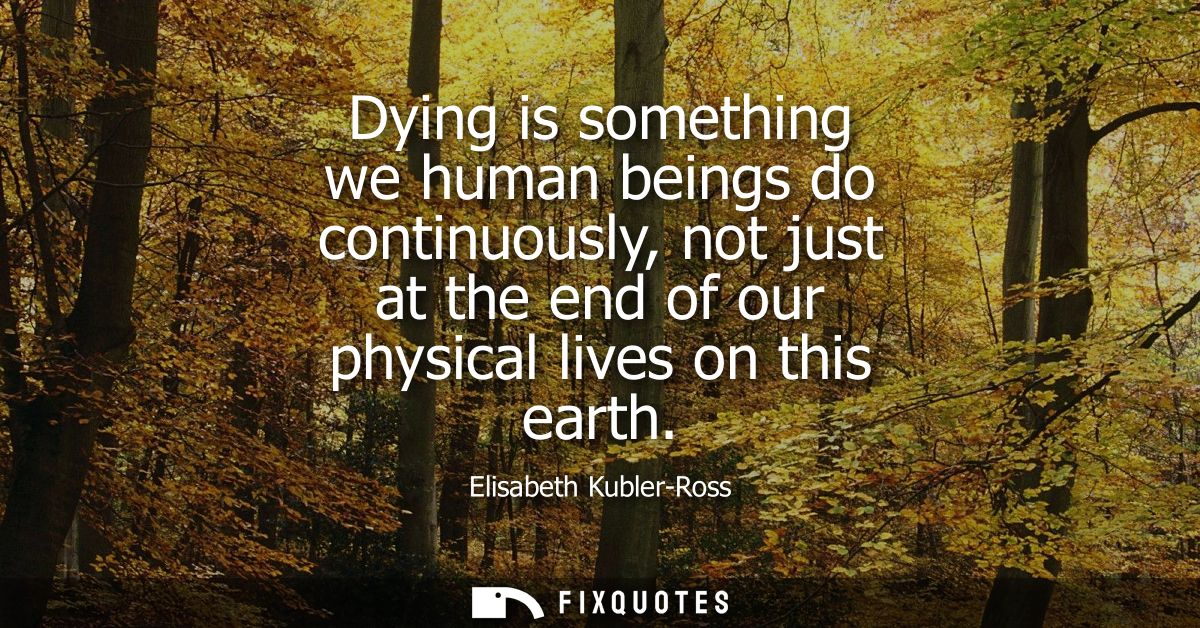
"Dying is something we human beings do continuously, not just at the end of our physical lives on this earth"
About this Quote
The intent isn’t morbidity; it’s leverage. If dying is ongoing, then denial becomes an ongoing habit, and so does the possibility of practice: practicing grief, practicing release, practicing presence. That’s classic Kubler-Ross - not in the pop-psych caricature that turned her work into a checklist, but in the deeper project of making death speakable so the living can stop outsourcing meaning to the “later” that may never arrive.
The subtext pushes against a Western obsession with control and productivity. “Continuously” implies that loss is not a malfunction; it’s the operating system. “On this earth” adds a gentle metaphysical wink without preaching: she’s leaving room for spiritual interpretation while staying grounded in human experience.
Context matters. Kubler-Ross wrote in an era when modern medicine could extend biological life while often shrinking emotional honesty. This sentence reads like a corrective to clinical euphemism: if we admit we’re always in motion toward an ending, we might finally learn how to live without flinching.
Quote Details
| Topic | Mortality |
|---|---|
| Source | Help us find the source |
| Cite |
Citation Formats
APA Style (7th ed.)
Kubler-Ross, Elisabeth. (2026, January 18). Dying is something we human beings do continuously, not just at the end of our physical lives on this earth. FixQuotes. https://fixquotes.com/quotes/dying-is-something-we-human-beings-do-2961/
Chicago Style
Kubler-Ross, Elisabeth. "Dying is something we human beings do continuously, not just at the end of our physical lives on this earth." FixQuotes. January 18, 2026. https://fixquotes.com/quotes/dying-is-something-we-human-beings-do-2961/.
MLA Style (9th ed.)
"Dying is something we human beings do continuously, not just at the end of our physical lives on this earth." FixQuotes, 18 Jan. 2026, https://fixquotes.com/quotes/dying-is-something-we-human-beings-do-2961/. Accessed 26 Mar. 2026.