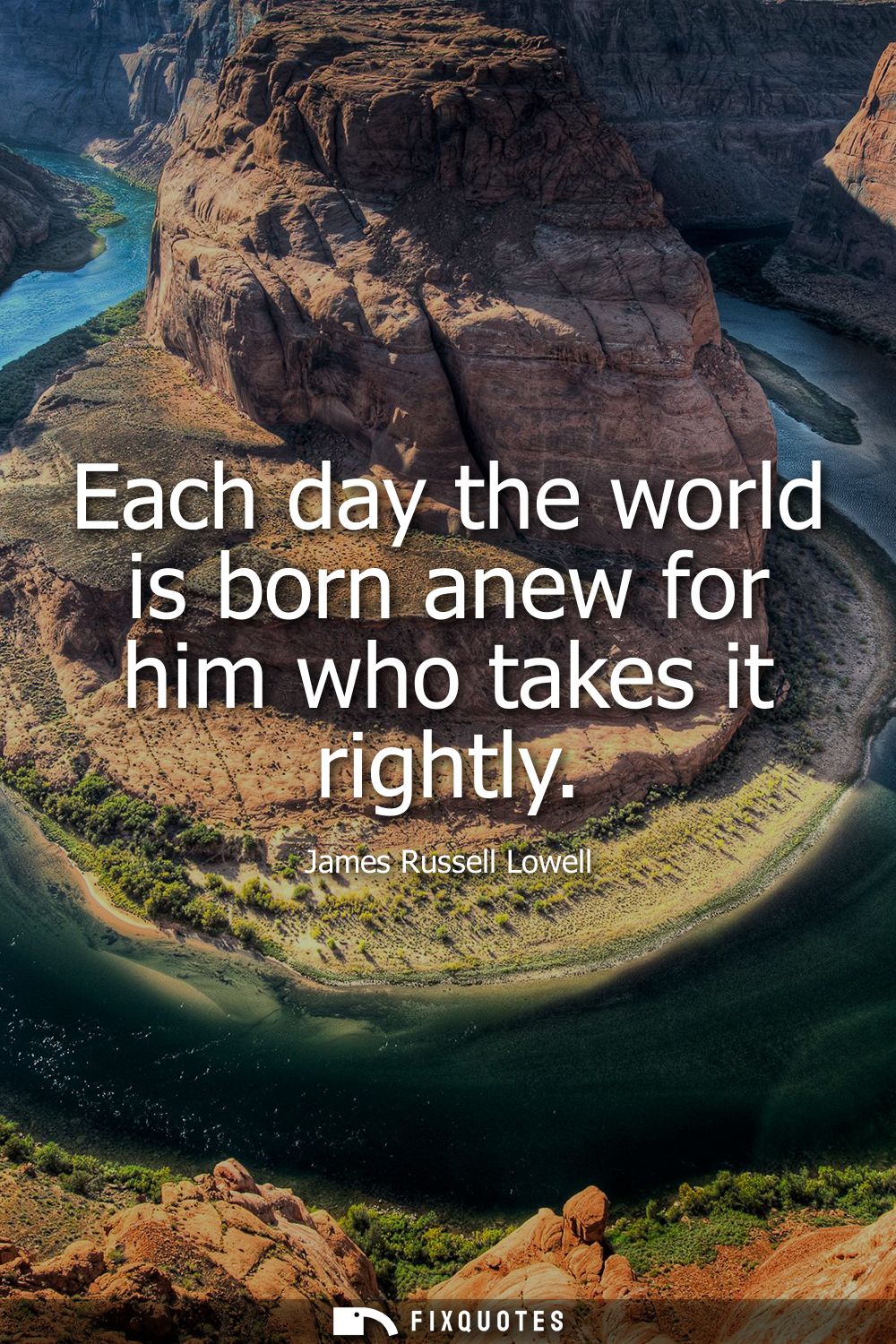
"Each day the world is born anew for him who takes it rightly"
About this Quote
Optimism, here, isn’t a mood; it’s a discipline. Lowell’s line turns the dramatic idea of “a new day” into a moral test: the world is “born anew” only for the person who knows how to meet it. That small clause - “for him who takes it rightly” - is where the poem’s pressure lives. It refuses the passive comfort of sunrise-as-guarantee. Renewal is conditional, awarded to a certain kind of perceiver.
The specific intent reads like a corrective to modern and 19th-century fatalism alike. Lowell, a poet with strong public commitments (abolitionist sympathies, reformist energy), often wrote as if character and conscience were practical forces, not private ornaments. This sentence carries that civic Protestant undertow: the day offers raw material, and the self is accountable for what it makes of it. “Takes” implies agency, even appetite; “rightly” implies a standard, as if the world is not merely experienced but interpreted, and interpretation has ethical stakes.
Subtext: the world doesn’t change first. You do. Lowell quietly relocates power from circumstance to stance, from history’s churn to the individual’s readiness to see and act. It’s bracing because it flatters no one: if the day feels stale, the problem may be your grip on it. At the same time, it’s not naive. “Born anew” suggests fragility: newness is perishable, easily squandered.
In an era of reform movements and national fracture, that conditional hope makes sense. It’s a poet’s way of saying progress begins as a daily practice, not a distant event.
The specific intent reads like a corrective to modern and 19th-century fatalism alike. Lowell, a poet with strong public commitments (abolitionist sympathies, reformist energy), often wrote as if character and conscience were practical forces, not private ornaments. This sentence carries that civic Protestant undertow: the day offers raw material, and the self is accountable for what it makes of it. “Takes” implies agency, even appetite; “rightly” implies a standard, as if the world is not merely experienced but interpreted, and interpretation has ethical stakes.
Subtext: the world doesn’t change first. You do. Lowell quietly relocates power from circumstance to stance, from history’s churn to the individual’s readiness to see and act. It’s bracing because it flatters no one: if the day feels stale, the problem may be your grip on it. At the same time, it’s not naive. “Born anew” suggests fragility: newness is perishable, easily squandered.
In an era of reform movements and national fracture, that conditional hope makes sense. It’s a poet’s way of saying progress begins as a daily practice, not a distant event.
Quote Details
| Topic | New Beginnings |
|---|---|
| Source | Help us find the source |
| Cite |
Citation Formats
APA Style (7th ed.)
Lowell, James Russell. (2026, January 17). Each day the world is born anew for him who takes it rightly. FixQuotes. https://fixquotes.com/quotes/each-day-the-world-is-born-anew-for-him-who-takes-26763/
Chicago Style
Lowell, James Russell. "Each day the world is born anew for him who takes it rightly." FixQuotes. January 17, 2026. https://fixquotes.com/quotes/each-day-the-world-is-born-anew-for-him-who-takes-26763/.
MLA Style (9th ed.)
"Each day the world is born anew for him who takes it rightly." FixQuotes, 17 Jan. 2026, https://fixquotes.com/quotes/each-day-the-world-is-born-anew-for-him-who-takes-26763/. Accessed 7 Apr. 2026.
More Quotes by James
Add to List