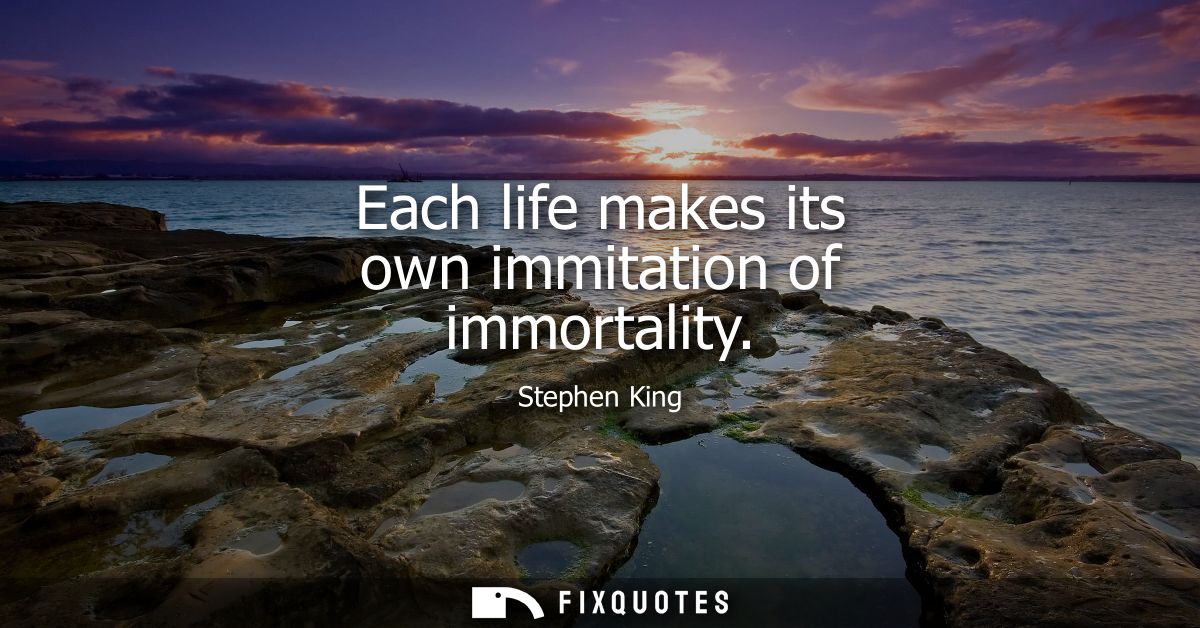
"Each life makes its own immitation of immortality"
About this Quote
King’s line lands like a ghost story told in daylight: immortality isn’t granted, it’s staged. “Each life” puts the burden on the individual, not on religion, history, or some grand moral ledger. And the key word is “imitation” (even with the quote’s misspelling, the idea holds): what we reach for isn’t the real thing, it’s a human-made replica, convincing enough to soothe us, flimsy enough to crack under pressure.
That’s classic King, less philosopher-king than popular anatomist of dread. He’s always been interested in the ways ordinary people build small structures against the terror of disappearance: family rituals, small-town legends, compulsions, careers, feuds. The subtext is almost tender and almost ruthless: you don’t beat death, you negotiate with it using meaning. You leave artifacts - children, books, kindnesses, grudges, a house that still smells like you - and then you call that endurance.
The line also slyly democratizes legacy. Not everyone gets monuments, but everyone makes something that tries to outlast them, even if it’s just the version of themselves that lingers in someone else’s memory. “Imitation of immortality” suggests a culture saturated with substitutes: fame as afterlife, archives as resurrection, the internet as a kind of haunted house where the dead keep posting.
King’s intent isn’t to mock that impulse; it’s to reveal its poignancy. We are temporary creatures making permanent-shaped gestures, and the gesture is the point.
That’s classic King, less philosopher-king than popular anatomist of dread. He’s always been interested in the ways ordinary people build small structures against the terror of disappearance: family rituals, small-town legends, compulsions, careers, feuds. The subtext is almost tender and almost ruthless: you don’t beat death, you negotiate with it using meaning. You leave artifacts - children, books, kindnesses, grudges, a house that still smells like you - and then you call that endurance.
The line also slyly democratizes legacy. Not everyone gets monuments, but everyone makes something that tries to outlast them, even if it’s just the version of themselves that lingers in someone else’s memory. “Imitation of immortality” suggests a culture saturated with substitutes: fame as afterlife, archives as resurrection, the internet as a kind of haunted house where the dead keep posting.
King’s intent isn’t to mock that impulse; it’s to reveal its poignancy. We are temporary creatures making permanent-shaped gestures, and the gesture is the point.
Quote Details
| Topic | Legacy & Remembrance |
|---|---|
| Source | Help us find the source |
More Quotes by Stephen
Add to List