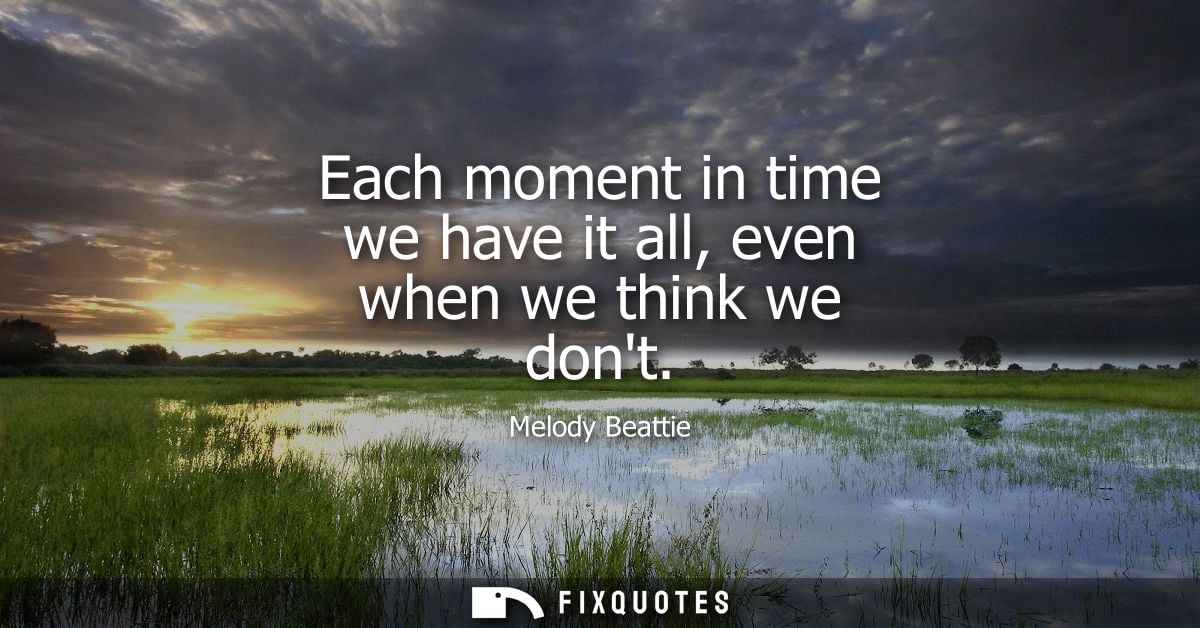
"Each moment in time, we have it all, even when we think we don't"
About this Quote
Beattie’s line lands like a hand on the shoulder in the middle of a spiral: not a pep talk, not denial, but a recalibration of what “having it all” is allowed to mean. Coming out of a writer whose work is steeped in recovery culture, the sentence carries the quiet authority of someone speaking to readers who are allergic to grand promises. The trick is its timing: “Each moment in time” shrinks the horizon. It doesn’t ask you to solve your life. It asks you to inhabit the next breath without bargaining with it.
The subtext is a corrective to scarcity thinking, the addictive mental habit that treats worth as something pending: once the relationship is fixed, once the money arrives, once the anxiety stops. Beattie flips that script by redefining abundance as presence rather than possession. “We have it all” isn’t about achieving a maximalist life; it’s about recognizing that the present moment already contains the essentials: choice, perception, a sliver of agency, the possibility of kindness. Even pain counts as evidence of being alive, not proof of failure.
The second clause, “even when we think we don’t,” is where the compassion is hiding. It anticipates the reader’s rebuttal - grief, relapse, loneliness, unpaid bills - and refuses to shame them for it. That’s the recovery-informed move: validate the distortion without validating the story. The intent isn’t to erase hardship; it’s to stop the mind from turning hardship into a totalizing verdict. The sentence works because it offers a smaller, more survivable definition of “all” - one you can access right now, without waiting to deserve it.
The subtext is a corrective to scarcity thinking, the addictive mental habit that treats worth as something pending: once the relationship is fixed, once the money arrives, once the anxiety stops. Beattie flips that script by redefining abundance as presence rather than possession. “We have it all” isn’t about achieving a maximalist life; it’s about recognizing that the present moment already contains the essentials: choice, perception, a sliver of agency, the possibility of kindness. Even pain counts as evidence of being alive, not proof of failure.
The second clause, “even when we think we don’t,” is where the compassion is hiding. It anticipates the reader’s rebuttal - grief, relapse, loneliness, unpaid bills - and refuses to shame them for it. That’s the recovery-informed move: validate the distortion without validating the story. The intent isn’t to erase hardship; it’s to stop the mind from turning hardship into a totalizing verdict. The sentence works because it offers a smaller, more survivable definition of “all” - one you can access right now, without waiting to deserve it.
Quote Details
| Topic | Live in the Moment |
|---|---|
| Source | Help us find the source |
| Cite |
Citation Formats
APA Style (7th ed.)
Beattie, Melody. (2026, February 16). Each moment in time, we have it all, even when we think we don't. FixQuotes. https://fixquotes.com/quotes/each-moment-in-time-we-have-it-all-even-when-we-124735/
Chicago Style
Beattie, Melody. "Each moment in time, we have it all, even when we think we don't." FixQuotes. February 16, 2026. https://fixquotes.com/quotes/each-moment-in-time-we-have-it-all-even-when-we-124735/.
MLA Style (9th ed.)
"Each moment in time, we have it all, even when we think we don't." FixQuotes, 16 Feb. 2026, https://fixquotes.com/quotes/each-moment-in-time-we-have-it-all-even-when-we-124735/. Accessed 3 Apr. 2026.
More Quotes by Melody
Add to List