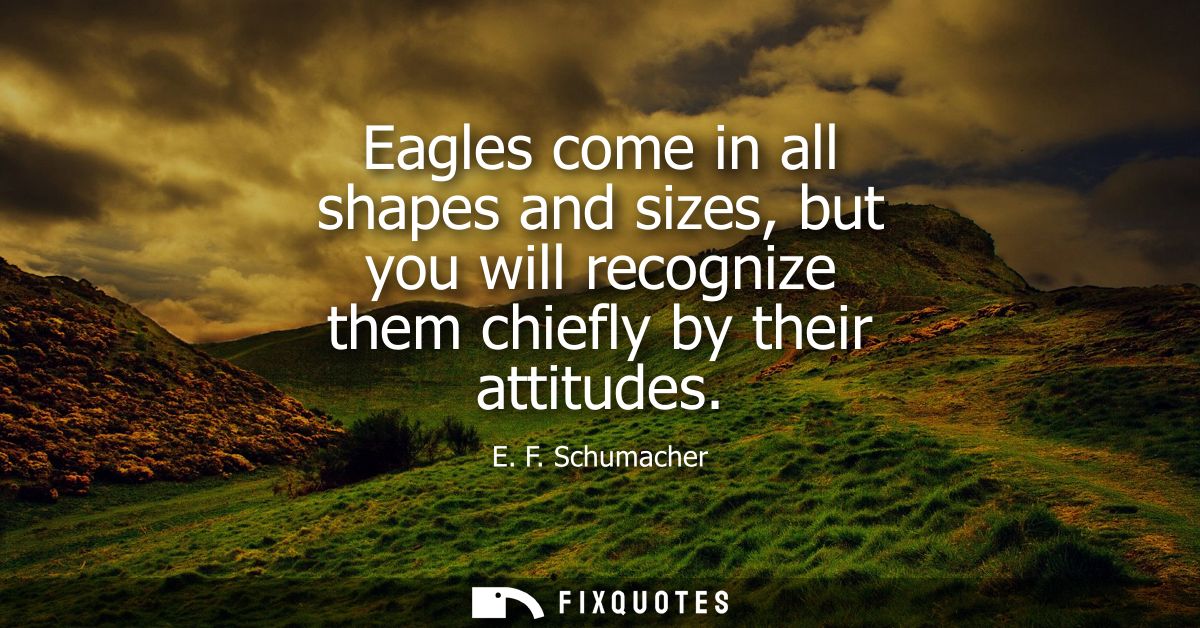
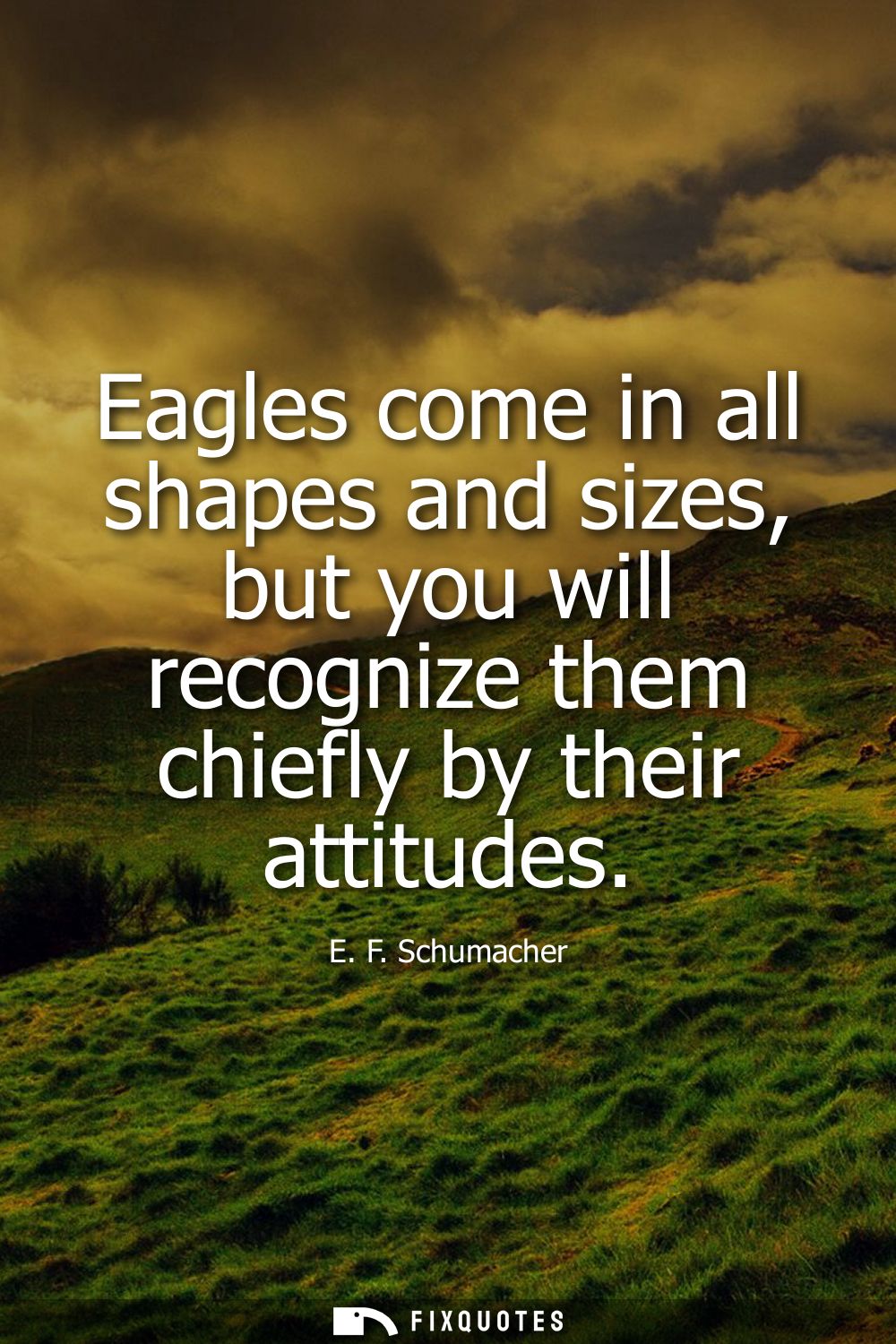
"Eagles come in all shapes and sizes, but you will recognize them chiefly by their attitudes"
About this Quote
Schumacher smuggles a moral psychology lesson into the disguise of natural history. “Eagles” sounds like a species, something you can measure and classify; “all shapes and sizes” nods to the economist’s habit of sorting people into categories. Then he flips the frame: what matters is not morphology but posture, a word that lives halfway between the body and the soul. An eagle is recognizable by how it holds itself in the air, how it claims height. The line is a quiet rebuke to status-by-credential thinking: titles, résumes, even raw talent can vary wildly, but the signal of excellence is behavioral and inward.
The intent isn’t to flatter “high achievers.” It’s to warn against mistaking scale for greatness, a consistent Schumacher theme in Small Is Beautiful. In a world of GDP worship, bigger firms, bigger systems, bigger ambitions, “shape and size” are the easy metrics. “Attitudes” is the harder, more human variable: judgment, courage, restraint, independence, the refusal to be domesticated by incentives. He’s arguing that character is legible, even when it isn’t quantifiable.
Subtext: you can’t counterfeit it for long. Attitude leaks through in decisions, risk tolerance, how someone treats the weak, how they respond to pressure. Contextually, Schumacher was writing against mid-century technocratic confidence, when economic planning promised managerial mastery over society. The “eagle” becomes a counter-icon to the well-trained bureaucrat: not obedient, not optimized, but self-directed, alert, and a little untamable.
The intent isn’t to flatter “high achievers.” It’s to warn against mistaking scale for greatness, a consistent Schumacher theme in Small Is Beautiful. In a world of GDP worship, bigger firms, bigger systems, bigger ambitions, “shape and size” are the easy metrics. “Attitudes” is the harder, more human variable: judgment, courage, restraint, independence, the refusal to be domesticated by incentives. He’s arguing that character is legible, even when it isn’t quantifiable.
Subtext: you can’t counterfeit it for long. Attitude leaks through in decisions, risk tolerance, how someone treats the weak, how they respond to pressure. Contextually, Schumacher was writing against mid-century technocratic confidence, when economic planning promised managerial mastery over society. The “eagle” becomes a counter-icon to the well-trained bureaucrat: not obedient, not optimized, but self-directed, alert, and a little untamable.
Quote Details
| Topic | Confidence |
|---|---|
| Source | Help us find the source |
More Quotes by F. Schumacher
Add to List