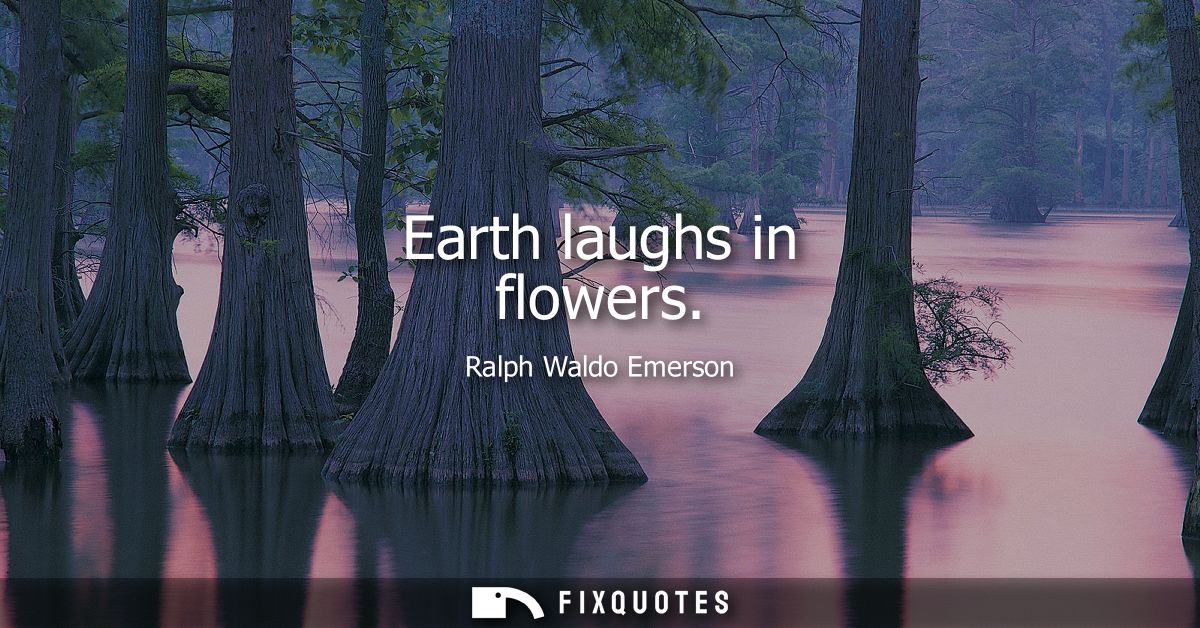
"Earth laughs in flowers"
About this Quote
“Earth laughs in flowers” is Emerson at his most disarming: a single line that makes nature feel not just alive, but mischievously expressive. The verb choice is the trick. Earth doesn’t “bloom” or “produce.” It laughs. Emerson smuggles a philosophy of vitality into a human gesture, suggesting the world isn’t inert matter waiting for meaning; it’s already performing meaning, constantly, in plain sight.
The intent is Transcendentalist persuasion without the sermon. Emerson spent his career arguing that the divine and the moral aren’t confined to churches or institutions but pulse through the everyday natural world. By framing flowers as laughter, he turns a botanical fact into a spiritual cue: notice the exuberance built into existence, and you’ll start distrusting the gray seriousness of “common sense” culture. There’s also a subtle rebuke to the era’s industrial tempo and utilitarian mindset. Flowers are famously “useless” in the narrow accounting of productivity, yet here they’re presented as the planet’s spontaneous joy - an output that refuses to justify itself.
Subtextually, the line flatters the reader into a better posture toward life. If the Earth is laughing, the proper human response isn’t domination or extraction; it’s attention, humility, maybe even a loosening of the self. Emerson’s genius is that he doesn’t argue this. He gives you an image so buoyant it feels like an instruction you chose.
The intent is Transcendentalist persuasion without the sermon. Emerson spent his career arguing that the divine and the moral aren’t confined to churches or institutions but pulse through the everyday natural world. By framing flowers as laughter, he turns a botanical fact into a spiritual cue: notice the exuberance built into existence, and you’ll start distrusting the gray seriousness of “common sense” culture. There’s also a subtle rebuke to the era’s industrial tempo and utilitarian mindset. Flowers are famously “useless” in the narrow accounting of productivity, yet here they’re presented as the planet’s spontaneous joy - an output that refuses to justify itself.
Subtextually, the line flatters the reader into a better posture toward life. If the Earth is laughing, the proper human response isn’t domination or extraction; it’s attention, humility, maybe even a loosening of the self. Emerson’s genius is that he doesn’t argue this. He gives you an image so buoyant it feels like an instruction you chose.
Quote Details
| Topic | Nature |
|---|---|
| Source | Verified source: Poems (Ralph Waldo Emerson, 1847)
Evidence: Earth laughs in flowers, to see her boastful boys (Page 53 ("Hamatreya")). This line appears in Ralph Waldo Emerson’s poem "Hamatreya" in his collection Poems (Boston: James Munroe and Company, 1847). The commonly repeated quotation "Earth laughs in flowers" is a shortened fragment of the full published line above. Wikisource’s table of contents for the 1847 volume places "Hamatreya" on page 53. Other candidates (1) Earth Laughs in Flowers (Kirsten Hartley, 2012) compilation95.0% ... Earth laughs in flowers , to see her boastful boys Earth - proud , proud of the earth which is not theirs ; Who s... |
| Cite |
Citation Formats
APA Style (7th ed.)
Emerson, Ralph Waldo. (2026, March 4). Earth laughs in flowers. FixQuotes. https://fixquotes.com/quotes/earth-laughs-in-flowers-16634/
Chicago Style
Emerson, Ralph Waldo. "Earth laughs in flowers." FixQuotes. March 4, 2026. https://fixquotes.com/quotes/earth-laughs-in-flowers-16634/.
MLA Style (9th ed.)
"Earth laughs in flowers." FixQuotes, 4 Mar. 2026, https://fixquotes.com/quotes/earth-laughs-in-flowers-16634/. Accessed 26 Mar. 2026.
More Quotes by Ralph
Add to List