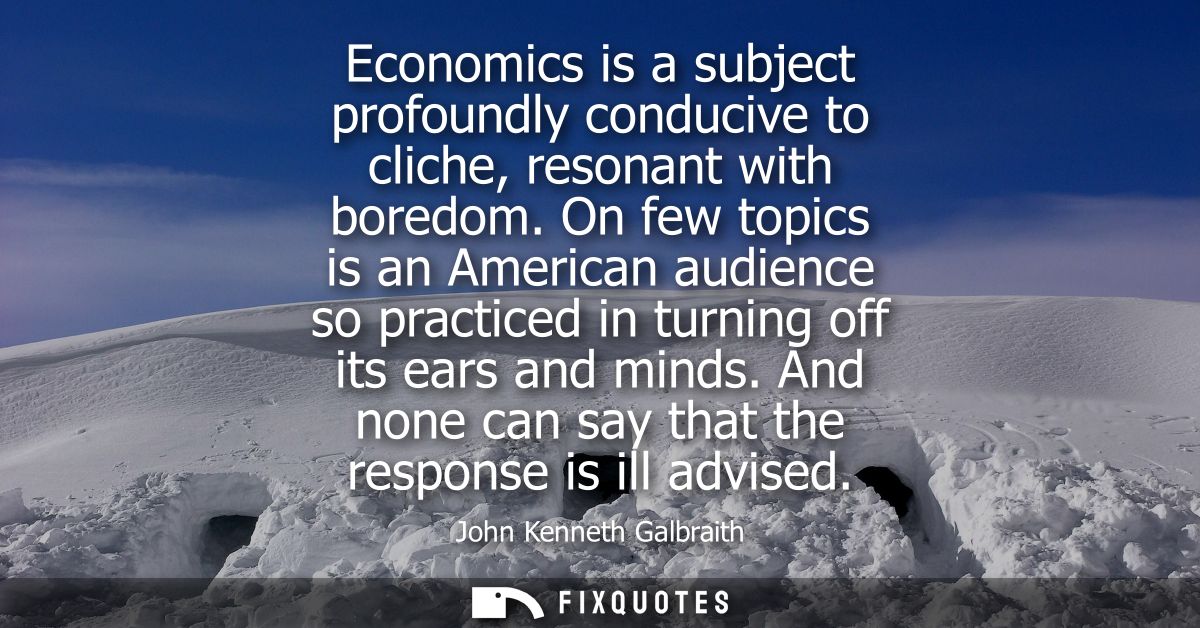
"Economics is a subject profoundly conducive to cliche, resonant with boredom. On few topics is an American audience so practiced in turning off its ears and minds. And none can say that the response is ill advised"
About this Quote
The American audience he describes is "practiced" at tuning out, as if civic disengagement is a learned skill. That word choice matters: it suggests repetition, media habit, and political conditioning. Economics arrives to most people as scolding or mystification, either a sermon about personal responsibility or an opaque math-fog that discourages questions. Galbraith, who spent his career arguing that corporate power, advertising, and public policy shape "the market" as much as any invisible hand, is also taking aim at the profession's rhetorical safety. Cliche is how orthodoxy protects itself.
The sting is the last line: the public's shutdown is "not ill advised". That's not contempt for ordinary people; it's a backhanded critique of economists who often deserve skepticism. If the field keeps selling certainty packaged as inevitability, refusing it becomes a rational defense. Galbraith is urging readers to hear the boredom as a warning signal: whenever economics sounds like a lullaby, someone may be slipping policy past you.
Quote Details
| Topic | Deep |
|---|---|
| Source | Help us find the source |
| Cite |
Citation Formats
APA Style (7th ed.)
Galbraith, John Kenneth. (2026, January 15). Economics is a subject profoundly conducive to cliche, resonant with boredom. On few topics is an American audience so practiced in turning off its ears and minds. And none can say that the response is ill advised. FixQuotes. https://fixquotes.com/quotes/economics-is-a-subject-profoundly-conducive-to-3039/
Chicago Style
Galbraith, John Kenneth. "Economics is a subject profoundly conducive to cliche, resonant with boredom. On few topics is an American audience so practiced in turning off its ears and minds. And none can say that the response is ill advised." FixQuotes. January 15, 2026. https://fixquotes.com/quotes/economics-is-a-subject-profoundly-conducive-to-3039/.
MLA Style (9th ed.)
"Economics is a subject profoundly conducive to cliche, resonant with boredom. On few topics is an American audience so practiced in turning off its ears and minds. And none can say that the response is ill advised." FixQuotes, 15 Jan. 2026, https://fixquotes.com/quotes/economics-is-a-subject-profoundly-conducive-to-3039/. Accessed 29 Mar. 2026.