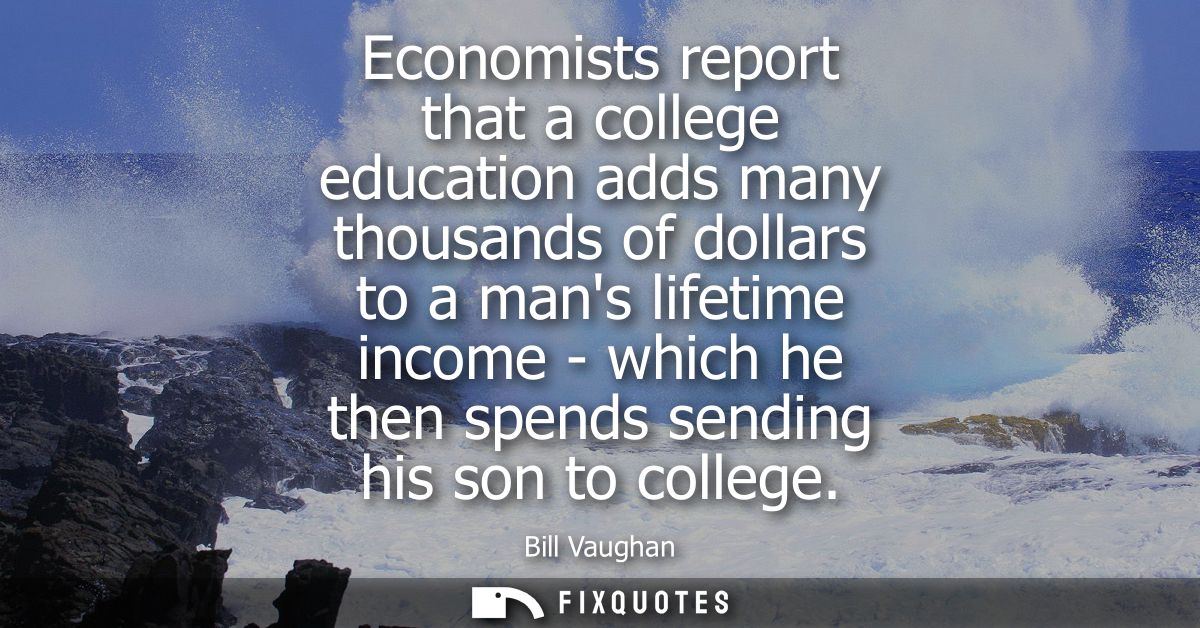
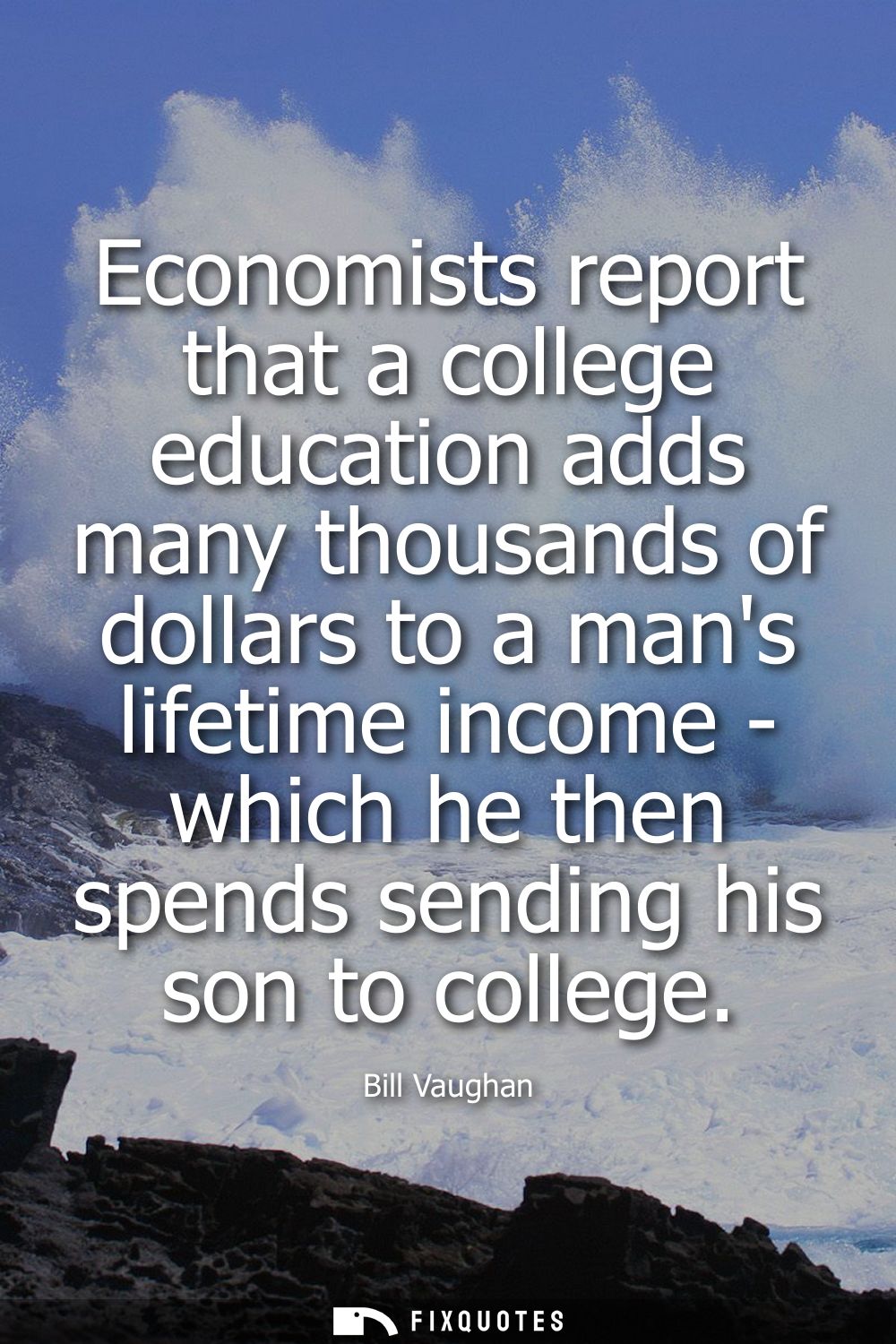
"Economists report that a college education adds many thousands of dollars to a man's lifetime income - which he then spends sending his son to college"
About this Quote
The intent is a dry little indictment of upward mobility as a treadmill. Vaughan isn’t arguing against college so much as against the way Americans learn to justify it: by converting aspiration into ROI. The subtext is that the “value” of education has been narrowed to a cash return, and even that return is semi-fictional because it gets absorbed by the cultural mandate to reproduce one’s status. The father’s gain isn’t a gain; it’s an obligation dressed up as progress.
Context matters: Vaughan is writing in mid-20th-century America, when college was becoming both more accessible and more socially compulsory, even before today’s sticker-shock debates. His line anticipates the modern anxiety that education is less a ladder than a membership fee. The gendered “a man” and “his son” quietly reflects the era’s assumed breadwinner pipeline, reinforcing the idea that college is an inheritance strategy. The brilliance is in how he compresses a whole system - credentialism, family pressure, intergenerational competition - into one neat economic loop.
Quote Details
| Topic | Witty One-Liners |
|---|---|
| Source | Help us find the source |
| Cite |
Citation Formats
APA Style (7th ed.)
Vaughan, Bill. (2026, January 17). Economists report that a college education adds many thousands of dollars to a man's lifetime income - which he then spends sending his son to college. FixQuotes. https://fixquotes.com/quotes/economists-report-that-a-college-education-adds-41740/
Chicago Style
Vaughan, Bill. "Economists report that a college education adds many thousands of dollars to a man's lifetime income - which he then spends sending his son to college." FixQuotes. January 17, 2026. https://fixquotes.com/quotes/economists-report-that-a-college-education-adds-41740/.
MLA Style (9th ed.)
"Economists report that a college education adds many thousands of dollars to a man's lifetime income - which he then spends sending his son to college." FixQuotes, 17 Jan. 2026, https://fixquotes.com/quotes/economists-report-that-a-college-education-adds-41740/. Accessed 1 Apr. 2026.