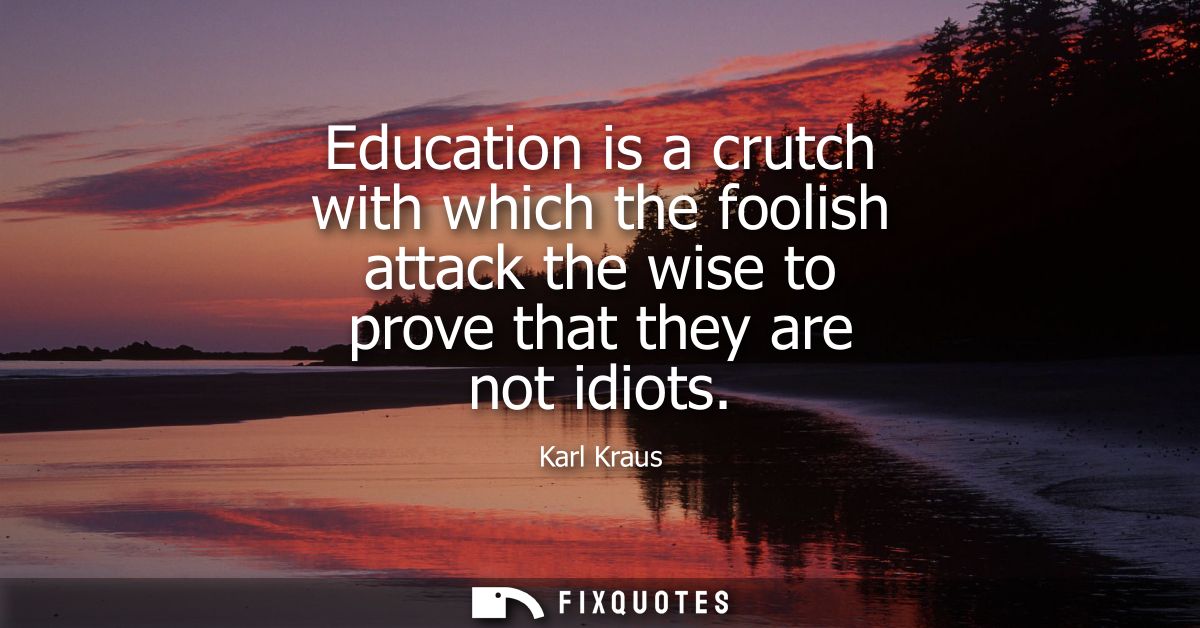
"Education is a crutch with which the foolish attack the wise to prove that they are not idiots"
About this Quote
The line’s real bite is in “attack the wise.” Kraus imagines wisdom as something lived and earned - messy, experiential, often skeptical of official narratives. Education, by contrast, becomes a social weapon: the educated fool doesn’t seek truth, they seek status. They don’t ask questions; they prosecute. “To prove that they are not idiots” nails the psychological engine: education as defensive posture, an anxious alibi. You collect diplomas the way you collect armor, not to explore the world but to avoid being exposed.
Context matters. Kraus wrote in fin-de-siecle Vienna, a culture drunk on respectability, titles, and bureaucratic correctness, while he made a career skewering journalism, hypocrisy, and the way language gets used to launder power. His target isn’t the classroom so much as the public sphere where schooling becomes moral authority. It’s a warning that institutions can manufacture confidence faster than they manufacture judgment - and that the loudest gatekeepers of “intelligence” are often advertising their fear of being found out.
Quote Details
| Topic | Wisdom |
|---|---|
| Source | Help us find the source |
| Cite |
Citation Formats
APA Style (7th ed.)
Kraus, Karl. (2026, January 17). Education is a crutch with which the foolish attack the wise to prove that they are not idiots. FixQuotes. https://fixquotes.com/quotes/education-is-a-crutch-with-which-the-foolish-78389/
Chicago Style
Kraus, Karl. "Education is a crutch with which the foolish attack the wise to prove that they are not idiots." FixQuotes. January 17, 2026. https://fixquotes.com/quotes/education-is-a-crutch-with-which-the-foolish-78389/.
MLA Style (9th ed.)
"Education is a crutch with which the foolish attack the wise to prove that they are not idiots." FixQuotes, 17 Jan. 2026, https://fixquotes.com/quotes/education-is-a-crutch-with-which-the-foolish-78389/. Accessed 10 Feb. 2026.