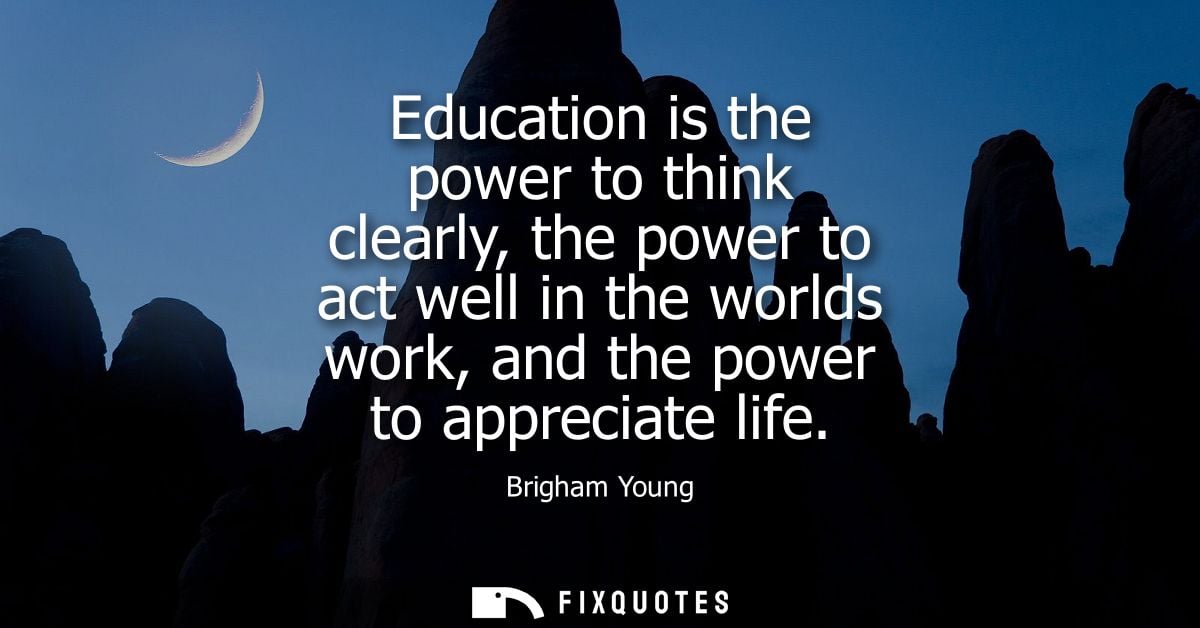
"Education is the power to think clearly, the power to act well in the world's work, and the power to appreciate life"
About this Quote
Then he pivots to “act well in the world’s work,” a phrase that smuggles in an ethic of productivity. Young’s era prized industriousness, but in his context it carries extra weight: competence becomes a form of communal loyalty. Education is framed not as self-expression but as capacity building, the practical intelligence needed to irrigate fields, organize labor, and turn a precarious settlement into a functioning order.
The final clause, “appreciate life,” softens what could read as pure utilitarianism. It asserts that discipline and work aren’t meant to shrink the human spirit; they’re supposed to widen it. Subtextually, it’s also an argument against the stereotype of religious austerity: a leader often painted as stern makes room for pleasure, beauty, and gratitude as educational outcomes.
The rhetoric is simple, almost sermonic, but that’s the point. Young is defining education as a full-spectrum authority: mental, civic, and emotional. Not merely to know more, but to become the kind of person a demanding, consequential world can’t easily break.
Quote Details
| Topic | Learning |
|---|---|
| Source | Help us find the source |
| Cite |
Citation Formats
APA Style (7th ed.)
Young, Brigham. (2026, February 20). Education is the power to think clearly, the power to act well in the world's work, and the power to appreciate life. FixQuotes. https://fixquotes.com/quotes/education-is-the-power-to-think-clearly-the-power-26643/
Chicago Style
Young, Brigham. "Education is the power to think clearly, the power to act well in the world's work, and the power to appreciate life." FixQuotes. February 20, 2026. https://fixquotes.com/quotes/education-is-the-power-to-think-clearly-the-power-26643/.
MLA Style (9th ed.)
"Education is the power to think clearly, the power to act well in the world's work, and the power to appreciate life." FixQuotes, 20 Feb. 2026, https://fixquotes.com/quotes/education-is-the-power-to-think-clearly-the-power-26643/. Accessed 7 Mar. 2026.