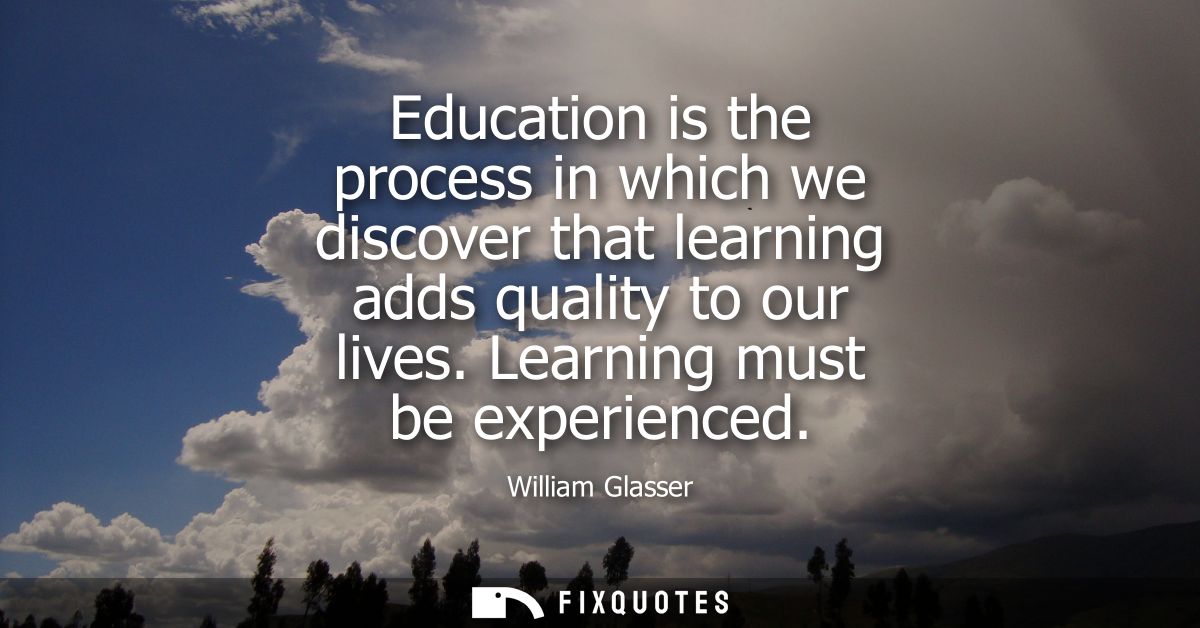
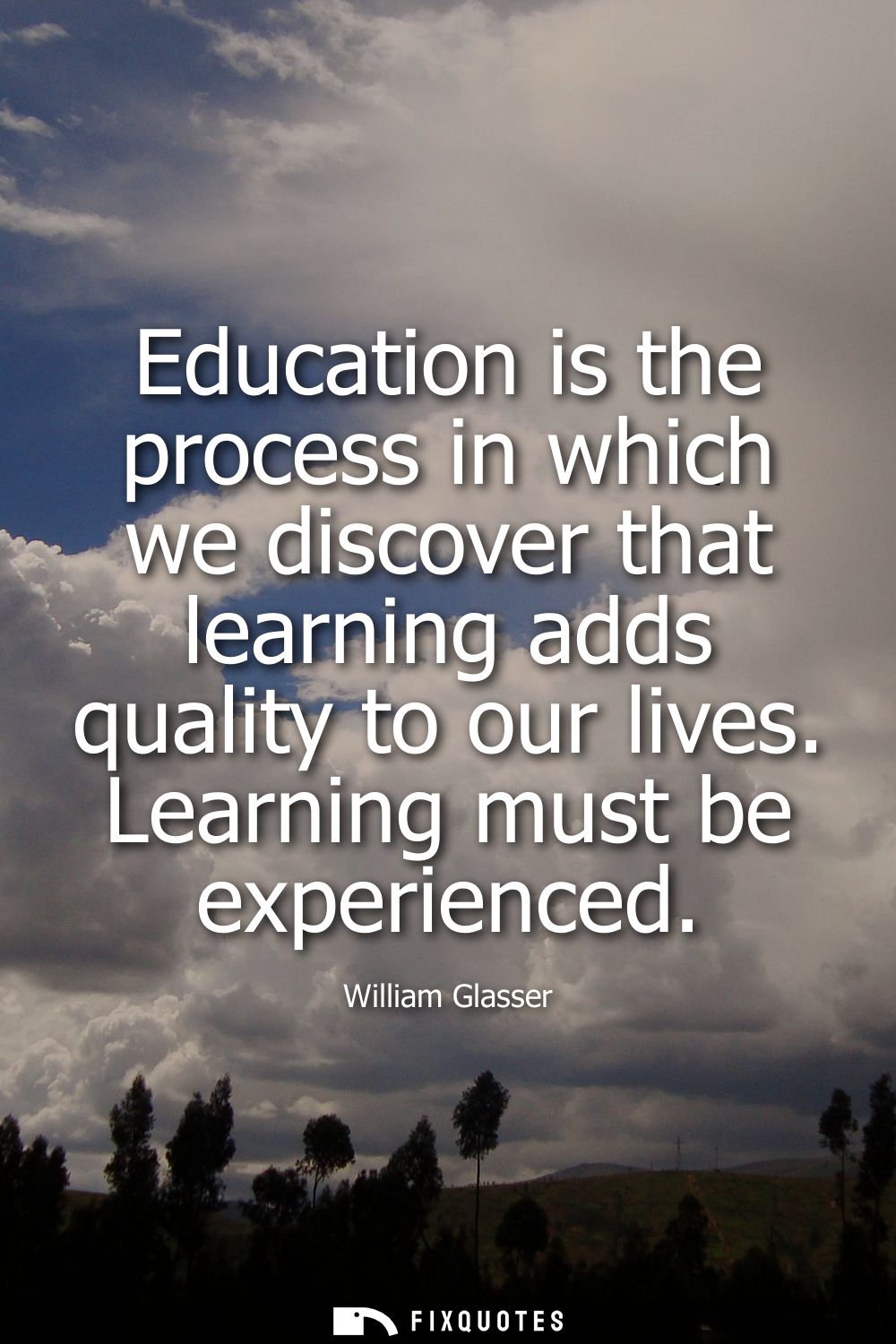
"Education is the process in which we discover that learning adds quality to our lives. Learning must be experienced!"
About this Quote
The subtext is a critique of schooling that treats knowledge like cargo to be delivered. “Adds quality to our lives” is doing heavy work here. Glasser isn’t praising learning as a moral virtue; he’s offering a pragmatic test. Does it make your life more capable, more meaningful, more self-directed? If not, it’s not really education, just compliance with a syllabus. That’s classic Glasser: less about sorting students by performance, more about the internal logic of motivation and choice.
“Learning must be experienced” is the hard edge of the quote. It rejects the idea that exposure equals mastery: reading about courage isn’t courage; memorizing a formula isn’t understanding; watching a demonstration isn’t the same as doing. The line echoes his broader project in Choice Theory and quality schooling: people learn best when they feel agency, relevance, and connection, not when they’re managed through threats and grades.
Context matters. Glasser wrote against the backdrop of postwar, industrial-style education and behaviorism’s appetite for control. His quote lands as a cultural argument: the classroom shouldn’t be a factory of correct answers, but a lab for lived competence.
Quote Details
| Topic | Learning |
|---|---|
| Source | Help us find the source |
| Cite |
Citation Formats
APA Style (7th ed.)
Glasser, William. (2026, February 20). Education is the process in which we discover that learning adds quality to our lives. Learning must be experienced! FixQuotes. https://fixquotes.com/quotes/education-is-the-process-in-which-we-discover-2932/
Chicago Style
Glasser, William. "Education is the process in which we discover that learning adds quality to our lives. Learning must be experienced!" FixQuotes. February 20, 2026. https://fixquotes.com/quotes/education-is-the-process-in-which-we-discover-2932/.
MLA Style (9th ed.)
"Education is the process in which we discover that learning adds quality to our lives. Learning must be experienced!" FixQuotes, 20 Feb. 2026, https://fixquotes.com/quotes/education-is-the-process-in-which-we-discover-2932/. Accessed 6 Mar. 2026.