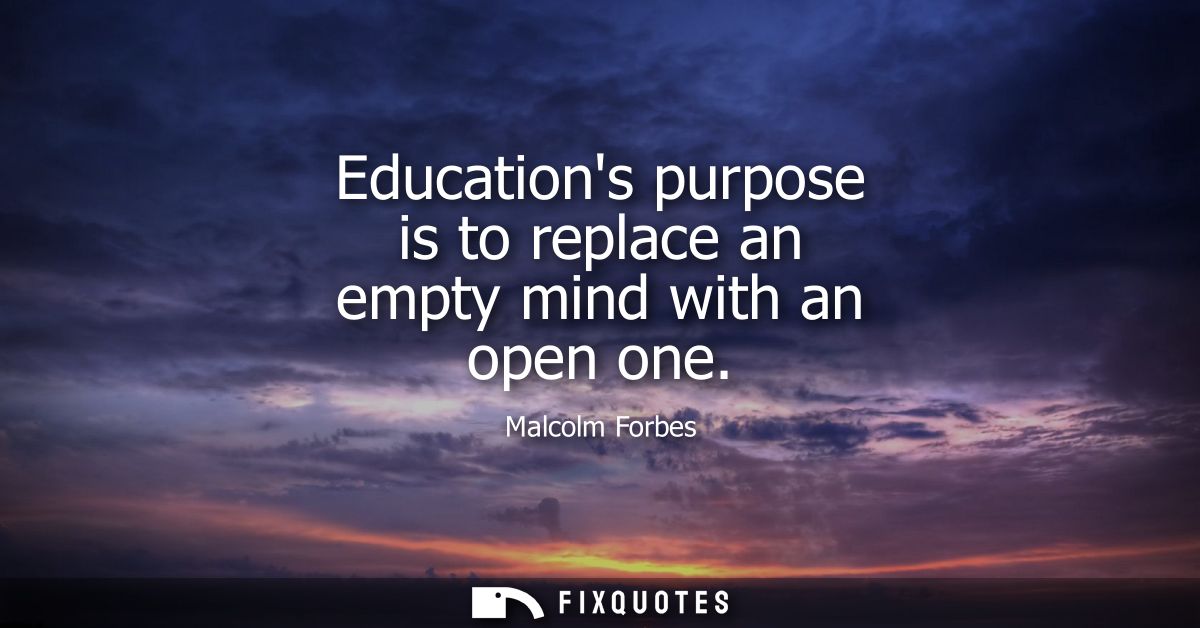
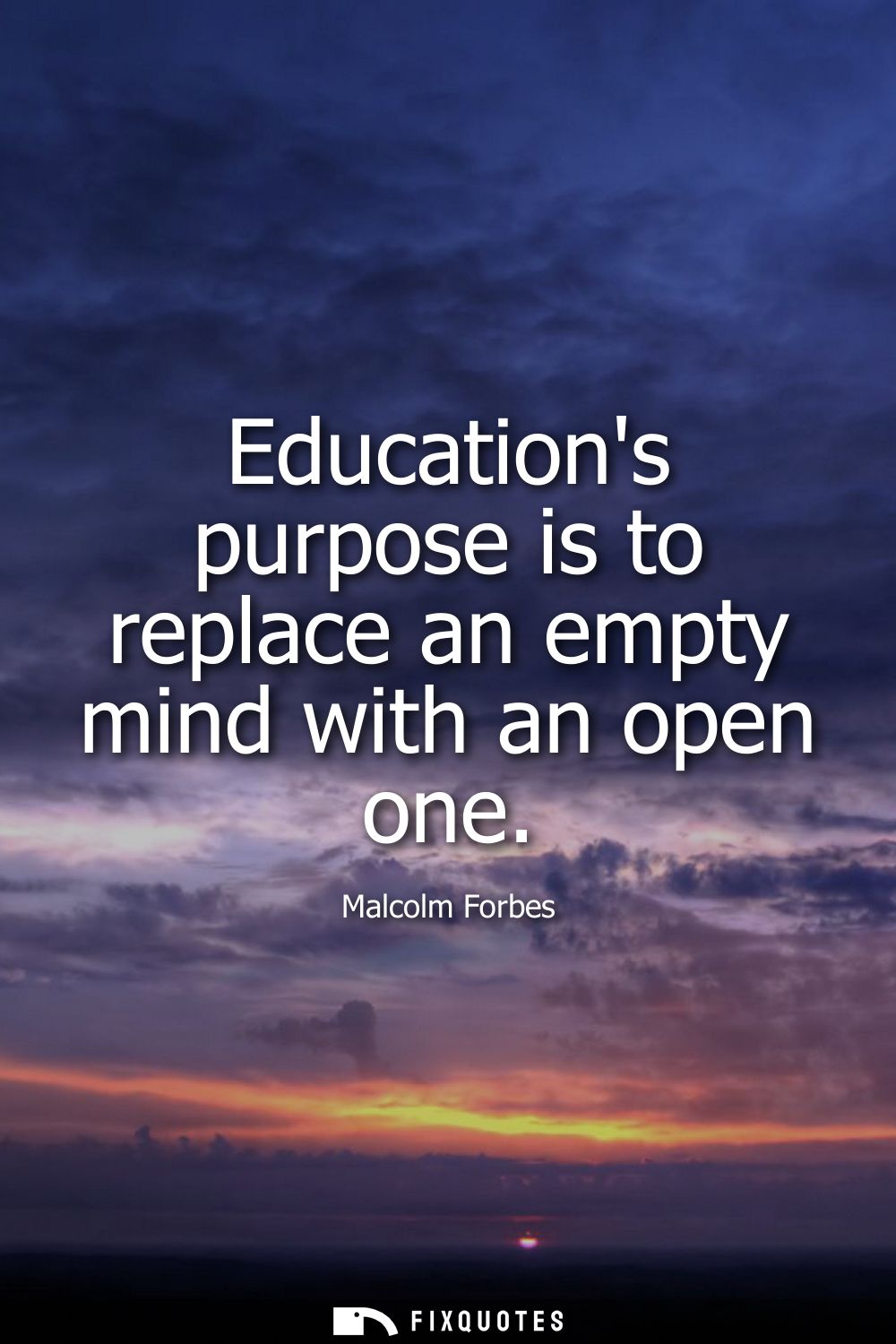
"Education's purpose is to replace an empty mind with an open one"
About this Quote
Forbes frames education as a conversion experience: not the filling of a vessel, but the rewiring of a mindset. The line flatters the reader into imagining “empty mind” as a temporary condition - ignorance as a starting point, not a moral failing - then pivots to a more demanding goal. An “open” mind isn’t full of correct answers; it’s structurally different, built to keep admitting new information without collapsing into dogma. That’s a shrewd rhetorical upgrade: he makes education sound less like credentialing and more like intellectual character formation.
The subtext is distinctly mid-century American and distinctly Forbes. As a publisher and business mogul, Malcolm Forbes had a stake in equating learning with adaptability. “Open” reads like a corporate virtue: flexible, curious, responsive to markets and ideas, allergic to ideology. It’s also a rebuke to rote schooling. Memorization can produce a mind that’s technically “full” yet functionally closed - armed with facts, incapable of revision. Forbes’s formulation implies that the real failure of education isn’t ignorance; it’s certainty.
Context matters: Forbes built an empire on information, access, and the prestige economy of knowing the right people and trends. In that world, an open mind is a competitive advantage and a social credential. The line sells an aspirational ethos of lifelong learning while quietly aligning it with ambition: stay permeable, stay relevant, keep moving. It’s a humanist sentiment with a publisher’s aftertaste - curiosity as both virtue and strategy.
The subtext is distinctly mid-century American and distinctly Forbes. As a publisher and business mogul, Malcolm Forbes had a stake in equating learning with adaptability. “Open” reads like a corporate virtue: flexible, curious, responsive to markets and ideas, allergic to ideology. It’s also a rebuke to rote schooling. Memorization can produce a mind that’s technically “full” yet functionally closed - armed with facts, incapable of revision. Forbes’s formulation implies that the real failure of education isn’t ignorance; it’s certainty.
Context matters: Forbes built an empire on information, access, and the prestige economy of knowing the right people and trends. In that world, an open mind is a competitive advantage and a social credential. The line sells an aspirational ethos of lifelong learning while quietly aligning it with ambition: stay permeable, stay relevant, keep moving. It’s a humanist sentiment with a publisher’s aftertaste - curiosity as both virtue and strategy.
Quote Details
| Topic | Learning |
|---|---|
| Source | Later attribution: The 12 Principles of Pyong'Hwa (Steev Ramsdell, 2012) modern compilationISBN: 9781452549286 · ID: 3ifhoc5xsj4C
Evidence:
... Education's purpose is to replace an empty mind with an open one . " -Malcolm Forbes “ You should never , never doubt what nobody is sure about . ” -Willy Wonka One way to avoid becoming an old dog , is to continue to learn new tricks ... |
| Cite |
Citation Formats
APA Style (7th ed.)
Forbes, Malcolm. (2026, February 26). Education's purpose is to replace an empty mind with an open one. FixQuotes. https://fixquotes.com/quotes/educations-purpose-is-to-replace-an-empty-mind-8892/
Chicago Style
Forbes, Malcolm. "Education's purpose is to replace an empty mind with an open one." FixQuotes. February 26, 2026. https://fixquotes.com/quotes/educations-purpose-is-to-replace-an-empty-mind-8892/.
MLA Style (9th ed.)
"Education's purpose is to replace an empty mind with an open one." FixQuotes, 26 Feb. 2026, https://fixquotes.com/quotes/educations-purpose-is-to-replace-an-empty-mind-8892/. Accessed 21 Mar. 2026.
More Quotes by Malcolm
Add to List