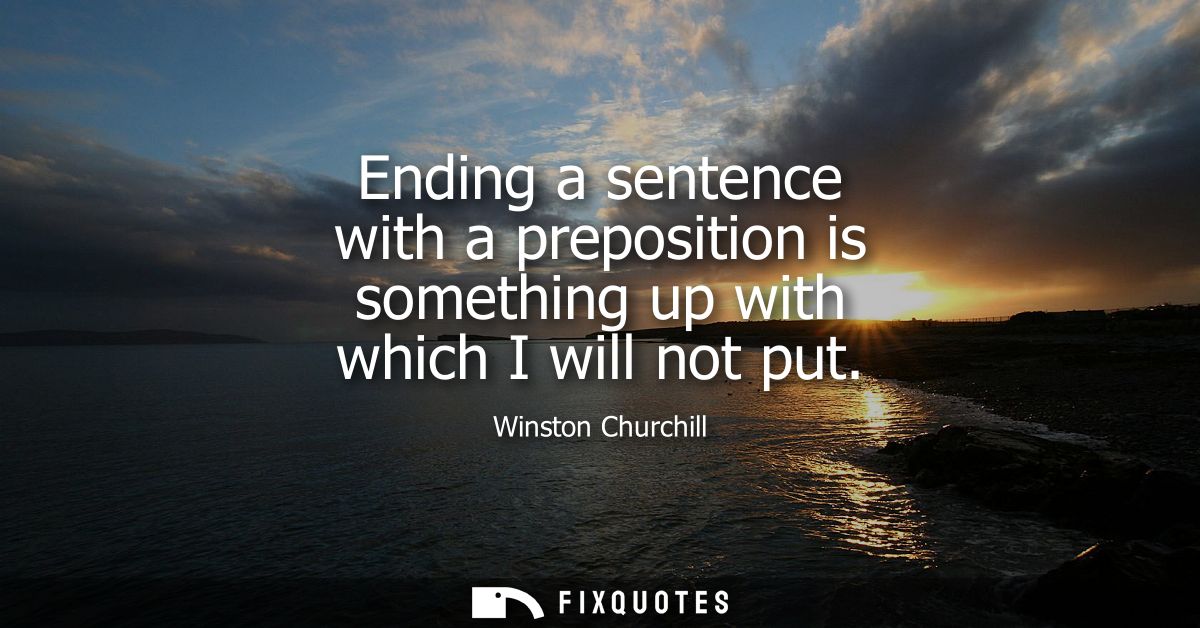
"Ending a sentence with a preposition is something up with which I will not put"
About this Quote
The subtext is political, too, in that very Churchillian way: suspicion of pedantry as a kind of soft authoritarianism. Grammar, in this telling, isn’t neutral; it’s a social instrument. People who insist on such rules often aren’t defending meaning, they’re defending status. The humor is a miniature rebellion against gatekeeping - the idea that correctness is less about communicating and more about sorting the educated from the merely articulate.
Context matters. Churchill lived in a Britain where accent, diction, and "proper" usage were class signals, and where public speech had consequences. His career depended on language that moved people, not language that pleased referees. So the line isn’t just a quip; it’s a credo for rhetoric: bend the rule if the rule bends the sentence out of shape. The punchline is that the most "correct" version sounds the least correct to any ear that actually speaks English.
Quote Details
| Topic | Witty One-Liners |
|---|---|
| Source | Help us find the source |
| Cite |
Citation Formats
APA Style (7th ed.)
Churchill, Winston. (2026, January 17). Ending a sentence with a preposition is something up with which I will not put. FixQuotes. https://fixquotes.com/quotes/ending-a-sentence-with-a-preposition-is-something-27763/
Chicago Style
Churchill, Winston. "Ending a sentence with a preposition is something up with which I will not put." FixQuotes. January 17, 2026. https://fixquotes.com/quotes/ending-a-sentence-with-a-preposition-is-something-27763/.
MLA Style (9th ed.)
"Ending a sentence with a preposition is something up with which I will not put." FixQuotes, 17 Jan. 2026, https://fixquotes.com/quotes/ending-a-sentence-with-a-preposition-is-something-27763/. Accessed 31 Mar. 2026.