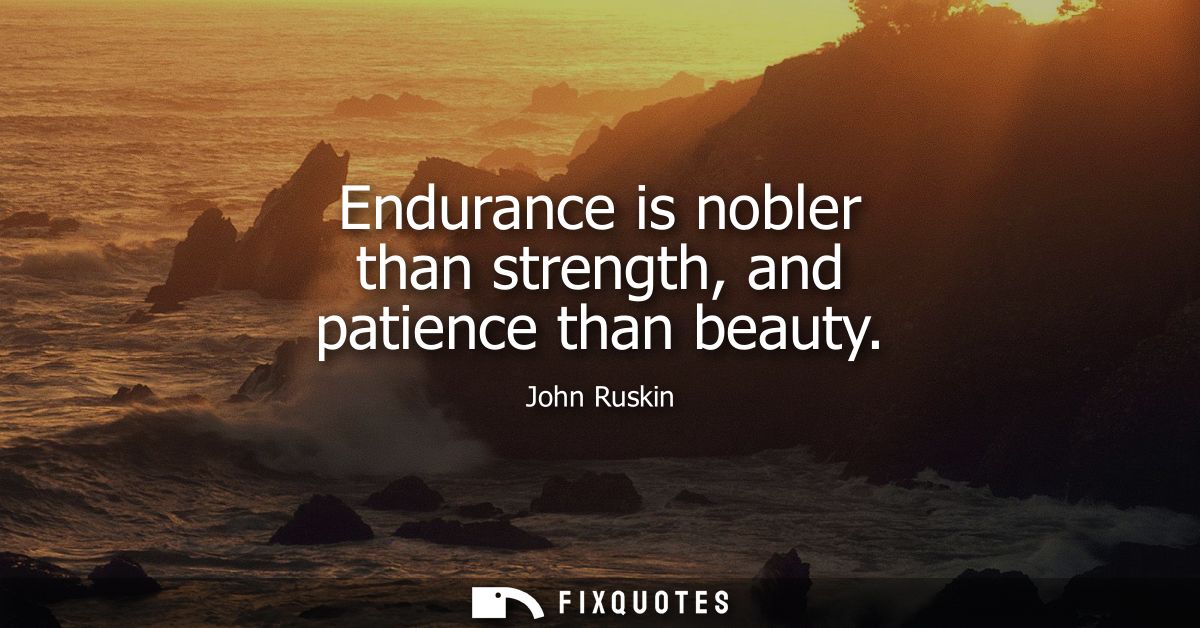
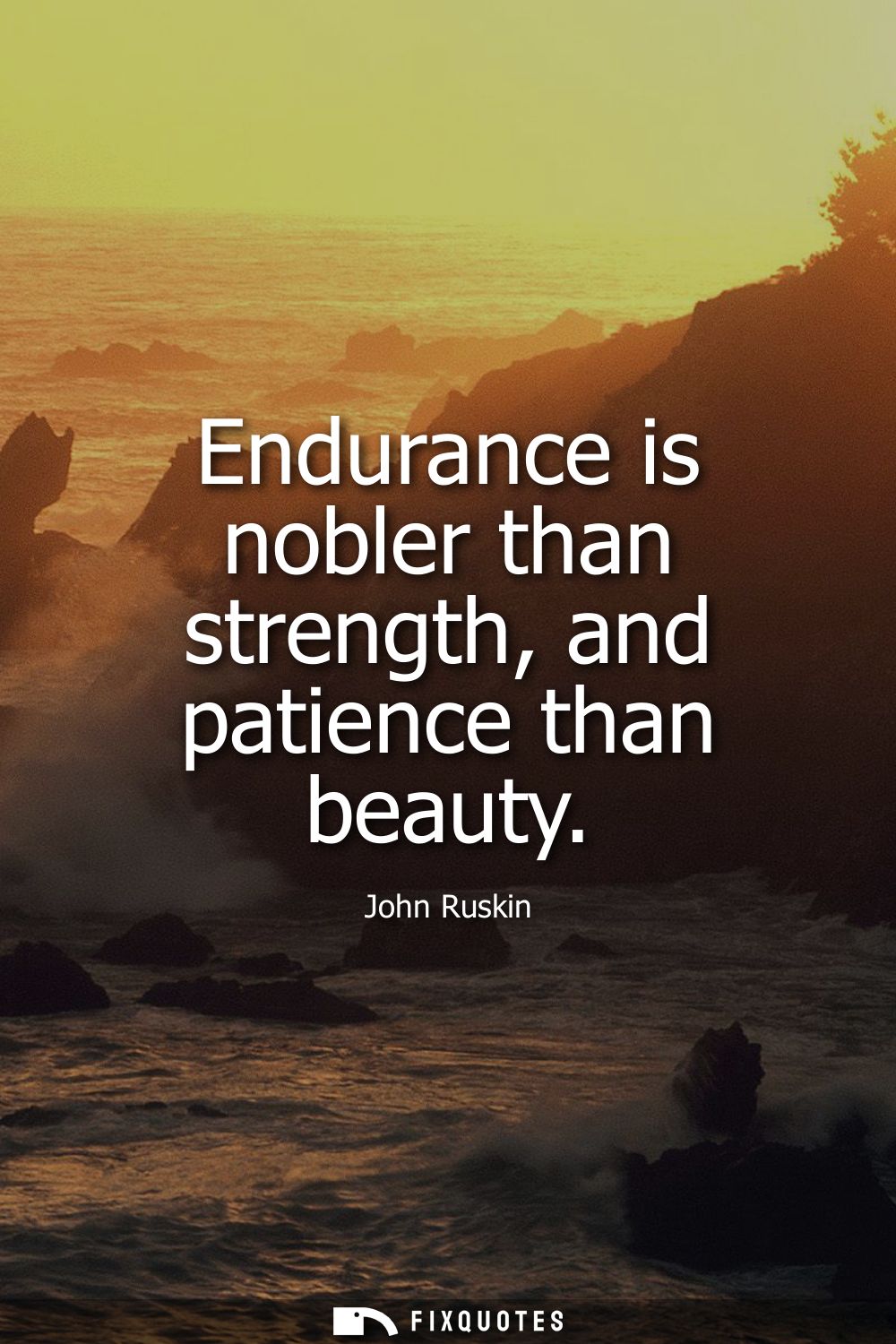
"Endurance is nobler than strength, and patience than beauty"
About this Quote
Ruskin’s ranking is a quiet act of sabotage against the Victorian obsession with display. “Strength” and “beauty” are public currencies: instantly legible, easily admired, and, crucially, easy to mistake for virtue. “Endurance” and “patience,” by contrast, are slow arts. They don’t photograph well. They don’t win a room on first impression. They reveal themselves only over time, through pressure.
The line works because it flips what looks like a natural hierarchy. Strength feels “noble” because it suggests power; beauty feels “valuable” because it confers status. Ruskin insists that the deeper moral achievement is staying present when you don’t get the reward of immediacy. Endurance implies suffering without theatricality; patience implies restraint in a culture that fetishizes appetite. He’s not romanticizing passivity so much as arguing that character is measured by duration: what you can carry, what you can wait out, what you refuse to turn into spectacle.
Context matters. Ruskin spent his career defending craftsmanship, ethics in labor, and a vision of art tied to moral life, not mere consumption. In an industrializing Britain that prized force, progress, and surface polish, he keeps pointing to the invisible costs: fatigue, exploitation, the hollowing-out of meaning. This aphorism compresses that critique into a single moral revaluation. It’s a rebuke to a society seduced by appearances and a reminder that the virtues that actually keep people and communities intact tend to look, from the outside, like nothing at all.
The line works because it flips what looks like a natural hierarchy. Strength feels “noble” because it suggests power; beauty feels “valuable” because it confers status. Ruskin insists that the deeper moral achievement is staying present when you don’t get the reward of immediacy. Endurance implies suffering without theatricality; patience implies restraint in a culture that fetishizes appetite. He’s not romanticizing passivity so much as arguing that character is measured by duration: what you can carry, what you can wait out, what you refuse to turn into spectacle.
Context matters. Ruskin spent his career defending craftsmanship, ethics in labor, and a vision of art tied to moral life, not mere consumption. In an industrializing Britain that prized force, progress, and surface polish, he keeps pointing to the invisible costs: fatigue, exploitation, the hollowing-out of meaning. This aphorism compresses that critique into a single moral revaluation. It’s a rebuke to a society seduced by appearances and a reminder that the virtues that actually keep people and communities intact tend to look, from the outside, like nothing at all.
Quote Details
| Topic | Perseverance |
|---|---|
| Source | Help us find the source |
| Cite |
Citation Formats
APA Style (7th ed.)
Ruskin, John. (2026, January 18). Endurance is nobler than strength, and patience than beauty. FixQuotes. https://fixquotes.com/quotes/endurance-is-nobler-than-strength-and-patience-8261/
Chicago Style
Ruskin, John. "Endurance is nobler than strength, and patience than beauty." FixQuotes. January 18, 2026. https://fixquotes.com/quotes/endurance-is-nobler-than-strength-and-patience-8261/.
MLA Style (9th ed.)
"Endurance is nobler than strength, and patience than beauty." FixQuotes, 18 Jan. 2026, https://fixquotes.com/quotes/endurance-is-nobler-than-strength-and-patience-8261/. Accessed 21 Feb. 2026.
More Quotes by John
Add to List