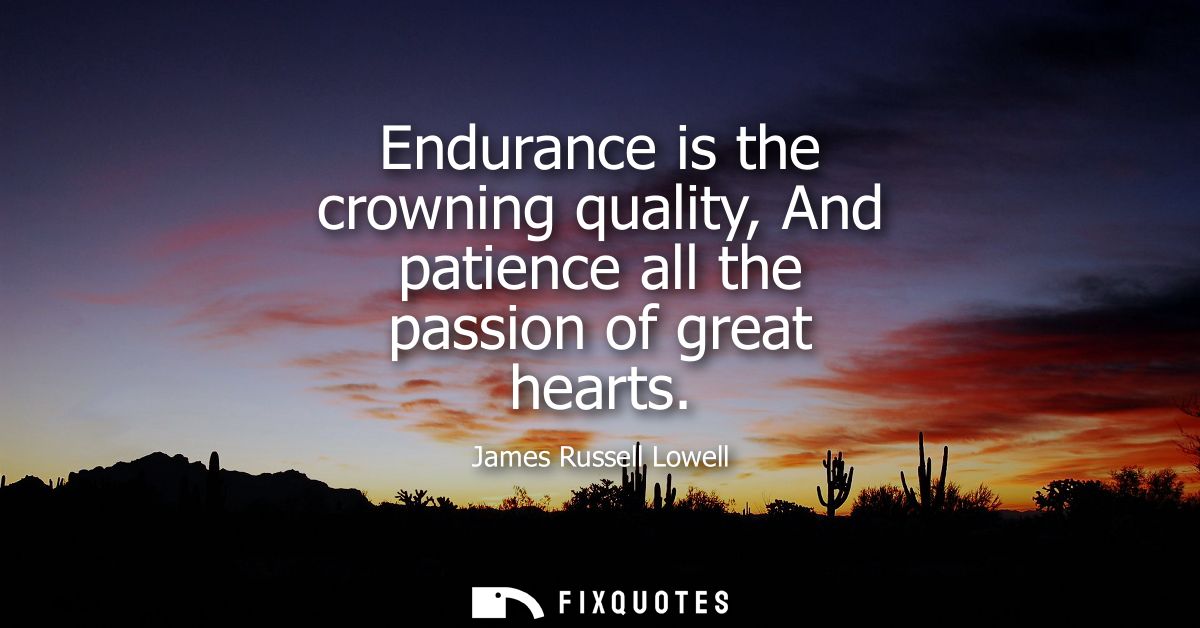
"Endurance is the crowning quality, and patience all the passion of great hearts"
About this Quote
The second clause sharpens the knife. "Patience all the passion of great hearts" is a deliberate paradox, a rebranding of passion away from fireworks and toward restraint. Lowell is arguing that the deepest emotional force isn't the outburst; it's the controlled burn. Patience becomes passion's adult form: love that stays, courage that waits, resolve that refuses the quick relief of quitting. There's an implied critique of performative ardor - the kind that looks heroic in a moment but collapses over time.
Context matters. Lowell wrote in a 19th-century America obsessed with moral improvement, national purpose, and reform movements that demanded stamina more than slogans. As a poet and public intellectual in an era of abolitionist struggle and postwar reckoning, he knew that big causes are mostly made of unglamorous days. The line works because it flatters no one cheaply; it turns greatness into a test of duration. In a culture that loves the drama of starting, Lowell quietly insists the nobler drama is finishing - slowly, stubbornly, without applause.
Quote Details
| Topic | Perseverance |
|---|---|
| Source | Help us find the source |
| Cite |
Citation Formats
APA Style (7th ed.)
Lowell, James Russell. (2026, February 20). Endurance is the crowning quality, and patience all the passion of great hearts. FixQuotes. https://fixquotes.com/quotes/endurance-is-the-crowning-quality-and-patience-26764/
Chicago Style
Lowell, James Russell. "Endurance is the crowning quality, and patience all the passion of great hearts." FixQuotes. February 20, 2026. https://fixquotes.com/quotes/endurance-is-the-crowning-quality-and-patience-26764/.
MLA Style (9th ed.)
"Endurance is the crowning quality, and patience all the passion of great hearts." FixQuotes, 20 Feb. 2026, https://fixquotes.com/quotes/endurance-is-the-crowning-quality-and-patience-26764/. Accessed 15 Mar. 2026.