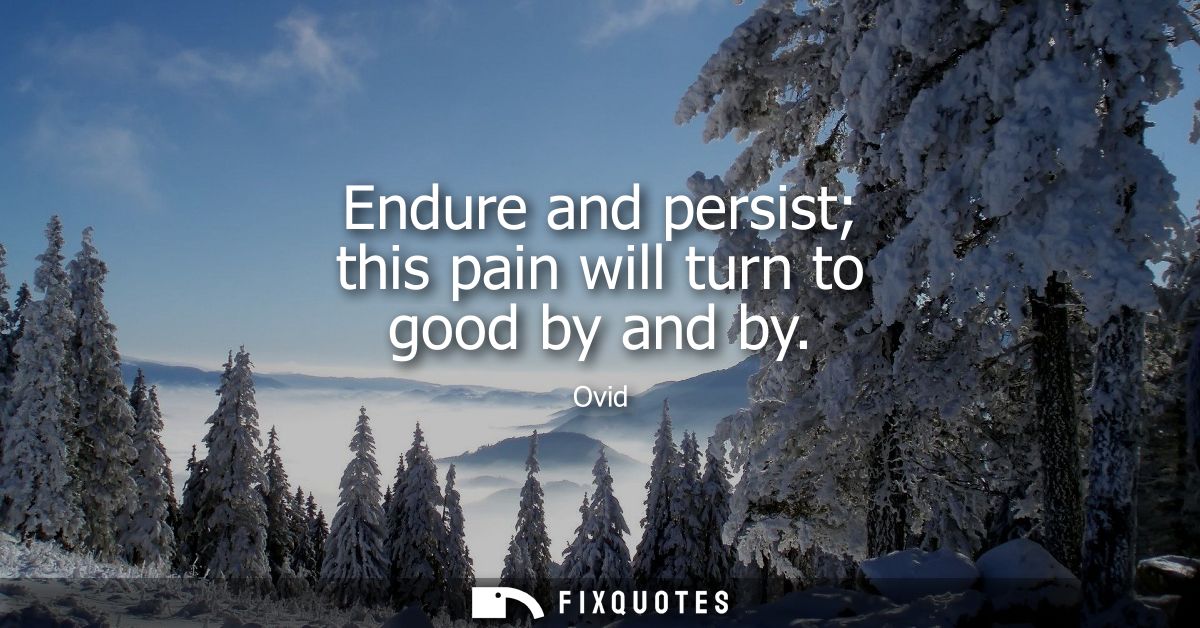
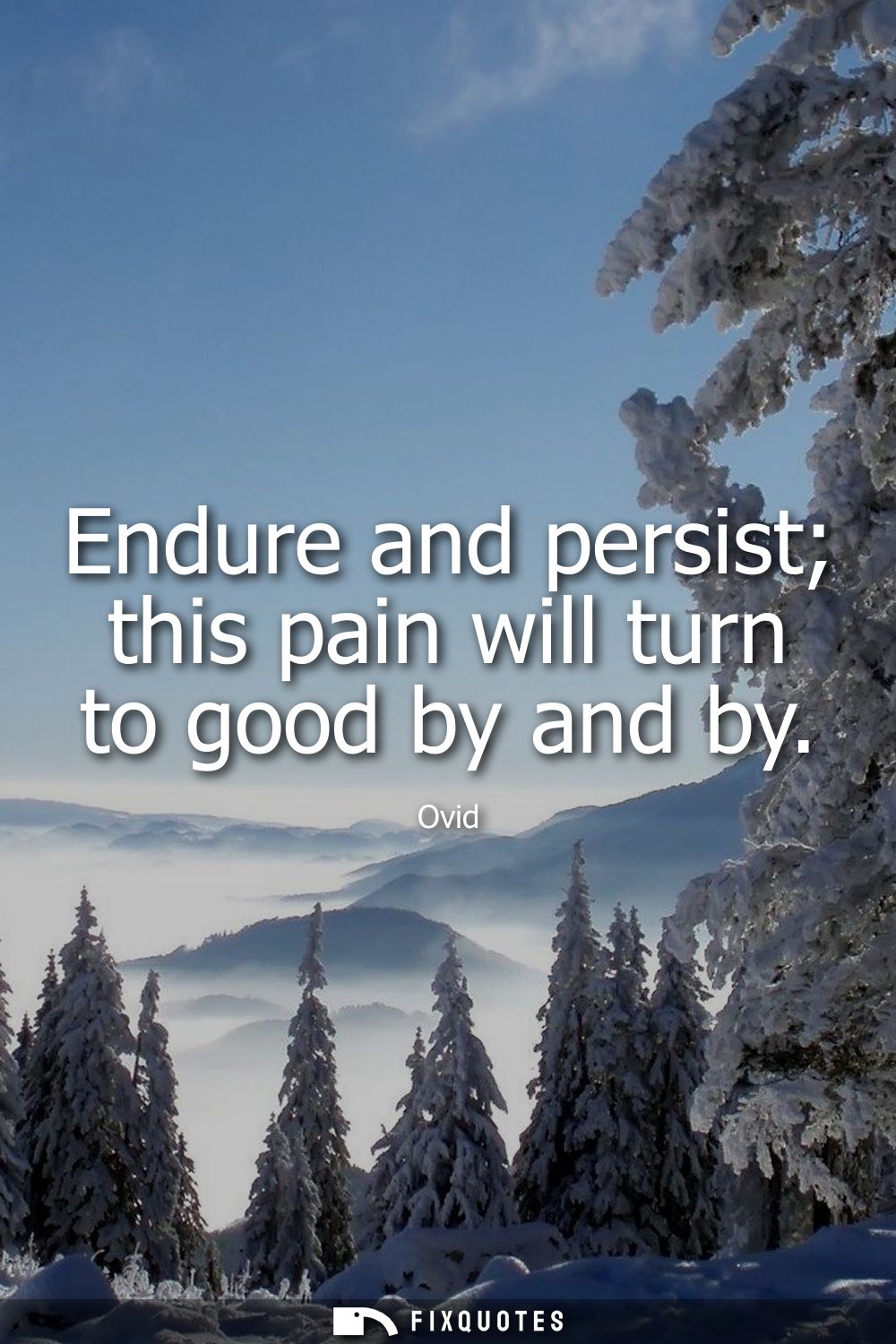
"Endure and persist; this pain will turn to good by and by"
About this Quote
Stoicism with a poet's sleight of hand: Ovid turns suffering into a promissory note. "Endure and persist" is blunt, almost military in cadence, then the line swivels into consolation, smuggling hope in under the cover of discipline. The genius is the timing. "By and by" refuses the instant-gratification fantasy; it offers no deadline, only direction. Pain is not denied or romanticized. It's treated as raw material that can be transmuted, eventually, into something usable.
That alchemy matters because Ovid's world was one where fortune was capricious and politics could be lethal. Exiled by Augustus to the edge of the empire, he knew what it meant to have your life rewritten by someone else's decree. Read against that backdrop, the line isn't a Hallmark pep talk; it's survival rhetoric. It's what you tell yourself when the state has the power to isolate you, when friends go quiet, when your past work becomes evidence against you.
Subtextually, the statement is also a wager on narrative. For a poet, "good" isn't only moral improvement; it's meaning. If you can endure long enough, you can reframe the wound into story, into art, into a form of agency. The command is practical, but the payoff is aesthetic: persistence buys you the future tense, the chance to look back and make coherence out of chaos. In an empire that demands obedience, Ovid offers a quieter rebellion - not against pain, but against pain's claim to be the final author.
That alchemy matters because Ovid's world was one where fortune was capricious and politics could be lethal. Exiled by Augustus to the edge of the empire, he knew what it meant to have your life rewritten by someone else's decree. Read against that backdrop, the line isn't a Hallmark pep talk; it's survival rhetoric. It's what you tell yourself when the state has the power to isolate you, when friends go quiet, when your past work becomes evidence against you.
Subtextually, the statement is also a wager on narrative. For a poet, "good" isn't only moral improvement; it's meaning. If you can endure long enough, you can reframe the wound into story, into art, into a form of agency. The command is practical, but the payoff is aesthetic: persistence buys you the future tense, the chance to look back and make coherence out of chaos. In an empire that demands obedience, Ovid offers a quieter rebellion - not against pain, but against pain's claim to be the final author.
Quote Details
| Topic | Perseverance |
|---|---|
| Source | Unverified source: Amores (Book 3, Elegy 11a) (Ovid, -16)
Evidence: Book III, Elegy 11a, line 7 (often cited as 3.11a.7). The English quote “Endure and persist; this pain will turn to good by and by” is a modern paraphrase/translation of Ovid’s Latin line “perfer et obdura! dolor hic tibi proderit olim;” found in Ovid, Amores 3.11a.7. A public-domain English pros... Other candidates (2) Gandhi and the Psychology of Nonviolence, Volume 1 (V. K. Kool, Rita Agrawal, 2020) compilation95.0% ... Endure and persist; this pain will turn to good by and by. This exhortation by the Roman poet, Publius Ovidius Na... Ovid (Ovid) compilation35.0% leasure in permitted joysbut whats forbidden is more keenly sought book ii xix 3 |
| Cite |
Citation Formats
APA Style (7th ed.)
Ovid. (2026, January 13). Endure and persist; this pain will turn to good by and by. FixQuotes. https://fixquotes.com/quotes/endure-and-persist-this-pain-will-turn-to-good-by-18222/
Chicago Style
Ovid. "Endure and persist; this pain will turn to good by and by." FixQuotes. January 13, 2026. https://fixquotes.com/quotes/endure-and-persist-this-pain-will-turn-to-good-by-18222/.
MLA Style (9th ed.)
"Endure and persist; this pain will turn to good by and by." FixQuotes, 13 Jan. 2026, https://fixquotes.com/quotes/endure-and-persist-this-pain-will-turn-to-good-by-18222/. Accessed 1 Apr. 2026.
More Quotes by Ovid
Add to List