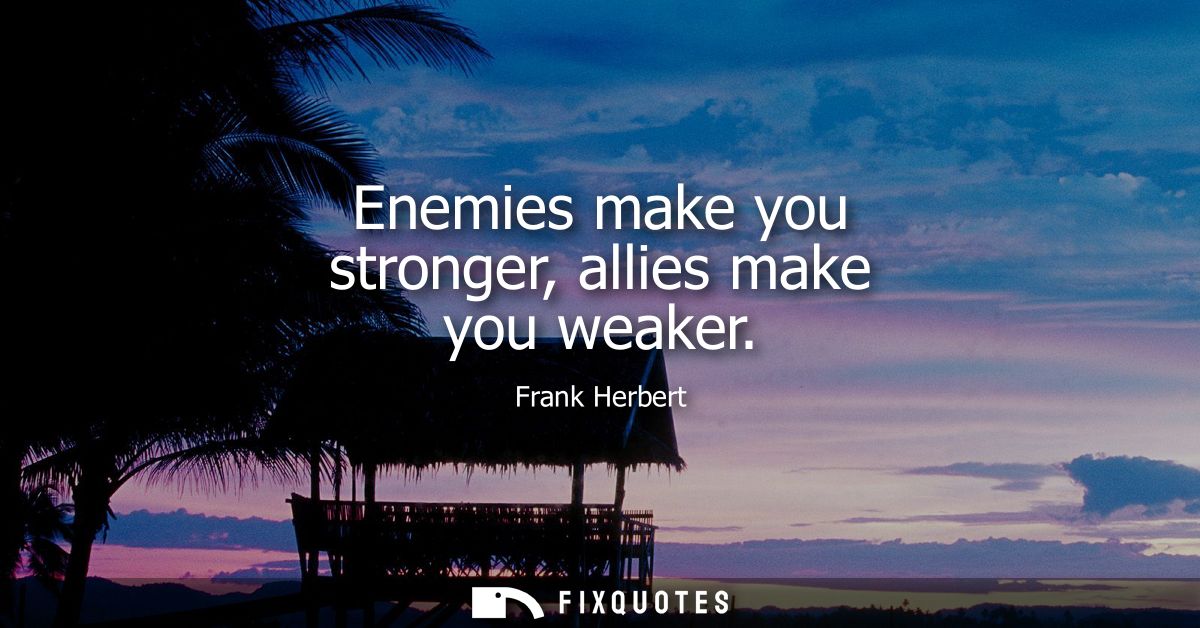
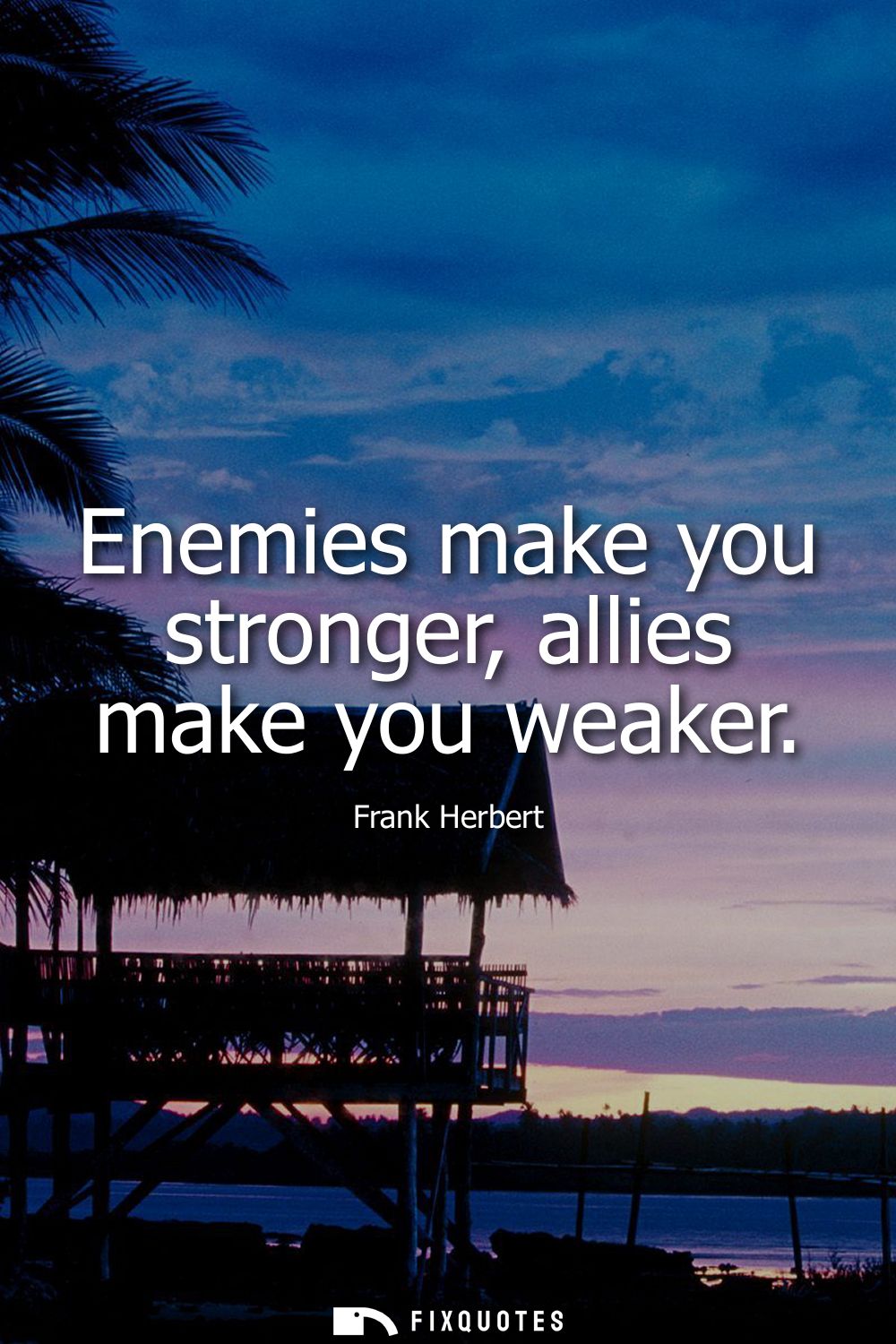
"Enemies make you stronger, allies make you weaker"
About this Quote
“Enemies make you stronger, allies make you weaker” is Frank Herbert at his most bracingly ecological about power: stress is not just inevitable, it’s productive. The line reads like a proverb, but it functions more like a warning label. In Herbert’s worlds, comfort is the fastest route to decay. Conflict forces adaptation; consensus invites complacency.
The intent isn’t to romanticize hostility so much as to puncture a cozy political fantasy: that safety and goodness naturally travel with friendship. Herbert distrusts systems that eliminate friction. Enemies clarify stakes. They expose your soft assumptions, harden your strategy, and force you to see yourself as others do. An adversary is a mirror that doesn’t flatter. Allies, by contrast, can become a narcotic - not because solidarity is evil, but because it can outsource your vigilance. They reassure you you’re right; enemies make you prove it.
The subtext is classic Herbert: survival depends on pressures that hurt. It echoes the logic of Dune’s Bene Gesserit and Fremen culture, where hardship is engineered or embraced to produce sharper minds and tougher bodies. Read politically, it’s also a critique of court politics and empire: alliances often demand compromise, loyalty tests, and shared illusions. They can calcify into factions that punish dissent and reward mediocrity.
Context matters: Herbert wrote during an era obsessed with systems - Cold War blocs, bureaucracies, technocracy. His fiction keeps insisting that the most dangerous threat isn’t an enemy at the gate; it’s the comforting coalition that convinces you the gate no longer matters.
The intent isn’t to romanticize hostility so much as to puncture a cozy political fantasy: that safety and goodness naturally travel with friendship. Herbert distrusts systems that eliminate friction. Enemies clarify stakes. They expose your soft assumptions, harden your strategy, and force you to see yourself as others do. An adversary is a mirror that doesn’t flatter. Allies, by contrast, can become a narcotic - not because solidarity is evil, but because it can outsource your vigilance. They reassure you you’re right; enemies make you prove it.
The subtext is classic Herbert: survival depends on pressures that hurt. It echoes the logic of Dune’s Bene Gesserit and Fremen culture, where hardship is engineered or embraced to produce sharper minds and tougher bodies. Read politically, it’s also a critique of court politics and empire: alliances often demand compromise, loyalty tests, and shared illusions. They can calcify into factions that punish dissent and reward mediocrity.
Context matters: Herbert wrote during an era obsessed with systems - Cold War blocs, bureaucracies, technocracy. His fiction keeps insisting that the most dangerous threat isn’t an enemy at the gate; it’s the comforting coalition that convinces you the gate no longer matters.
Quote Details
| Topic | Wisdom |
|---|---|
| Source | Help us find the source |
| Cite |
Citation Formats
APA Style (7th ed.)
Herbert, Frank. (2026, January 15). Enemies make you stronger, allies make you weaker. FixQuotes. https://fixquotes.com/quotes/enemies-make-you-stronger-allies-make-you-weaker-110586/
Chicago Style
Herbert, Frank. "Enemies make you stronger, allies make you weaker." FixQuotes. January 15, 2026. https://fixquotes.com/quotes/enemies-make-you-stronger-allies-make-you-weaker-110586/.
MLA Style (9th ed.)
"Enemies make you stronger, allies make you weaker." FixQuotes, 15 Jan. 2026, https://fixquotes.com/quotes/enemies-make-you-stronger-allies-make-you-weaker-110586/. Accessed 2 Apr. 2026.
More Quotes by Frank
Add to List