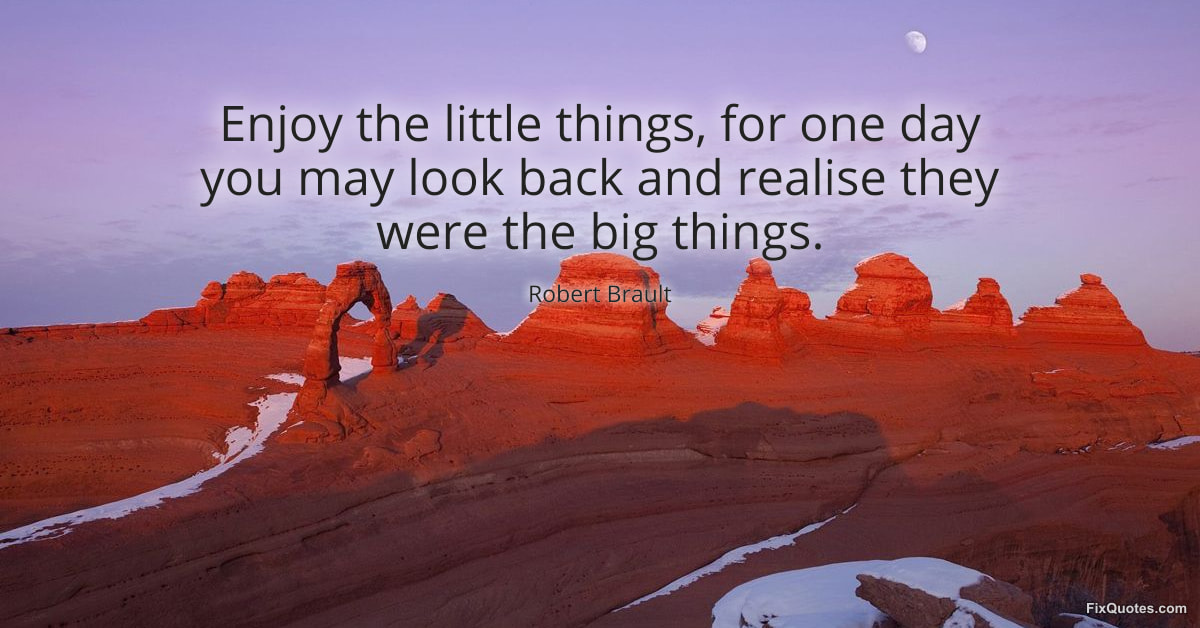
"Enjoy the little things, for one day you may look back and realise they were the big things"
About this Quote
The subtext is a rebuke to our default budgeting of attention. We act as if meaning arrives in scheduled packages: promotions, weddings, graduations, the clean narrative beats. Brault implies that those moments are often just loud, not large. The “little things” are small only because they’re frequent, domestic, and unbranded: morning light, a friend’s dumb joke, a parent’s habitual question. They don’t announce themselves as capital-M Meaning, so they’re easy to spend thoughtlessly.
Contextually, this is late-modern philosophy in plain clothes: a mindfulness ethic without incense, an anti-hustle manifesto without naming an enemy. Its softness is tactical. By avoiding specifics, it can sit on a fridge magnet or in a eulogy, which is exactly the point: the line wants to ambush you in ordinary life, where the “big things” are supposedly not happening.
Quote Details
| Topic | Live in the Moment |
|---|---|
| Source | Help us find the source |
| Cite |
Citation Formats
APA Style (7th ed.)
Brault, Robert. (2026, January 11). Enjoy the little things, for one day you may look back and realise they were the big things. FixQuotes. https://fixquotes.com/quotes/enjoy-the-little-things-for-one-day-you-may-look-183917/
Chicago Style
Brault, Robert. "Enjoy the little things, for one day you may look back and realise they were the big things." FixQuotes. January 11, 2026. https://fixquotes.com/quotes/enjoy-the-little-things-for-one-day-you-may-look-183917/.
MLA Style (9th ed.)
"Enjoy the little things, for one day you may look back and realise they were the big things." FixQuotes, 11 Jan. 2026, https://fixquotes.com/quotes/enjoy-the-little-things-for-one-day-you-may-look-183917/. Accessed 27 Mar. 2026.