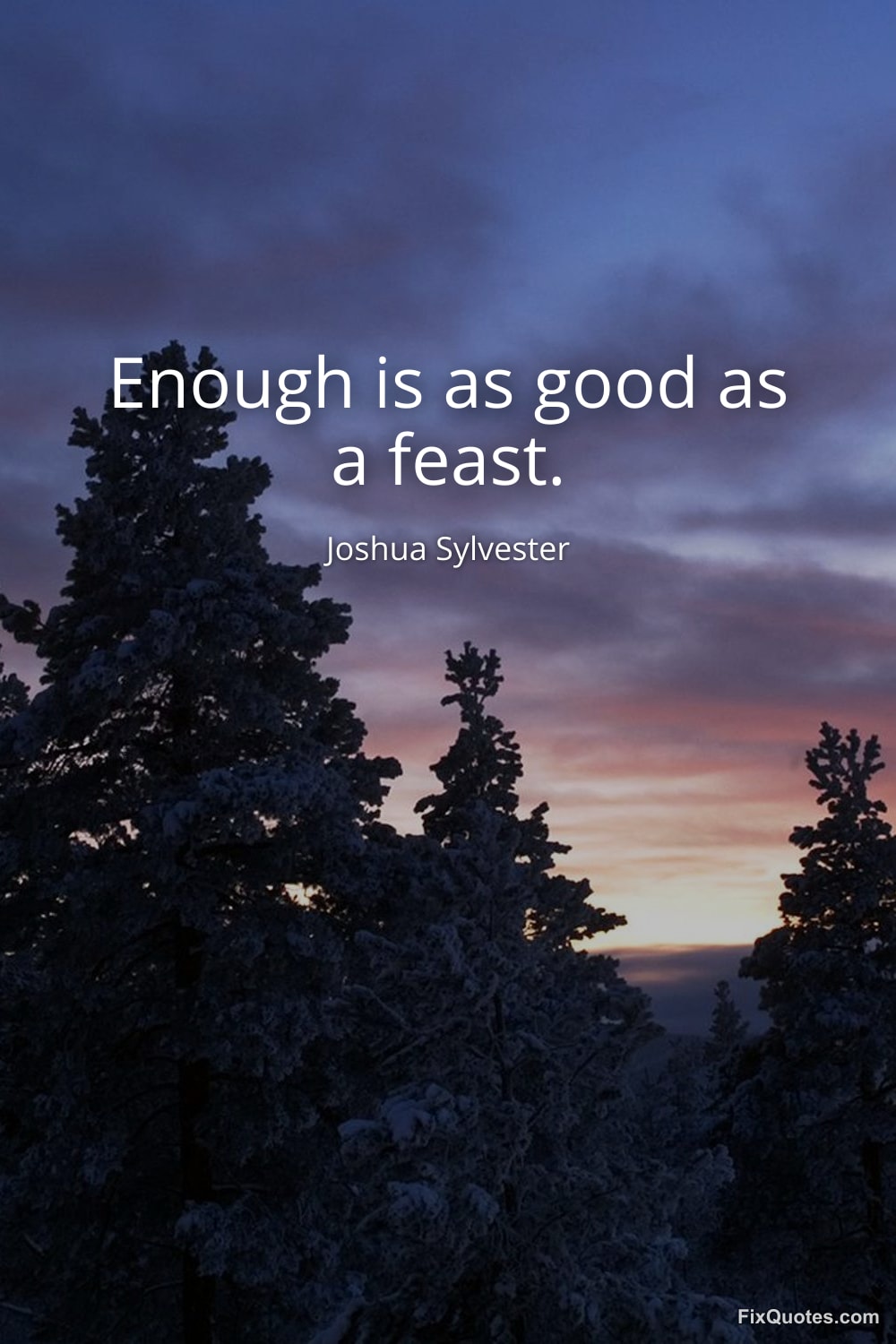
"Enough is as good as a feast"
About this Quote
A feast is the obvious fantasy: abundance, spectacle, the table groaning with proof that you have more than you need. Sylvester flips that craving into a moral flex. "Enough is as good as a feast" treats sufficiency not as settling, but as a different kind of richness - the kind that doesn’t make you dependent on the next course. The line works because it’s blunt, balanced, and slightly provocative: it asks readers to downgrade desire without sounding like a scold.
In Sylvester’s world, that matters. As a late Elizabethan/early Jacobean poet and a translator of devout verse (notably Du Bartas), he writes into a Protestant culture that prizes temperance and distrusts the theater of excess. A feast isn’t just food; it’s status, indulgence, and, in moral literature, a trapdoor to vanity and sin. "Enough" becomes a spiritual technology: moderation as insurance against both poverty’s anxiety and wealth’s corruptions.
The subtext is also quietly social. When inequality is structural and patronage culture makes survival contingent on pleasing the powerful, celebrating "enough" can read as consolation for those who will never get the feast. Yet it’s not mere resignation. It’s a redefinition of success away from display and toward autonomy: if you can name your "enough", you stop being easily controlled by appetites - your own or someone else’s. The aphorism’s staying power comes from that double edge: piety and pragmatism, virtue and self-defense, packed into eight plain words.
In Sylvester’s world, that matters. As a late Elizabethan/early Jacobean poet and a translator of devout verse (notably Du Bartas), he writes into a Protestant culture that prizes temperance and distrusts the theater of excess. A feast isn’t just food; it’s status, indulgence, and, in moral literature, a trapdoor to vanity and sin. "Enough" becomes a spiritual technology: moderation as insurance against both poverty’s anxiety and wealth’s corruptions.
The subtext is also quietly social. When inequality is structural and patronage culture makes survival contingent on pleasing the powerful, celebrating "enough" can read as consolation for those who will never get the feast. Yet it’s not mere resignation. It’s a redefinition of success away from display and toward autonomy: if you can name your "enough", you stop being easily controlled by appetites - your own or someone else’s. The aphorism’s staying power comes from that double edge: piety and pragmatism, virtue and self-defense, packed into eight plain words.
Quote Details
| Topic | Contentment |
|---|---|
| Source | Help us find the source |
| Cite |
Citation Formats
APA Style (7th ed.)
Sylvester, Joshua. (2026, January 16). Enough is as good as a feast. FixQuotes. https://fixquotes.com/quotes/enough-is-as-good-as-a-feast-101843/
Chicago Style
Sylvester, Joshua. "Enough is as good as a feast." FixQuotes. January 16, 2026. https://fixquotes.com/quotes/enough-is-as-good-as-a-feast-101843/.
MLA Style (9th ed.)
"Enough is as good as a feast." FixQuotes, 16 Jan. 2026, https://fixquotes.com/quotes/enough-is-as-good-as-a-feast-101843/. Accessed 7 Mar. 2026.
More Quotes by Joshua
Add to List