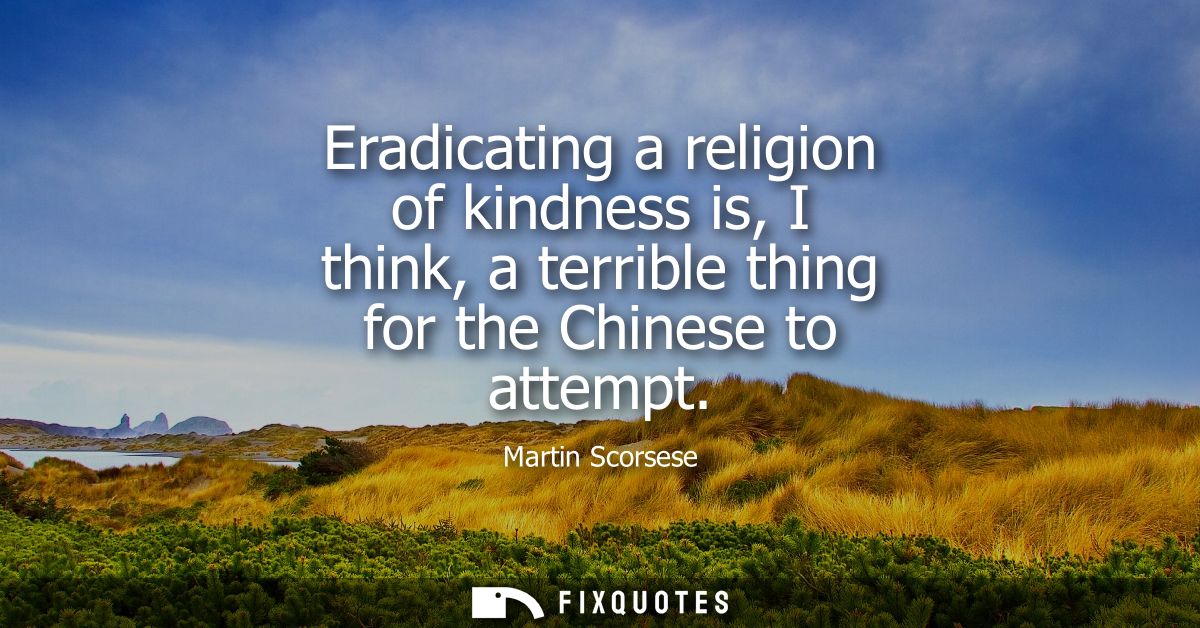
"Eradicating a religion of kindness is, I think, a terrible thing for the Chinese to attempt"
About this Quote
The intent is twofold. On the surface, he’s condemning religious persecution in China (often read in relation to Tibetan Buddhism or Christianity, depending on the conversation). Underneath, he’s defending the idea that spiritual traditions can function as cultural immune systems: they teach restraint, compassion, and limits on power, which is precisely why governments that demand total allegiance find them threatening. The subtext is less “China is bad” than “any state that tries to monopolize meaning will eventually criminalize mercy.”
Context matters because Scorsese isn’t a celebrity dabbling in geopolitics; he’s a director whose films obsess over sin, redemption, and the violence people commit in the name of order. His sensitivity to faith isn’t abstract. It’s cinematic: he understands that when you remove a vocabulary for conscience, you don’t create neutrality - you create a vacuum that power rushes to fill.
Quote Details
| Topic | Human Rights |
|---|---|
| Source | Help us find the source |
| Cite |
Citation Formats
APA Style (7th ed.)
Scorsese, Martin. (2026, January 17). Eradicating a religion of kindness is, I think, a terrible thing for the Chinese to attempt. FixQuotes. https://fixquotes.com/quotes/eradicating-a-religion-of-kindness-is-i-think-a-24092/
Chicago Style
Scorsese, Martin. "Eradicating a religion of kindness is, I think, a terrible thing for the Chinese to attempt." FixQuotes. January 17, 2026. https://fixquotes.com/quotes/eradicating-a-religion-of-kindness-is-i-think-a-24092/.
MLA Style (9th ed.)
"Eradicating a religion of kindness is, I think, a terrible thing for the Chinese to attempt." FixQuotes, 17 Jan. 2026, https://fixquotes.com/quotes/eradicating-a-religion-of-kindness-is-i-think-a-24092/. Accessed 30 Mar. 2026.