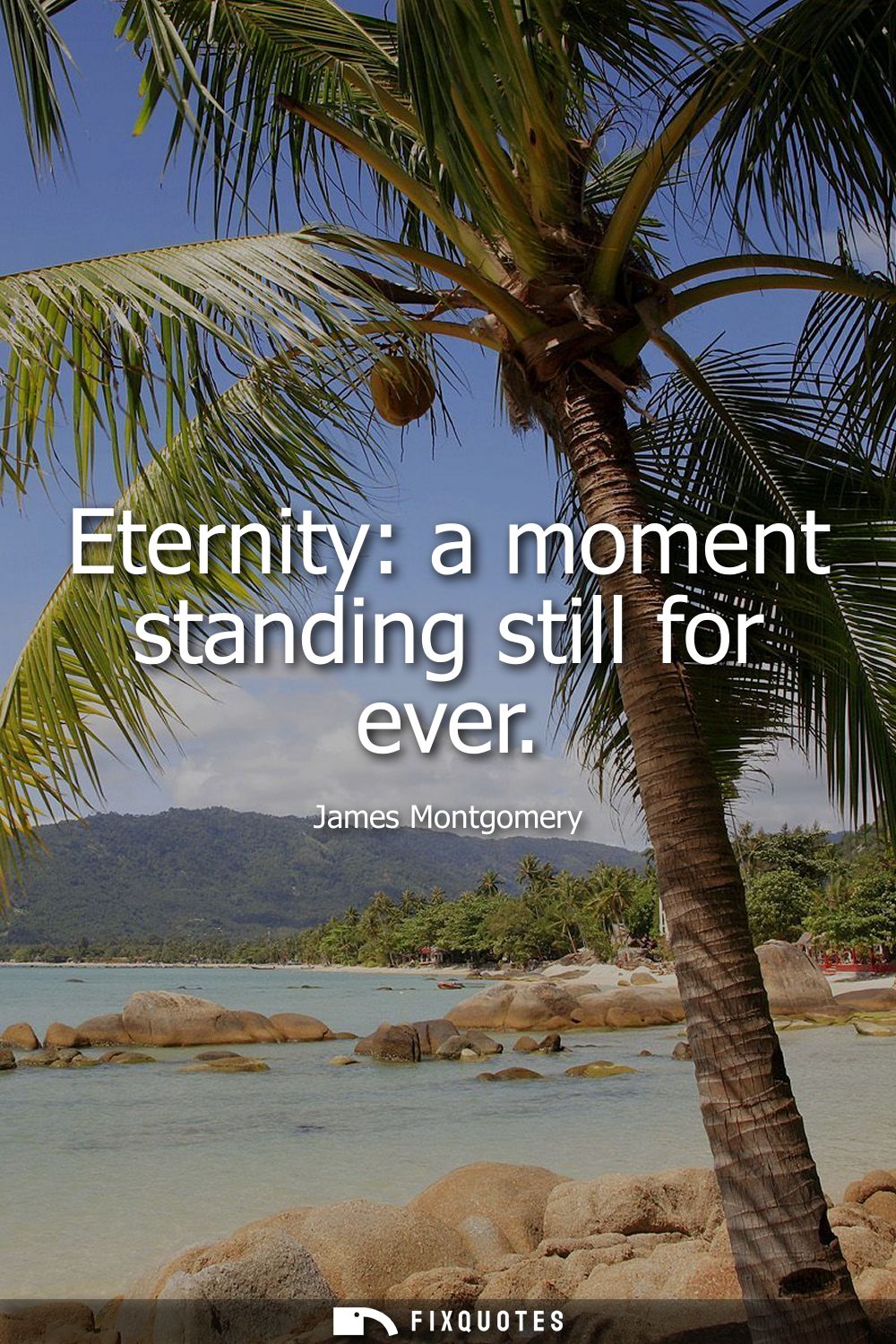
"Eternity: a moment standing still for ever"
About this Quote
Montgomery’s “Eternity: a moment standing still for ever” compresses theology into a single optical illusion. Eternity isn’t presented as an endless corridor of time - the tired image of “forever” as just more minutes. It’s a freeze-frame: a moment so intensified it stops behaving like time at all. The line works because it yanks the reader out of chronology and into a different register, where duration is less important than density.
As a poet writing in an era steeped in Protestant moral seriousness and Romantic feeling, Montgomery is playing both sides. There’s the devotional promise: eternity as the soul’s arrival, the final settling of accounts, the point where history’s noise drops away. But there’s also a quietly modern psychological insight: our lived experience of “the infinite” often arrives through the finite. Trauma, ecstasy, grief, conversion - each can feel like a single instant that swallows the calendar. By defining eternity as a moment “standing still,” he suggests that the eternal isn’t somewhere else; it’s what happens when perception breaks its normal constraints.
The phrase “for ever” is doing sly double duty. It sounds like reassurance, but it also hints at terror: what if the moment that hardens into eternity is regret, not bliss? That tension gives the line its charge. Montgomery offers a metaphysical definition that doubles as a warning: time isn’t just passing; it’s aiming.
As a poet writing in an era steeped in Protestant moral seriousness and Romantic feeling, Montgomery is playing both sides. There’s the devotional promise: eternity as the soul’s arrival, the final settling of accounts, the point where history’s noise drops away. But there’s also a quietly modern psychological insight: our lived experience of “the infinite” often arrives through the finite. Trauma, ecstasy, grief, conversion - each can feel like a single instant that swallows the calendar. By defining eternity as a moment “standing still,” he suggests that the eternal isn’t somewhere else; it’s what happens when perception breaks its normal constraints.
The phrase “for ever” is doing sly double duty. It sounds like reassurance, but it also hints at terror: what if the moment that hardens into eternity is regret, not bliss? That tension gives the line its charge. Montgomery offers a metaphysical definition that doubles as a warning: time isn’t just passing; it’s aiming.
Quote Details
| Topic | Time |
|---|
More Quotes by James
Add to List