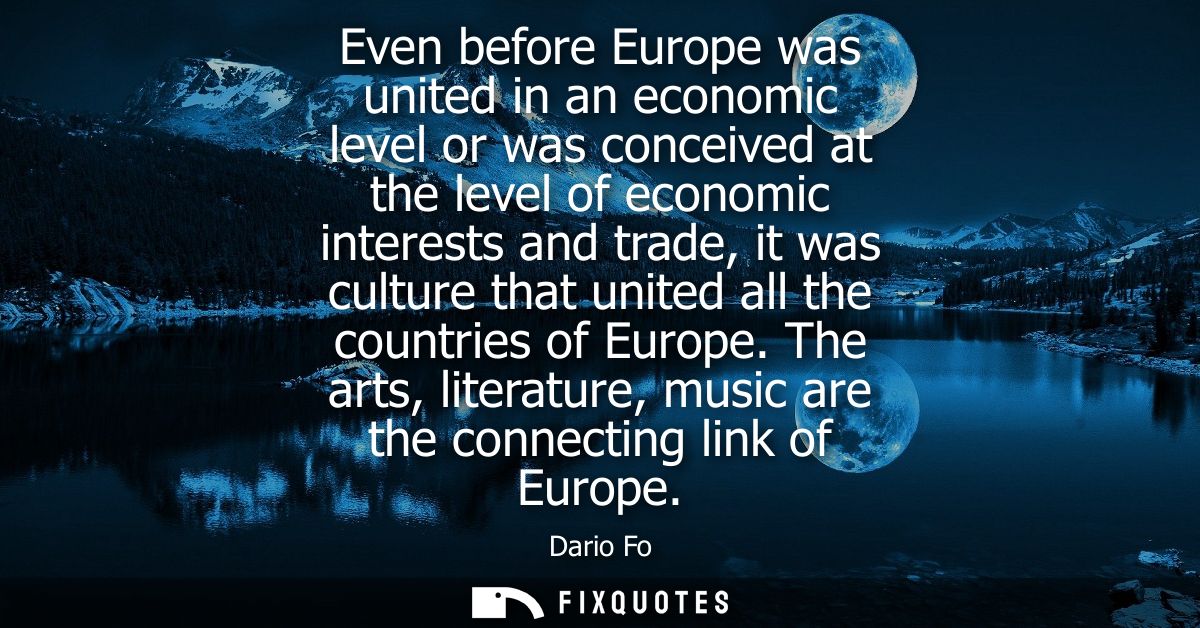
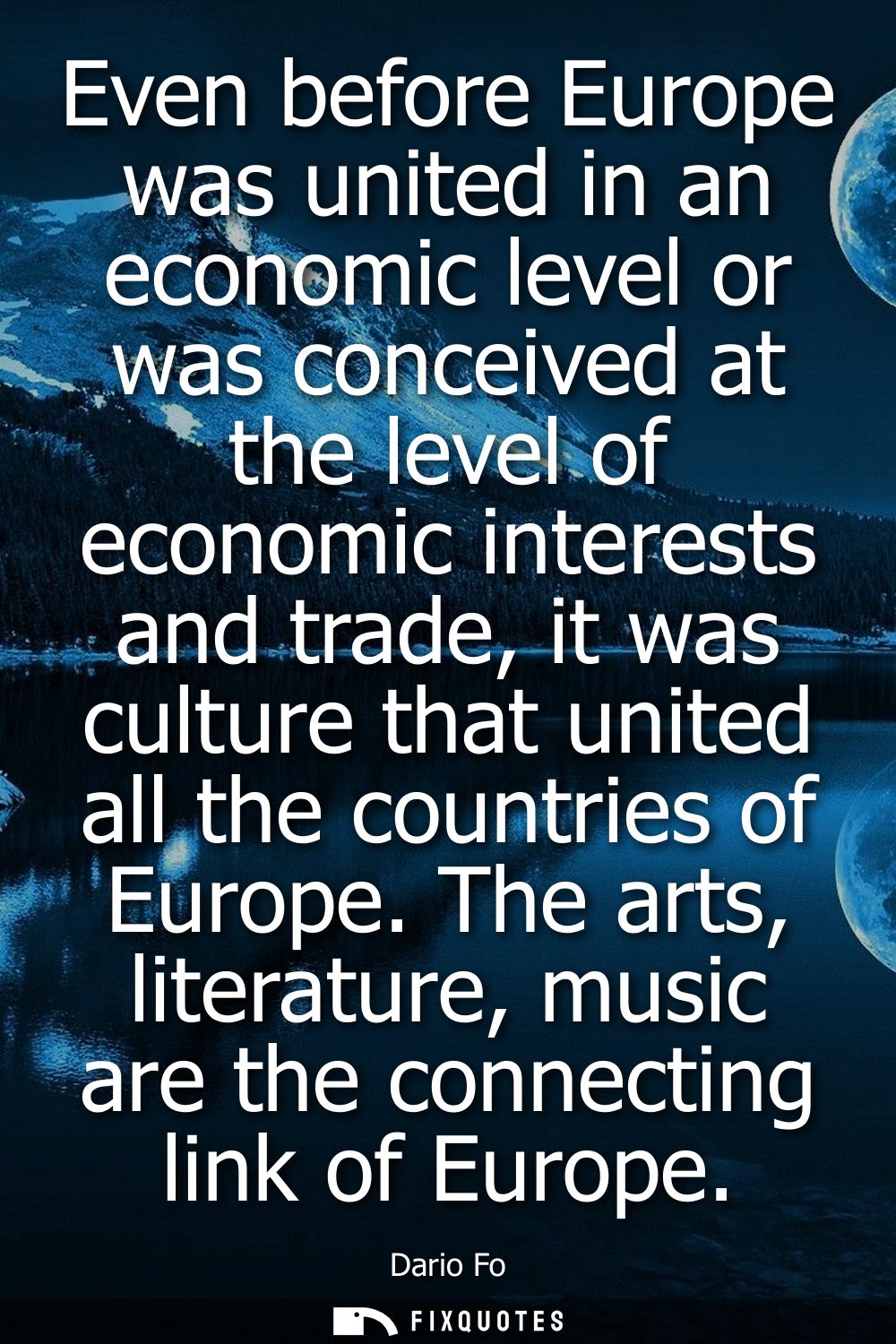
"Even before Europe was united in an economic level or was conceived at the level of economic interests and trade, it was culture that united all the countries of Europe. The arts, literature, music are the connecting link of Europe"
About this Quote
The intent is strategic. By placing culture before commerce, Fo rewrites the origin story of “Europe” away from postwar technocracy and toward a longer, messier lineage of exchange: troubadours crossing borders, novels circulating in translation, musical forms mutating from court to street. It’s a reminder that cultural traffic predates political unity and often survives its breakdowns. Subtext: the EU’s legitimacy problem isn’t just democratic; it’s imaginative. People don’t rally for regulatory harmonization. They rally for belonging, for a shared narrative that doesn’t erase local texture.
Fo’s phrasing carries a sly edge. “Even before” implies that the economic project is late to the party, perhaps even parasitic on a cultural ecosystem it didn’t create. “Connecting link” is deliberately modest, almost mechanical, but it lands like an accusation: culture has been doing the integrative labor all along, while power reduces Europe to “interests and trade.”
Context matters: Fo wrote from Italy, a country both central to Europe’s cultural mythos and frequently positioned as a problem child within Europe’s fiscal morality plays. His claim doubles as a defense against a punitive, accountant-style Europe. Culture isn’t decoration on the union; it’s the only adhesive that can outlast crisis.
Quote Details
| Topic | Art |
|---|---|
| Source | Help us find the source |
| Cite |
Citation Formats
APA Style (7th ed.)
Fo, Dario. (2026, January 15). Even before Europe was united in an economic level or was conceived at the level of economic interests and trade, it was culture that united all the countries of Europe. The arts, literature, music are the connecting link of Europe. FixQuotes. https://fixquotes.com/quotes/even-before-europe-was-united-in-an-economic-57658/
Chicago Style
Fo, Dario. "Even before Europe was united in an economic level or was conceived at the level of economic interests and trade, it was culture that united all the countries of Europe. The arts, literature, music are the connecting link of Europe." FixQuotes. January 15, 2026. https://fixquotes.com/quotes/even-before-europe-was-united-in-an-economic-57658/.
MLA Style (9th ed.)
"Even before Europe was united in an economic level or was conceived at the level of economic interests and trade, it was culture that united all the countries of Europe. The arts, literature, music are the connecting link of Europe." FixQuotes, 15 Jan. 2026, https://fixquotes.com/quotes/even-before-europe-was-united-in-an-economic-57658/. Accessed 11 Mar. 2026.