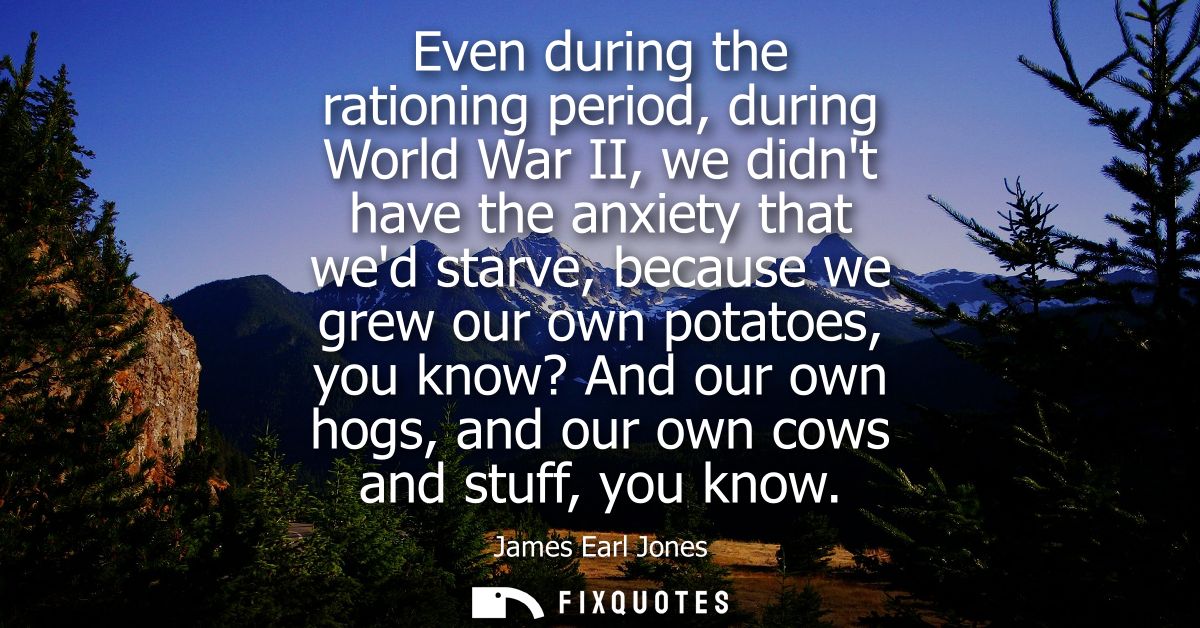
"Even during the rationing period, during World War II, we didn't have the anxiety that we'd starve, because we grew our own potatoes, you know? And our own hogs, and our own cows and stuff, you know"
About this Quote
The subtext is class and geography, smuggled in through potatoes. Rural life could be punishing, but it also offered a kind of insulation from market shocks and bureaucratic scarcity. While urban families stood in lines and watched shelves empty, a household with a garden, livestock, and know-how lived inside a different economy. “Hogs, and our own cows and stuff” lands with almost comic understatement, as if raising animals were just background noise. That casualness is the point: security feels invisible when it’s routine.
Coming from an actor whose voice later became synonymous with authority, the quote’s power is its lack of performance. Jones isn’t narrating WWII as spectacle; he’s measuring it by the presence or absence of dread. It’s an origin story of steadiness: not triumph, not trauma-as-brand, but a grounded account of how material conditions shape the emotions we remember as history.
Quote Details
| Topic | Nostalgia |
|---|---|
| Source | Help us find the source |
| Cite |
Citation Formats
APA Style (7th ed.)
Jones, James Earl. (2026, January 16). Even during the rationing period, during World War II, we didn't have the anxiety that we'd starve, because we grew our own potatoes, you know? And our own hogs, and our own cows and stuff, you know. FixQuotes. https://fixquotes.com/quotes/even-during-the-rationing-period-during-world-war-95430/
Chicago Style
Jones, James Earl. "Even during the rationing period, during World War II, we didn't have the anxiety that we'd starve, because we grew our own potatoes, you know? And our own hogs, and our own cows and stuff, you know." FixQuotes. January 16, 2026. https://fixquotes.com/quotes/even-during-the-rationing-period-during-world-war-95430/.
MLA Style (9th ed.)
"Even during the rationing period, during World War II, we didn't have the anxiety that we'd starve, because we grew our own potatoes, you know? And our own hogs, and our own cows and stuff, you know." FixQuotes, 16 Jan. 2026, https://fixquotes.com/quotes/even-during-the-rationing-period-during-world-war-95430/. Accessed 12 Feb. 2026.