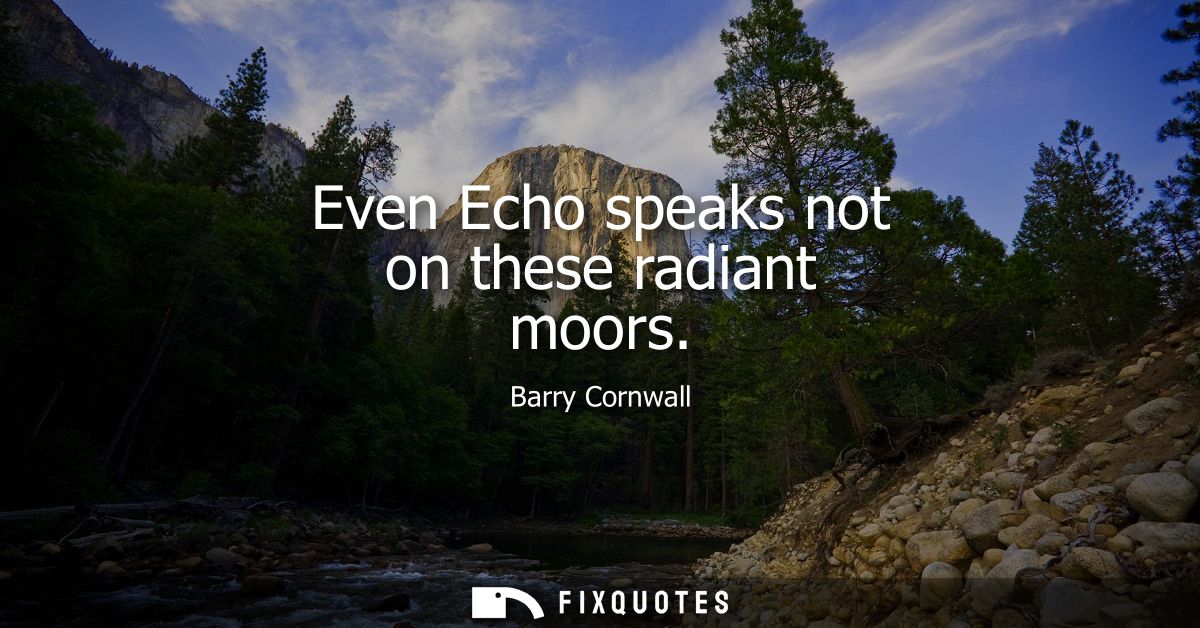
"Even Echo speaks not on these radiant moors"
About this Quote
Silence is doing the heavy lifting here, and Cornwall knows it. “Even Echo speaks not on these radiant moors” takes a landscape that should be alive with return and response and makes it refuse the most basic courtesy of nature: an answer. Echo, the mythic figure condemned to repetition, is practically built for moorland theatrics. If even she won’t “speak,” the quiet isn’t just absence of sound; it’s a moral mood, a hush that feels chosen.
The word “Even” is the pressure point. It implies a hierarchy of expectations: on open moors, where voices carry and emptiness invites call-and-response, Echo is the last thing you’d expect to go missing. Cornwall turns that expectation into a negative revelation. Radiance, in this line, isn’t comfort. It’s glare. The moors are “radiant” in the way grief can be bright at noon: indifferent, almost insulting in its clarity. That clash between visual abundance and acoustic emptiness makes the scene uncanny, as if the world is showing off while refusing to communicate.
As a Romantic-era poet (writing in a period that fetishized wild scenery as emotional instrument), Cornwall is tapping into a familiar device and sharpening it. Nature isn’t mirroring the speaker’s feelings; it’s withholding. The subtext is alienation: a person so cut off that not even the landscape’s built-in mechanism for reply will cooperate. The line lands because it turns a technical phenomenon (echo) into a social one (being answered), then lets the moorland become the ultimate read receipt: seen, not responded to.
The word “Even” is the pressure point. It implies a hierarchy of expectations: on open moors, where voices carry and emptiness invites call-and-response, Echo is the last thing you’d expect to go missing. Cornwall turns that expectation into a negative revelation. Radiance, in this line, isn’t comfort. It’s glare. The moors are “radiant” in the way grief can be bright at noon: indifferent, almost insulting in its clarity. That clash between visual abundance and acoustic emptiness makes the scene uncanny, as if the world is showing off while refusing to communicate.
As a Romantic-era poet (writing in a period that fetishized wild scenery as emotional instrument), Cornwall is tapping into a familiar device and sharpening it. Nature isn’t mirroring the speaker’s feelings; it’s withholding. The subtext is alienation: a person so cut off that not even the landscape’s built-in mechanism for reply will cooperate. The line lands because it turns a technical phenomenon (echo) into a social one (being answered), then lets the moorland become the ultimate read receipt: seen, not responded to.
Quote Details
| Topic | Poetry |
|---|---|
| Source | Help us find the source |
| Cite |
Citation Formats
APA Style (7th ed.)
Cornwall, Barry. (2026, January 16). Even Echo speaks not on these radiant moors. FixQuotes. https://fixquotes.com/quotes/even-echo-speaks-not-on-these-radiant-moors-129965/
Chicago Style
Cornwall, Barry. "Even Echo speaks not on these radiant moors." FixQuotes. January 16, 2026. https://fixquotes.com/quotes/even-echo-speaks-not-on-these-radiant-moors-129965/.
MLA Style (9th ed.)
"Even Echo speaks not on these radiant moors." FixQuotes, 16 Jan. 2026, https://fixquotes.com/quotes/even-echo-speaks-not-on-these-radiant-moors-129965/. Accessed 26 Mar. 2026.
More Quotes by Barry
Add to List