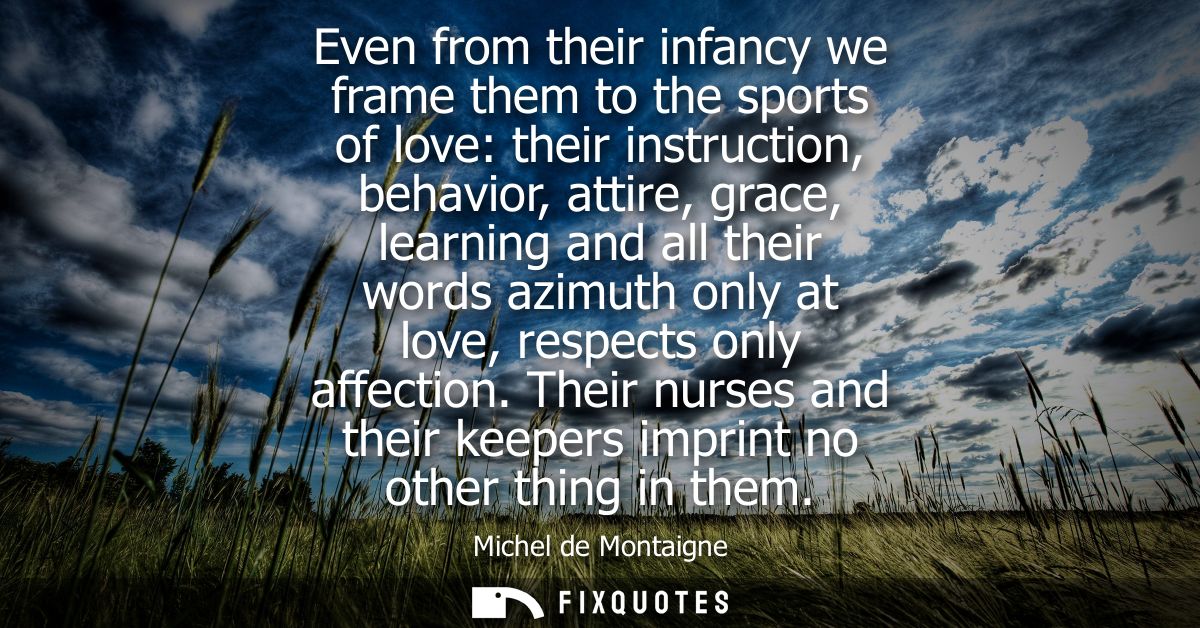
"Even from their infancy we frame them to the sports of love: their instruction, behavior, attire, grace, learning and all their words azimuth only at love, respects only affection. Their nurses and their keepers imprint no other thing in them"
About this Quote
Montaigne isn’t romanticizing love here; he’s exposing it as a curriculum. The “we” is the tell: this isn’t a private feeling bubbling up naturally, but a social project imposed early and relentlessly, especially on girls. From “infancy” onward, everything becomes training for desirability and attachment: instruction, posture, clothing, “grace,” even “learning” is bent into a single aim. The word “frame” does heavy work. It suggests both construction and enclosure: a life built around love and narrowed by it.
What makes the passage sting is its inventory of the mundane. He doesn’t argue abstractly about patriarchy; he points to the everyday mechanisms that do the persuading - nurses, keepers, etiquette, wardrobe, the policing of “behavior.” Montaigne’s rhetorical move is to strip the mystique from “affection” by showing the infrastructure underneath it. Love isn’t just an emotion; it’s an outcome engineered by caretakers and customs, repeated until it feels like nature.
The subtext is skeptical in a way that feels startlingly current: if you aim every “word” toward love, you don’t simply encourage romance - you preempt other possible selves. Ambition, intellectual independence, pleasure not tethered to approval: these become extracurriculars at best. In Montaigne’s 16th-century world, marriage and courtship were central to women’s security and a family’s standing, so the training had real stakes. His critique lands because it recognizes how power hides in tenderness: the warm hands of “nurses” also shape the script.
What makes the passage sting is its inventory of the mundane. He doesn’t argue abstractly about patriarchy; he points to the everyday mechanisms that do the persuading - nurses, keepers, etiquette, wardrobe, the policing of “behavior.” Montaigne’s rhetorical move is to strip the mystique from “affection” by showing the infrastructure underneath it. Love isn’t just an emotion; it’s an outcome engineered by caretakers and customs, repeated until it feels like nature.
The subtext is skeptical in a way that feels startlingly current: if you aim every “word” toward love, you don’t simply encourage romance - you preempt other possible selves. Ambition, intellectual independence, pleasure not tethered to approval: these become extracurriculars at best. In Montaigne’s 16th-century world, marriage and courtship were central to women’s security and a family’s standing, so the training had real stakes. His critique lands because it recognizes how power hides in tenderness: the warm hands of “nurses” also shape the script.
Quote Details
| Topic | Parenting |
|---|
More Quotes by Michel
Add to List