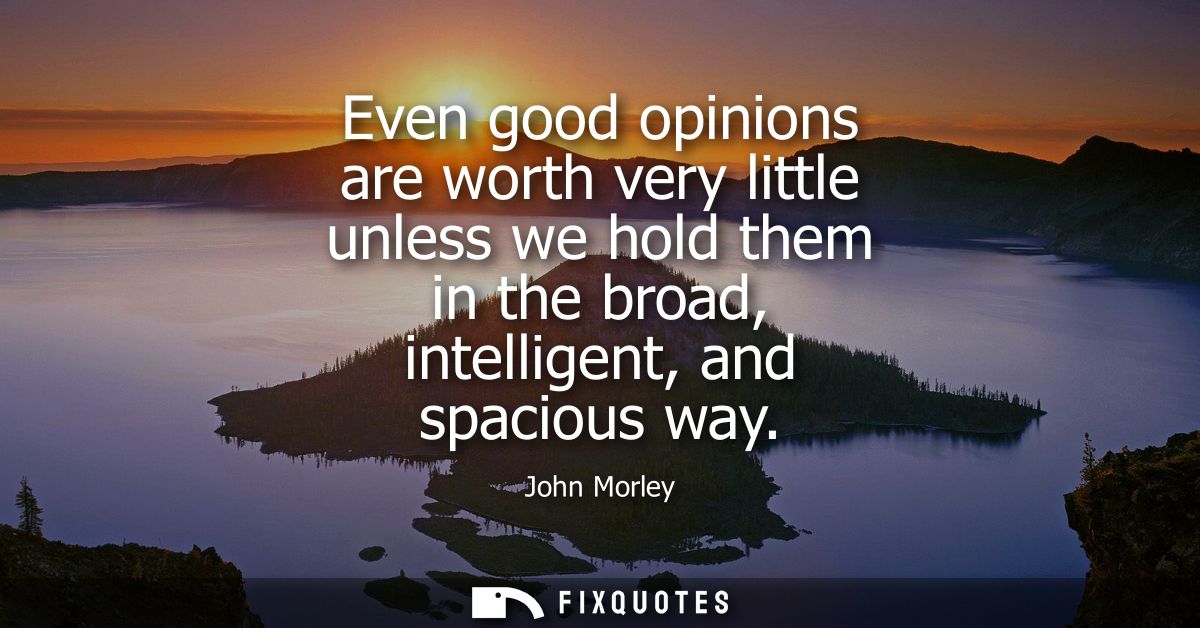
"Even good opinions are worth very little unless we hold them in the broad, intelligent, and spacious way"
About this Quote
The sentence works by shifting the burden from content to posture. “Good opinions” flatters the reader for having the correct view, then immediately strips that comfort away: correctness without “broad, intelligent, and spacious” holding is “worth very little.” The subtext is that opinions aren’t just private convictions; they are social forces. Held tightly, even admirable beliefs turn into pretexts for cruelty, censorship, or moral vanity. Held spaciously, they become something closer to judgment: the ability to weigh competing goods, recognize tradeoffs, and stay alert to new facts without collapsing into cynicism.
Morley’s triad matters. “Broad” suggests range and tolerance, “intelligent” demands rigor rather than vibes, “spacious” implies an inner architecture roomy enough for complexity, doubt, and the humanity of opponents. In the late-19th-century liberal tradition Morley inhabited, that’s a defense of pluralism under pressure: empire, class conflict, religious fracture. The line quietly insists that the health of public life depends less on who has the “right” opinions and more on who can carry them without shrinking the world.
Quote Details
| Topic | Wisdom |
|---|---|
| Source | Help us find the source |
| Cite |
Citation Formats
APA Style (7th ed.)
Morley, John. (2026, January 18). Even good opinions are worth very little unless we hold them in the broad, intelligent, and spacious way. FixQuotes. https://fixquotes.com/quotes/even-good-opinions-are-worth-very-little-unless-4755/
Chicago Style
Morley, John. "Even good opinions are worth very little unless we hold them in the broad, intelligent, and spacious way." FixQuotes. January 18, 2026. https://fixquotes.com/quotes/even-good-opinions-are-worth-very-little-unless-4755/.
MLA Style (9th ed.)
"Even good opinions are worth very little unless we hold them in the broad, intelligent, and spacious way." FixQuotes, 18 Jan. 2026, https://fixquotes.com/quotes/even-good-opinions-are-worth-very-little-unless-4755/. Accessed 9 Mar. 2026.