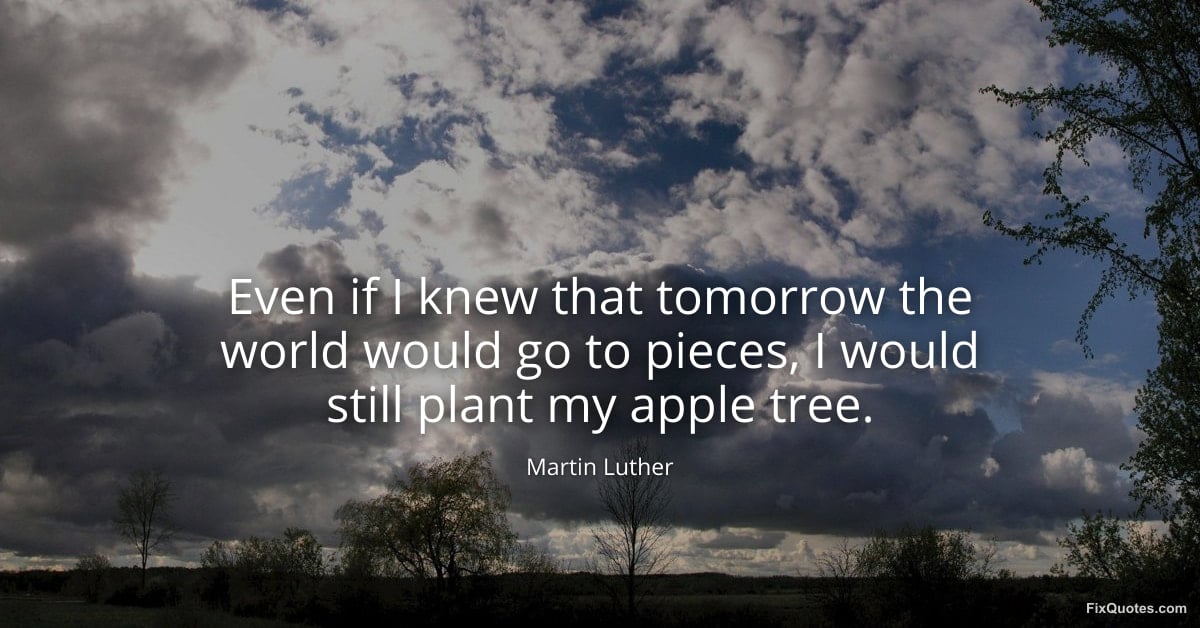
"Even if I knew that tomorrow the world would go to pieces, I would still plant my apple tree"
About this Quote
The subtext is theological without sounding pious: faith is not a bet on outcomes. It’s fidelity under uncertainty. Planting an apple tree is slow work, a wager on time you may not have. Precisely because it’s “wasted” in the apocalypse scenario, it becomes pure intention - a protest against panic, despair, and the fashionable pose of cynicism. In other words: if your ethics only function when the future looks bright, they’re not ethics, they’re optimism.
Context matters because Luther was writing and preaching in an era that felt, to many Europeans, end-times adjacent: plague, peasant revolts, religious schism, war. Whether the sentence is authentically his is debated, but the spirit matches his larger project: relocate holiness from monasteries and grand gestures to daily labor done responsibly. The apple tree is vocation made visible - a small, concrete defiance that turns looming catastrophe into a reason to practice steadiness, not surrender.
Quote Details
| Topic | Faith |
|---|---|
| Source | Help us find the source |
| Cite |
Citation Formats
APA Style (7th ed.)
Luther, Martin. (2026, January 14). Even if I knew that tomorrow the world would go to pieces, I would still plant my apple tree. FixQuotes. https://fixquotes.com/quotes/even-if-i-knew-that-tomorrow-the-world-would-go-18333/
Chicago Style
Luther, Martin. "Even if I knew that tomorrow the world would go to pieces, I would still plant my apple tree." FixQuotes. January 14, 2026. https://fixquotes.com/quotes/even-if-i-knew-that-tomorrow-the-world-would-go-18333/.
MLA Style (9th ed.)
"Even if I knew that tomorrow the world would go to pieces, I would still plant my apple tree." FixQuotes, 14 Jan. 2026, https://fixquotes.com/quotes/even-if-i-knew-that-tomorrow-the-world-would-go-18333/. Accessed 11 Feb. 2026.