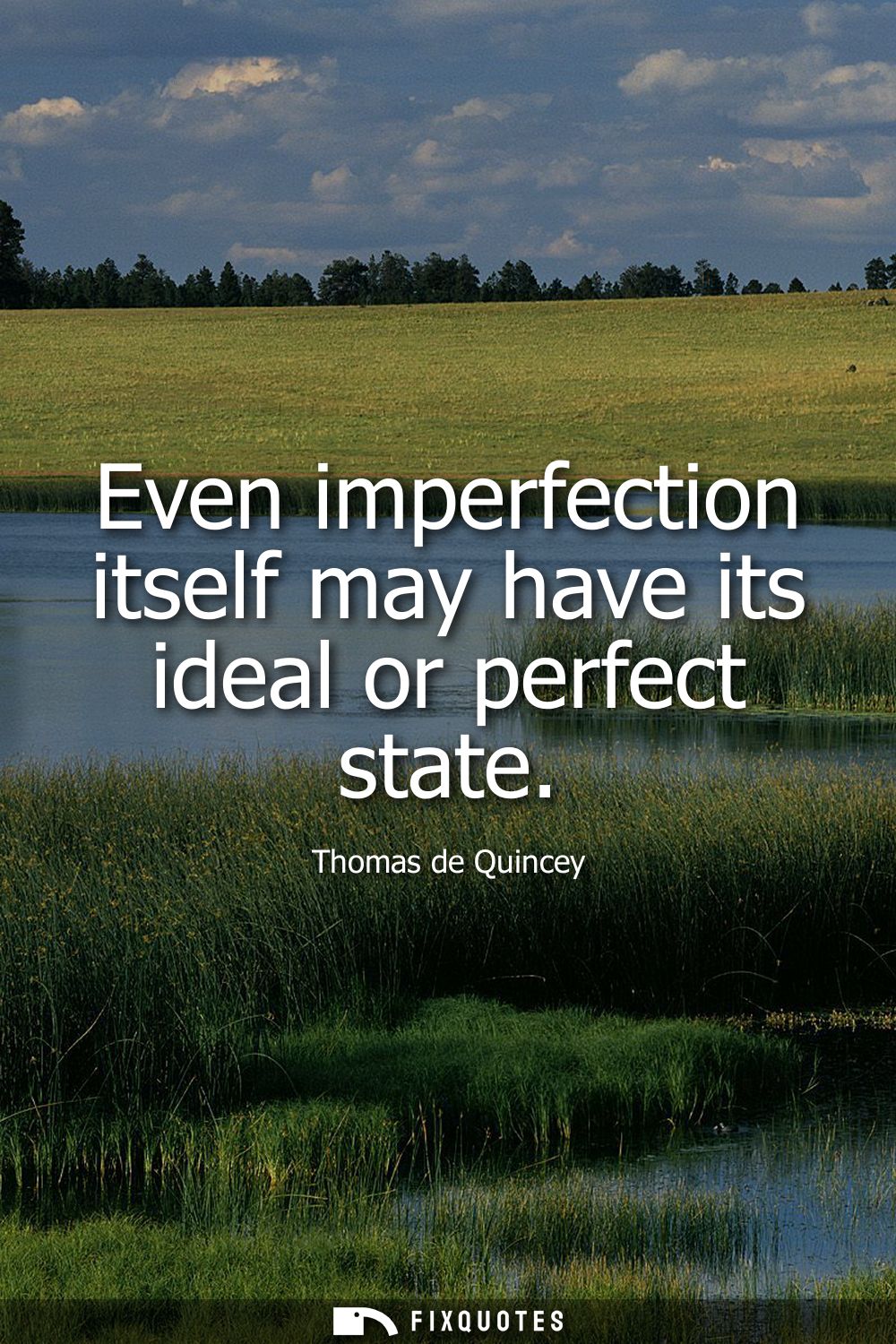
"Even imperfection itself may have its ideal or perfect state"
About this Quote
De Quincey’s line is a small philosophical blade: it cuts the reader away from the comforting idea that “perfect” and “imperfect” are opposites. Instead, he suggests they’re categories we manufacture, and that even the flawed can be judged by an internal standard. The trick is in the double move: “imperfection itself” becomes a thing with its own structure, almost a design principle. He isn’t pardoning mistakes; he’s elevating them into a system.
That’s very Romantic-era, but with De Quincey’s particular tincture of psychological realism. Writing in a culture obsessed with ideals - aesthetic, moral, spiritual - he nudges the conversation toward something more unsettling: what if the messy parts of human life have their own optimal form? Not “fixed,” not “redeemed,” but fully realized as imperfection. It’s the difference between a cracked vase that can’t be repaired and a cracked vase whose crack becomes the defining feature of its beauty.
The subtext lands hardest as a comment on taste and judgment. If even imperfection has an “ideal state,” then criticism isn’t simply measuring art or character against purity; it’s asking whether the flaw is coherent, expressive, truthful. De Quincey, who wrote with intimate knowledge of compulsion and altered states, implies a world where deviations aren’t random embarrassments but patterned experiences. The line turns moral panic into analysis: not “why are you broken?” but “what shape does your brokenness take when it’s most itself?”
That’s very Romantic-era, but with De Quincey’s particular tincture of psychological realism. Writing in a culture obsessed with ideals - aesthetic, moral, spiritual - he nudges the conversation toward something more unsettling: what if the messy parts of human life have their own optimal form? Not “fixed,” not “redeemed,” but fully realized as imperfection. It’s the difference between a cracked vase that can’t be repaired and a cracked vase whose crack becomes the defining feature of its beauty.
The subtext lands hardest as a comment on taste and judgment. If even imperfection has an “ideal state,” then criticism isn’t simply measuring art or character against purity; it’s asking whether the flaw is coherent, expressive, truthful. De Quincey, who wrote with intimate knowledge of compulsion and altered states, implies a world where deviations aren’t random embarrassments but patterned experiences. The line turns moral panic into analysis: not “why are you broken?” but “what shape does your brokenness take when it’s most itself?”
Quote Details
| Topic | Wisdom |
|---|---|
| Source | Help us find the source |
| Cite |
Citation Formats
APA Style (7th ed.)
Quincey, Thomas de. (2026, January 15). Even imperfection itself may have its ideal or perfect state. FixQuotes. https://fixquotes.com/quotes/even-imperfection-itself-may-have-its-ideal-or-105411/
Chicago Style
Quincey, Thomas de. "Even imperfection itself may have its ideal or perfect state." FixQuotes. January 15, 2026. https://fixquotes.com/quotes/even-imperfection-itself-may-have-its-ideal-or-105411/.
MLA Style (9th ed.)
"Even imperfection itself may have its ideal or perfect state." FixQuotes, 15 Jan. 2026, https://fixquotes.com/quotes/even-imperfection-itself-may-have-its-ideal-or-105411/. Accessed 13 Feb. 2026.
More Quotes by Thomas
Add to List