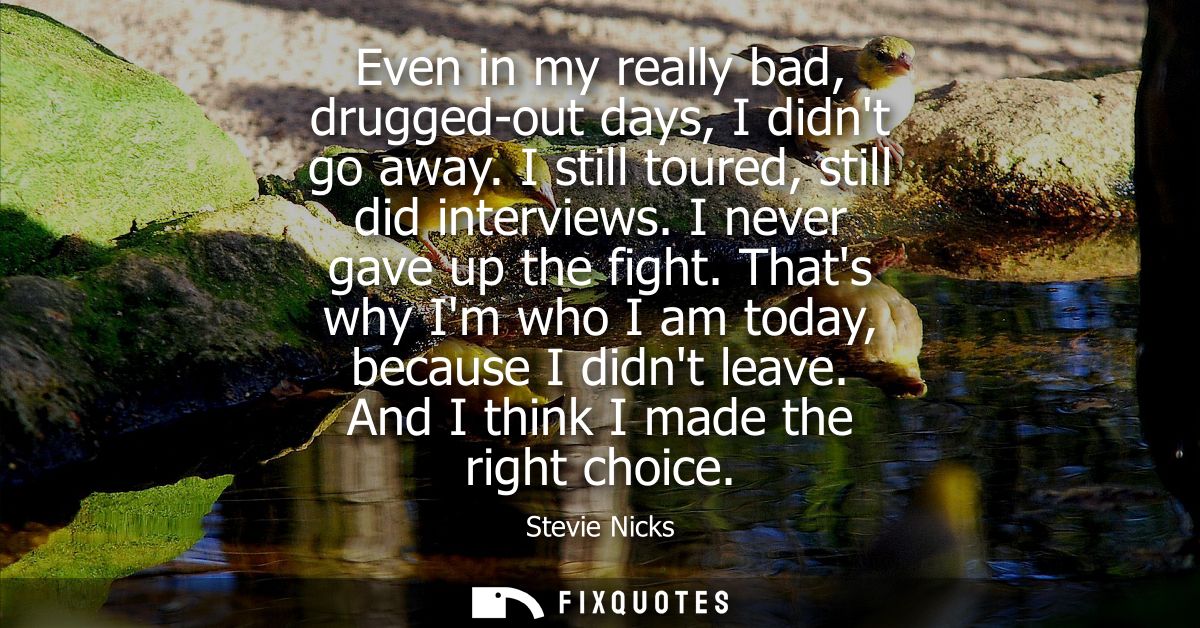
"Even in my really bad, drugged-out days, I didn't go away. I still toured, still did interviews. I never gave up the fight. That's why I'm who I am today, because I didn't leave. And I think I made the right choice"
About this Quote
Stevie Nicks frames survival as a kind of stubborn stagecraft: not the glamorous myth of the rock star who burns out, but the unromantic choice to keep showing up. The line “I didn’t go away” lands like a rebuttal to the industry’s favorite narrative arc, where women either disappear, get reinvented by someone else, or are politely archived as “troubled.” Nicks claims continuity. She wasn’t rescued; she stayed present long enough to become undeniable.
The subtext is an argument about agency inside chaos. “Drugged-out days” is blunt, almost anti-poetic for an artist synonymous with mystique. That plainness does two things: it strips away the romanticizing of addiction, and it refuses the confessional posture that asks for absolution. Instead, she emphasizes labor: touring, interviews, the grind of public life. It’s a reminder that for a working musician, even self-destruction can’t fully cancel the obligations. The “fight” she names isn’t only against substances; it’s against erasure, against being written off as unreliable, against the machine that keeps rolling whether you’re well or not.
Context matters: Nicks came up in an era that commodified her persona while policing her autonomy. To “leave” would have meant surrendering authorship of her own story to tabloids, band politics, and a culture eager to turn complicated women into cautionary tales. “I made the right choice” is less self-congratulation than a stake in the ground: presence is power, and endurance can be its own kind of artistry.
The subtext is an argument about agency inside chaos. “Drugged-out days” is blunt, almost anti-poetic for an artist synonymous with mystique. That plainness does two things: it strips away the romanticizing of addiction, and it refuses the confessional posture that asks for absolution. Instead, she emphasizes labor: touring, interviews, the grind of public life. It’s a reminder that for a working musician, even self-destruction can’t fully cancel the obligations. The “fight” she names isn’t only against substances; it’s against erasure, against being written off as unreliable, against the machine that keeps rolling whether you’re well or not.
Context matters: Nicks came up in an era that commodified her persona while policing her autonomy. To “leave” would have meant surrendering authorship of her own story to tabloids, band politics, and a culture eager to turn complicated women into cautionary tales. “I made the right choice” is less self-congratulation than a stake in the ground: presence is power, and endurance can be its own kind of artistry.
Quote Details
| Topic | Never Give Up |
|---|
More Quotes by Stevie
Add to List