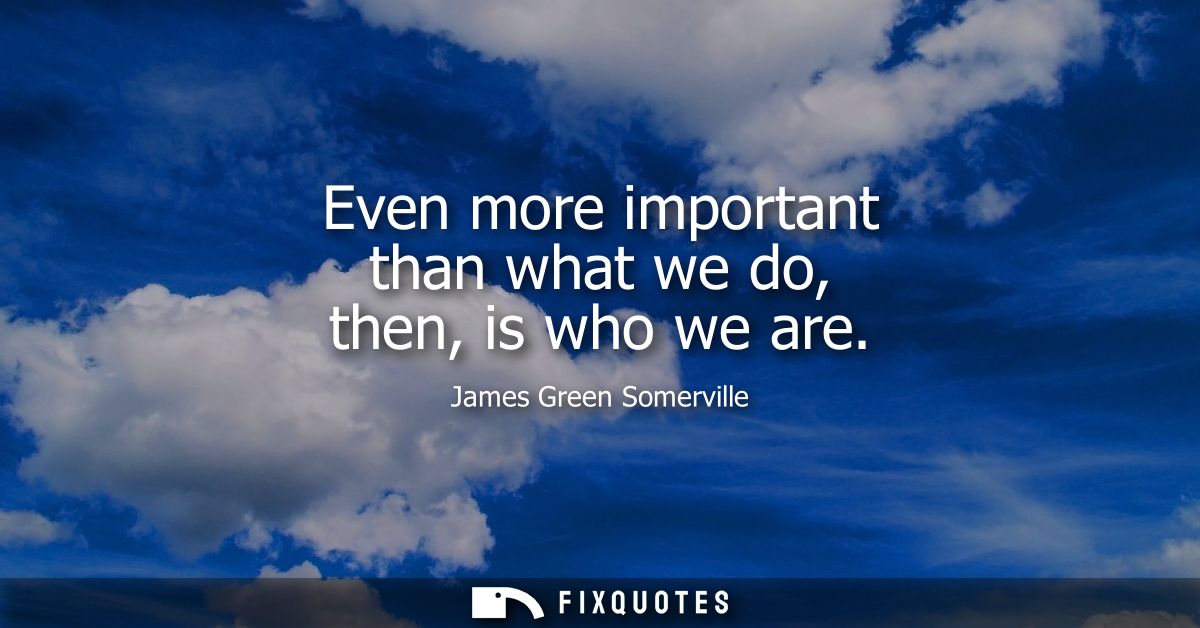
"Even more important than what we do, then, is who we are"
About this Quote
Somerville’s line is a quiet rebuke to the modern obsession with output. It doesn’t deny the value of action; it demotes it. “Even more important” concedes that what we do matters, then pivots to the more volatile claim: identity is the real moral ledger. That’s a provocative hierarchy in a culture that loves measurable wins, resumable achievements, and the clean arithmetic of productivity.
The subtext is about integrity under pressure. Actions can be strategic, performative, even accidental; “who we are” implies the inner architecture that produces those actions when nobody is watching. It’s also a warning about the seductive alibi of good deeds. People can do commendable things for ugly reasons, or do mediocre things for principled ones; Somerville is telling you where the truth leaks out. The line invites a more uncomfortable audit: not “Did I succeed?” but “What kind of person did this success require me to become?”
Contextually, the phrasing feels shaped by a moral-literary tradition that prizes character over spectacle: a writerly compression of the old distinction between virtue and reputation. The sentence structure does the work. The “then” suggests this is a conclusion reached after argument, not a slogan. The plain diction (“what we do,” “who we are”) reads almost biblical in its simplicity, which is precisely how it smuggles in its radical demand: stop hiding behind the busywork of being seen as good, and start wrestling with the harder project of being good.
The subtext is about integrity under pressure. Actions can be strategic, performative, even accidental; “who we are” implies the inner architecture that produces those actions when nobody is watching. It’s also a warning about the seductive alibi of good deeds. People can do commendable things for ugly reasons, or do mediocre things for principled ones; Somerville is telling you where the truth leaks out. The line invites a more uncomfortable audit: not “Did I succeed?” but “What kind of person did this success require me to become?”
Contextually, the phrasing feels shaped by a moral-literary tradition that prizes character over spectacle: a writerly compression of the old distinction between virtue and reputation. The sentence structure does the work. The “then” suggests this is a conclusion reached after argument, not a slogan. The plain diction (“what we do,” “who we are”) reads almost biblical in its simplicity, which is precisely how it smuggles in its radical demand: stop hiding behind the busywork of being seen as good, and start wrestling with the harder project of being good.
Quote Details
| Topic | Honesty & Integrity |
|---|---|
| Source | Help us find the source |
| Cite |
Citation Formats
APA Style (7th ed.)
Somerville, James Green. (2026, January 15). Even more important than what we do, then, is who we are. FixQuotes. https://fixquotes.com/quotes/even-more-important-than-what-we-do-then-is-who-167655/
Chicago Style
Somerville, James Green. "Even more important than what we do, then, is who we are." FixQuotes. January 15, 2026. https://fixquotes.com/quotes/even-more-important-than-what-we-do-then-is-who-167655/.
MLA Style (9th ed.)
"Even more important than what we do, then, is who we are." FixQuotes, 15 Jan. 2026, https://fixquotes.com/quotes/even-more-important-than-what-we-do-then-is-who-167655/. Accessed 8 Mar. 2026.
More Quotes by James
Add to List