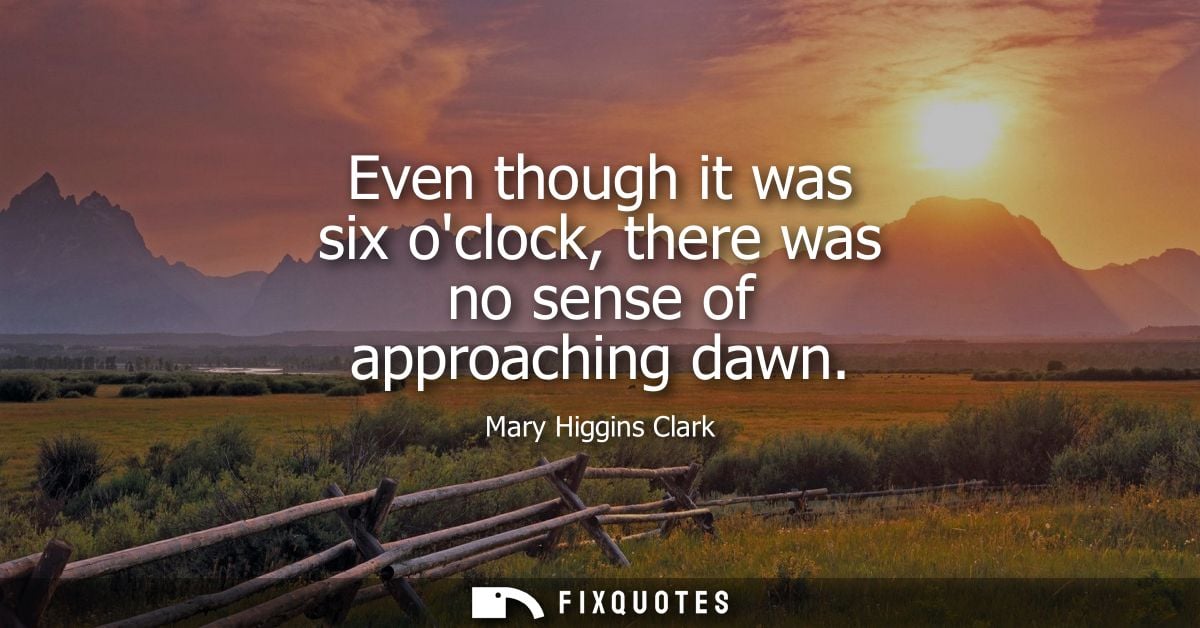
"Even though it was six o'clock, there was no sense of approaching dawn"
About this Quote
That move is classic suspense craft. Clark takes a neutral detail and turns it into an omen. The subtext is that the normal rules are suspended: if dawn won't arrive when it should, what else won't? It quietly infantilizes the reader, too, returning us to the primal fear that darkness can be endless, that the world can simply fail to reset.
The phrasing also does something slyly modern. We live by metrics: timestamps, calendars, notifications. Clark suggests that data is not experience. Six o'clock can be true on paper while the body still feels trapped at 2 a.m. It mirrors the way dread stretches time, how anxiety makes minutes viscous, how grief can freeze a room regardless of what the sun is doing outside.
In context, it reads like an opening shot or a scene transition engineered to keep the audience off-balance. Clark isn't describing weather; she's establishing a moral climate: a world where reassurance arrives late, if it arrives at all.
Quote Details
| Topic | Good Morning |
|---|---|
| Source | Help us find the source |
| Cite |
Citation Formats
APA Style (7th ed.)
Clark, Mary Higgins. (2026, January 16). Even though it was six o'clock, there was no sense of approaching dawn. FixQuotes. https://fixquotes.com/quotes/even-though-it-was-six-oclock-there-was-no-sense-93312/
Chicago Style
Clark, Mary Higgins. "Even though it was six o'clock, there was no sense of approaching dawn." FixQuotes. January 16, 2026. https://fixquotes.com/quotes/even-though-it-was-six-oclock-there-was-no-sense-93312/.
MLA Style (9th ed.)
"Even though it was six o'clock, there was no sense of approaching dawn." FixQuotes, 16 Jan. 2026, https://fixquotes.com/quotes/even-though-it-was-six-oclock-there-was-no-sense-93312/. Accessed 31 Mar. 2026.