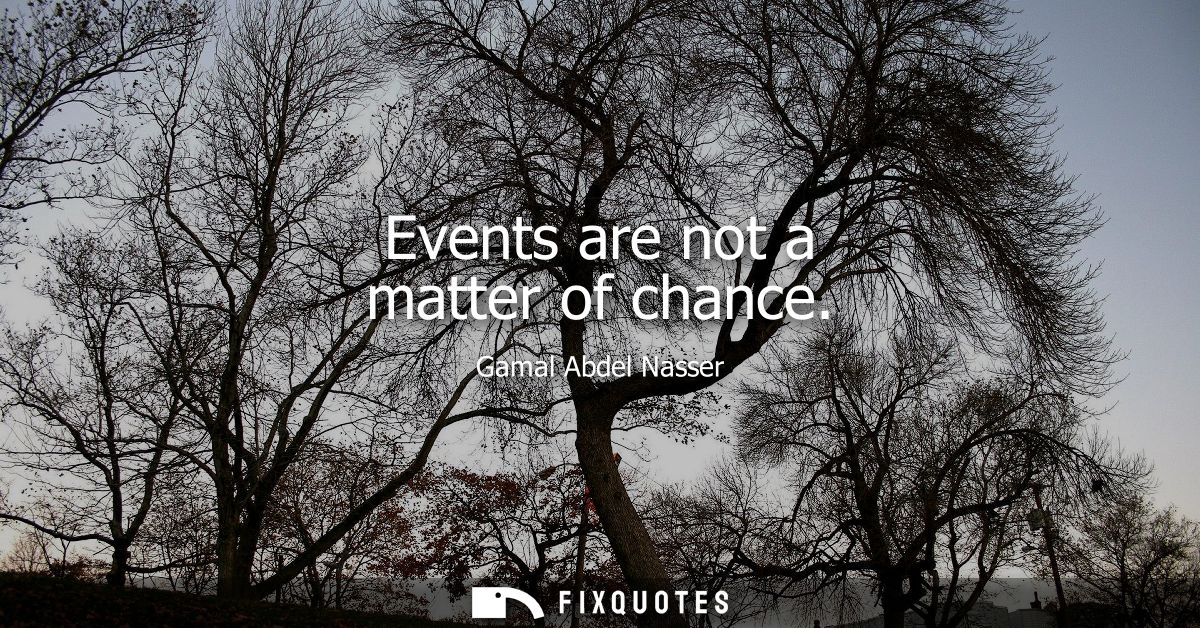
"Events are not a matter of chance"
About this Quote
"Events are not a matter of chance" lands like a warning dressed up as reassurance. Coming from Gamal Abdel Nasser, it’s less a metaphysical claim than a political one: history is made, not merely suffered. The line shrinks the space for accident and enlarges the space for agency, which is exactly what a leader needs when asking a public to accept sacrifice, discipline, or risk. If nothing is random, then setbacks are not humiliations; they are stages in a plan. If nothing is random, then opponents are not just rivals; they are forces to be outmaneuvered.
The subtext is control. Nasser’s charisma worked partly because he spoke in the grammar of inevitability, turning national aspiration into something that sounded like destiny with a timetable. In the post-colonial moment, when Egypt and much of the Arab world were trying to translate rage and pride into statecraft, “chance” is an insulting concept. Colonialism wasn’t a fluke; it had architects. Underdevelopment wasn’t bad luck; it had beneficiaries. Saying events aren’t chance reframes politics as a contest of designs, not moods.
Context sharpens the edge. Nasser’s era was a churn of coups, Cold War pressure, Suez brinkmanship, pan-Arab hopes, and brutal reversals. Determinism here isn’t academic; it’s a survival tool. The risk, of course, is that denying chance can justify coercion: if history is engineered, then dissent becomes sabotage. The line’s power is that it promises meaning in chaos while quietly demanding obedience to the engineer.
The subtext is control. Nasser’s charisma worked partly because he spoke in the grammar of inevitability, turning national aspiration into something that sounded like destiny with a timetable. In the post-colonial moment, when Egypt and much of the Arab world were trying to translate rage and pride into statecraft, “chance” is an insulting concept. Colonialism wasn’t a fluke; it had architects. Underdevelopment wasn’t bad luck; it had beneficiaries. Saying events aren’t chance reframes politics as a contest of designs, not moods.
Context sharpens the edge. Nasser’s era was a churn of coups, Cold War pressure, Suez brinkmanship, pan-Arab hopes, and brutal reversals. Determinism here isn’t academic; it’s a survival tool. The risk, of course, is that denying chance can justify coercion: if history is engineered, then dissent becomes sabotage. The line’s power is that it promises meaning in chaos while quietly demanding obedience to the engineer.
Quote Details
| Topic | Free Will & Fate |
|---|---|
| Source | Help us find the source |
More Quotes by Gamal
Add to List