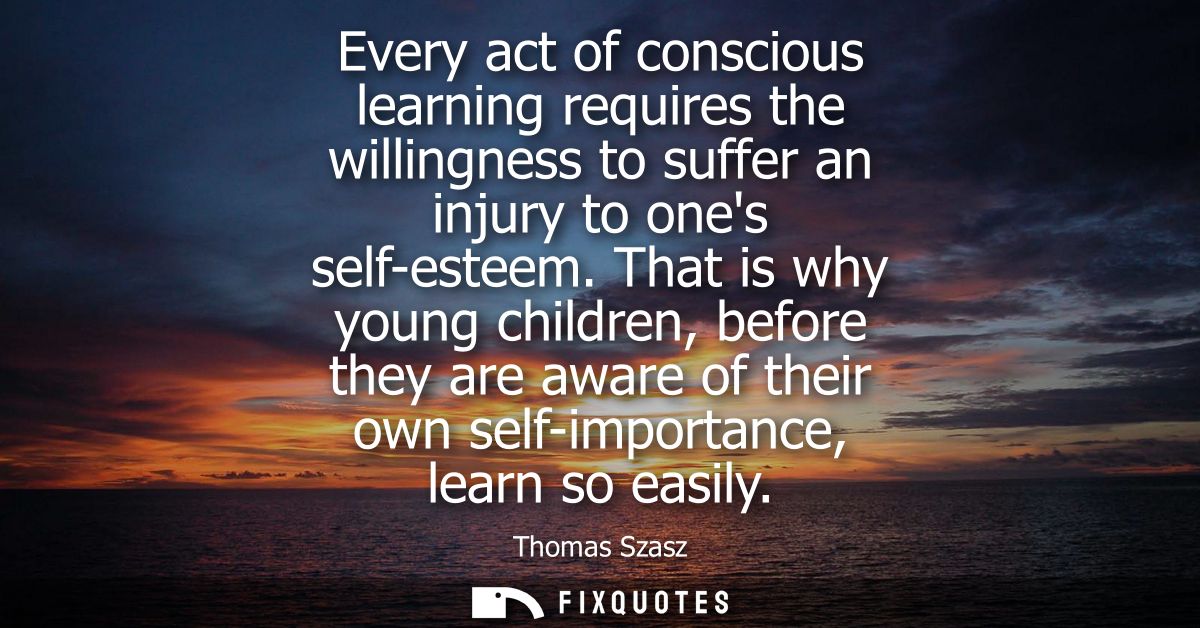
"Every act of conscious learning requires the willingness to suffer an injury to one's self-esteem. That is why young children, before they are aware of their own self-importance, learn so easily"
About this Quote
Learning, Szasz suggests, isn’t just accumulating facts; it’s a controlled humiliation. The line lands because it flips the usual inspirational story of education into something more bodily and bruising: “conscious learning” demands the ego take a hit. You have to admit you’re wrong, slow, confused, unskilled. That momentary collapse of competence is the price of entry, and most adults would rather pay almost anything else.
Szasz’s intent is partly clinical, partly polemical. As a psychiatrist famous for challenging the moral authority of his field, he’s always alert to the ways “expertise” can disguise coercion or self-deception. Here, the coercion is internal: pride polices curiosity. The subtext is that resistance to learning often masquerades as skepticism, sophistication, or “having standards,” when it’s really a protective reflex against shame.
The second sentence sharpens the critique by idealizing the child’s advantage: not innocence, exactly, but a lack of ego-investment. Young kids can iterate publicly. They fail loudly, then try again, because they haven’t fully built the brittle social artifact we call “self-esteem.” Adults, trained by grades, performance reviews, and status games, learn to treat not-knowing as a reputational threat. In that context, “injury” isn’t metaphorical melodrama; it’s social pain with real consequences in workplaces and classrooms.
What makes the quote work is its unsentimental honesty: it frames education as a character test. Not intelligence, not access, not even motivation first, but the willingness to be small for a minute so you can become capable later.
Szasz’s intent is partly clinical, partly polemical. As a psychiatrist famous for challenging the moral authority of his field, he’s always alert to the ways “expertise” can disguise coercion or self-deception. Here, the coercion is internal: pride polices curiosity. The subtext is that resistance to learning often masquerades as skepticism, sophistication, or “having standards,” when it’s really a protective reflex against shame.
The second sentence sharpens the critique by idealizing the child’s advantage: not innocence, exactly, but a lack of ego-investment. Young kids can iterate publicly. They fail loudly, then try again, because they haven’t fully built the brittle social artifact we call “self-esteem.” Adults, trained by grades, performance reviews, and status games, learn to treat not-knowing as a reputational threat. In that context, “injury” isn’t metaphorical melodrama; it’s social pain with real consequences in workplaces and classrooms.
What makes the quote work is its unsentimental honesty: it frames education as a character test. Not intelligence, not access, not even motivation first, but the willingness to be small for a minute so you can become capable later.
Quote Details
| Topic | Learning |
|---|
More Quotes by Thomas
Add to List