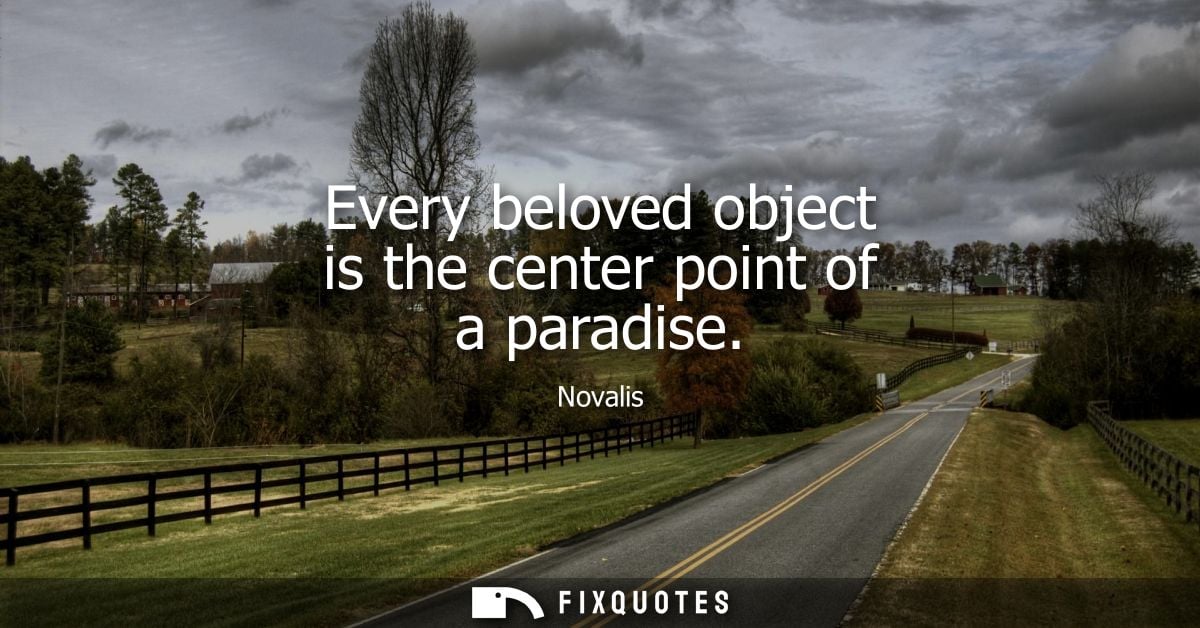
"Every beloved object is the center point of a paradise"
About this Quote
“Every beloved object” is an audacious claim because it refuses to rank what deserves rapture. Novalis, one of German Romanticism’s most mystically inclined poets, takes love off the grand pedestal of abstractions and plants it in the particular: an object, a person, a scrap of the world that attention has singled out. The trick is in “center point.” Paradise isn’t somewhere else; it’s an effect of orientation. Love becomes a kind of astronomy where the beloved turns into the fixed star and everything else reorganizes around it.
The subtext is both tender and slightly dangerous. If the beloved is the center, then the self is no longer sovereign; desire redraws your map. That’s the Romantic wager: subjectivity doesn’t just perceive reality, it generates it. Novalis is writing in a moment when Enlightenment reason has started to feel emotionally insufficient, and early industrial modernity is stripping the world of enchantment. His answer isn’t to deny reality but to re-enchant it through devotion, to insist that meaning is made in the act of cherishing.
“Paradise” also carries religious voltage. Novalis flirts with the idea that everyday attachments can mimic the sacred, that transcendence can be smuggled into the mundane. It’s not escapism so much as a quiet rebellion against a world that wants objects to stay inert and utilitarian. In Novalis’s line, the beloved object refuses to be merely used; it becomes inexhaustible, a portal. The paradise is not found. It’s centered.
The subtext is both tender and slightly dangerous. If the beloved is the center, then the self is no longer sovereign; desire redraws your map. That’s the Romantic wager: subjectivity doesn’t just perceive reality, it generates it. Novalis is writing in a moment when Enlightenment reason has started to feel emotionally insufficient, and early industrial modernity is stripping the world of enchantment. His answer isn’t to deny reality but to re-enchant it through devotion, to insist that meaning is made in the act of cherishing.
“Paradise” also carries religious voltage. Novalis flirts with the idea that everyday attachments can mimic the sacred, that transcendence can be smuggled into the mundane. It’s not escapism so much as a quiet rebellion against a world that wants objects to stay inert and utilitarian. In Novalis’s line, the beloved object refuses to be merely used; it becomes inexhaustible, a portal. The paradise is not found. It’s centered.
Quote Details
| Topic | Wisdom |
|---|---|
| Source | Help us find the source |
| Cite | Cite this Quote |
Citation Formats
APA Style (7th ed.)
Novalis. (n.d.). Every beloved object is the center point of a paradise. FixQuotes. https://fixquotes.com/quotes/every-beloved-object-is-the-center-point-of-a-7998/
Chicago Style
Novalis. "Every beloved object is the center point of a paradise." FixQuotes. Accessed February 1, 2026. https://fixquotes.com/quotes/every-beloved-object-is-the-center-point-of-a-7998/.
MLA Style (9th ed.)
"Every beloved object is the center point of a paradise." FixQuotes, https://fixquotes.com/quotes/every-beloved-object-is-the-center-point-of-a-7998/. Accessed 1 Feb. 2026.
More Quotes by Novalis
Add to List