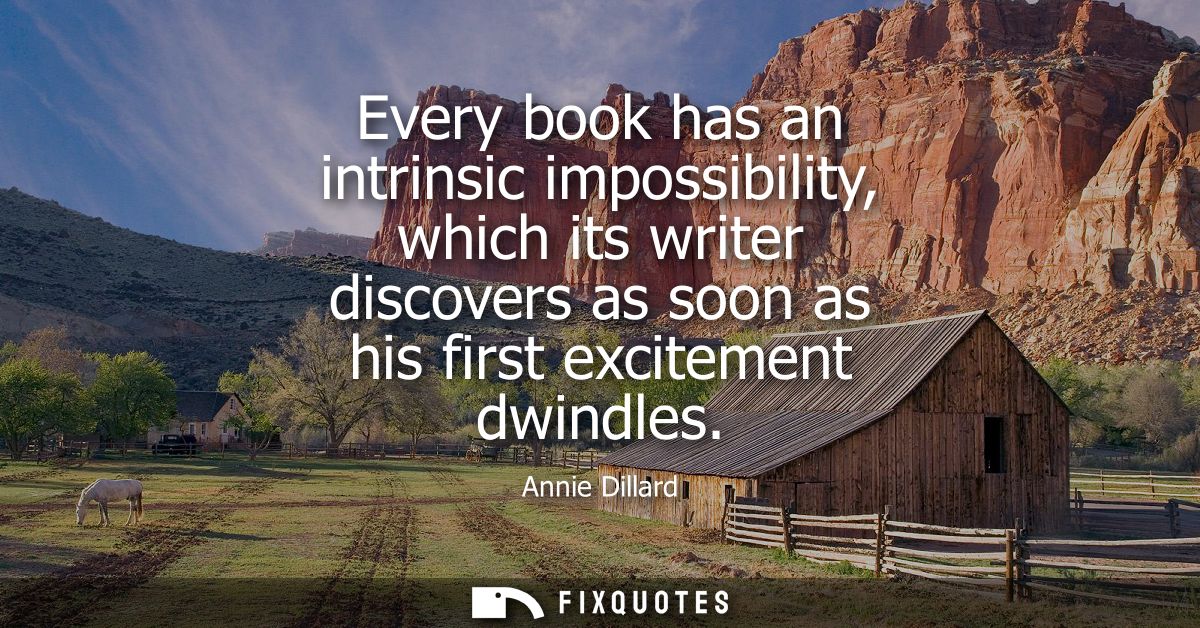
"Every book has an intrinsic impossibility, which its writer discovers as soon as his first excitement dwindles"
About this Quote
Dillard punctures the romantic myth of authorship with a single, quietly brutal turn: the book doesn’t become hard because the writer gets lazy or distracted, but because the project contains a built-in flaw the writer can only see once the honeymoon ends. “Intrinsic impossibility” is the key phrase. It suggests that every book, no matter how urgent the premise, asks for something reality won’t fully supply: perfect coherence, total knowledge, emotional precision, a world that holds still long enough to be described. The writer starts in the intoxicating phase where the work feels inevitable; then the draft reveals its true nature as a compromise between intention and language.
The subtext is both consoling and unforgiving. Consoling, because the struggle is not a personal failure; it’s structural. Unforgiving, because Dillard implies that professionalism isn’t inspiration but stamina in the face of discovery: you don’t write to express what you already know; you write to find the limits of what can be said. That makes “dwindles” an especially honest verb. Excitement isn’t demonized, just treated as perishable fuel.
Context matters: Dillard’s work, from Pilgrim at Tinker Creek onward, is obsessed with the gap between the luminous experience and the blunt instrument of description. Her sentence carries the ethic of the essayist who trusts attention but distrusts easy transcendence. The line doubles as a warning to aspiring writers and a diagnosis of the creative process itself: the real book begins when the fantasy of the book collapses.
The subtext is both consoling and unforgiving. Consoling, because the struggle is not a personal failure; it’s structural. Unforgiving, because Dillard implies that professionalism isn’t inspiration but stamina in the face of discovery: you don’t write to express what you already know; you write to find the limits of what can be said. That makes “dwindles” an especially honest verb. Excitement isn’t demonized, just treated as perishable fuel.
Context matters: Dillard’s work, from Pilgrim at Tinker Creek onward, is obsessed with the gap between the luminous experience and the blunt instrument of description. Her sentence carries the ethic of the essayist who trusts attention but distrusts easy transcendence. The line doubles as a warning to aspiring writers and a diagnosis of the creative process itself: the real book begins when the fantasy of the book collapses.
Quote Details
| Topic | Writing |
|---|
More Quotes by Annie
Add to List