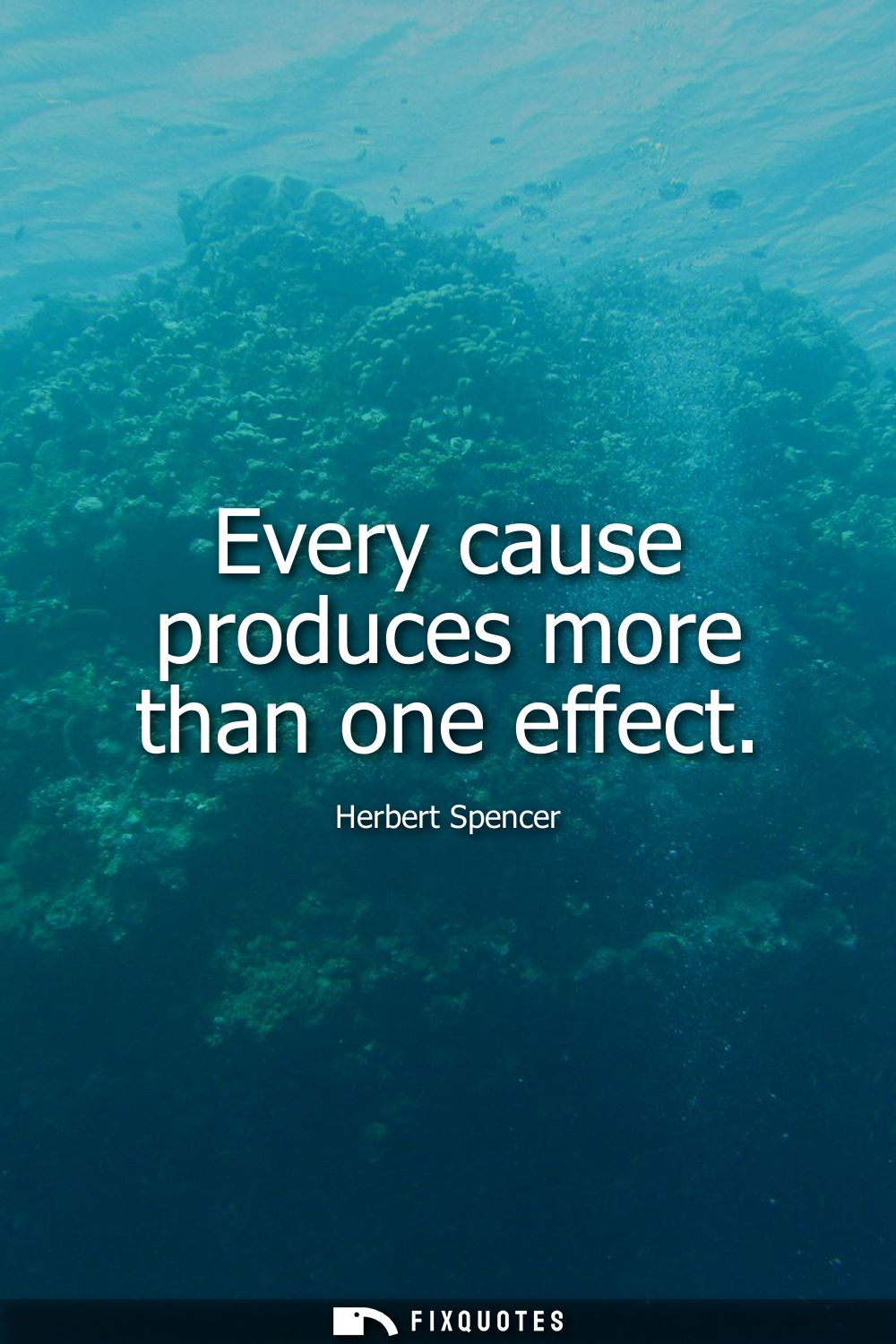
"Every cause produces more than one effect"
About this Quote
Spencer’s line reads like a sober warning dressed up as a law of nature: stop pretending the world is a single-variable equation. “Every cause produces more than one effect” carries the cool confidence of Victorian science, but its real force is political and moral. It tells reformers, revolutionaries, and well-meaning planners that history is littered with collateral outcomes, and that unintended consequences aren’t glitches in the system; they’re the system.
The phrasing is deceptively plain. “Every” makes it totalizing, almost punitive: no exceptions for good intentions. “More than one” is the dagger. It doesn’t merely say effects can be complex; it insists complexity is inevitable. Spencer is smuggling in a critique of simplistic narratives - the kind that flatter policymakers (“we’ll fix poverty by doing X”) and ideologues (“remove this obstacle and virtue will bloom”). He’s also protecting his broader worldview, rooted in evolutionary thinking and social complexity, where interventions reverberate through networks of incentives and dependencies.
In Spencer’s 19th-century context, this lands amid industrial upheaval, expanding bureaucracies, and heated arguments over state welfare and social reform. The line functions as an intellectual brake: before you pull a lever, ask what else it moves. That’s not neutrality; it’s a stance. Spencer’s skepticism about centralized solutions is encoded in the structure of the sentence, a compact argument that the world punishes linear thinking - especially when power is involved.
The phrasing is deceptively plain. “Every” makes it totalizing, almost punitive: no exceptions for good intentions. “More than one” is the dagger. It doesn’t merely say effects can be complex; it insists complexity is inevitable. Spencer is smuggling in a critique of simplistic narratives - the kind that flatter policymakers (“we’ll fix poverty by doing X”) and ideologues (“remove this obstacle and virtue will bloom”). He’s also protecting his broader worldview, rooted in evolutionary thinking and social complexity, where interventions reverberate through networks of incentives and dependencies.
In Spencer’s 19th-century context, this lands amid industrial upheaval, expanding bureaucracies, and heated arguments over state welfare and social reform. The line functions as an intellectual brake: before you pull a lever, ask what else it moves. That’s not neutrality; it’s a stance. Spencer’s skepticism about centralized solutions is encoded in the structure of the sentence, a compact argument that the world punishes linear thinking - especially when power is involved.
Quote Details
| Topic | Wisdom |
|---|---|
| Source | Help us find the source |
| Cite |
Citation Formats
APA Style (7th ed.)
Spencer, Herbert. (2026, January 15). Every cause produces more than one effect. FixQuotes. https://fixquotes.com/quotes/every-cause-produces-more-than-one-effect-22833/
Chicago Style
Spencer, Herbert. "Every cause produces more than one effect." FixQuotes. January 15, 2026. https://fixquotes.com/quotes/every-cause-produces-more-than-one-effect-22833/.
MLA Style (9th ed.)
"Every cause produces more than one effect." FixQuotes, 15 Jan. 2026, https://fixquotes.com/quotes/every-cause-produces-more-than-one-effect-22833/. Accessed 12 Feb. 2026.
More Quotes by Herbert
Add to List