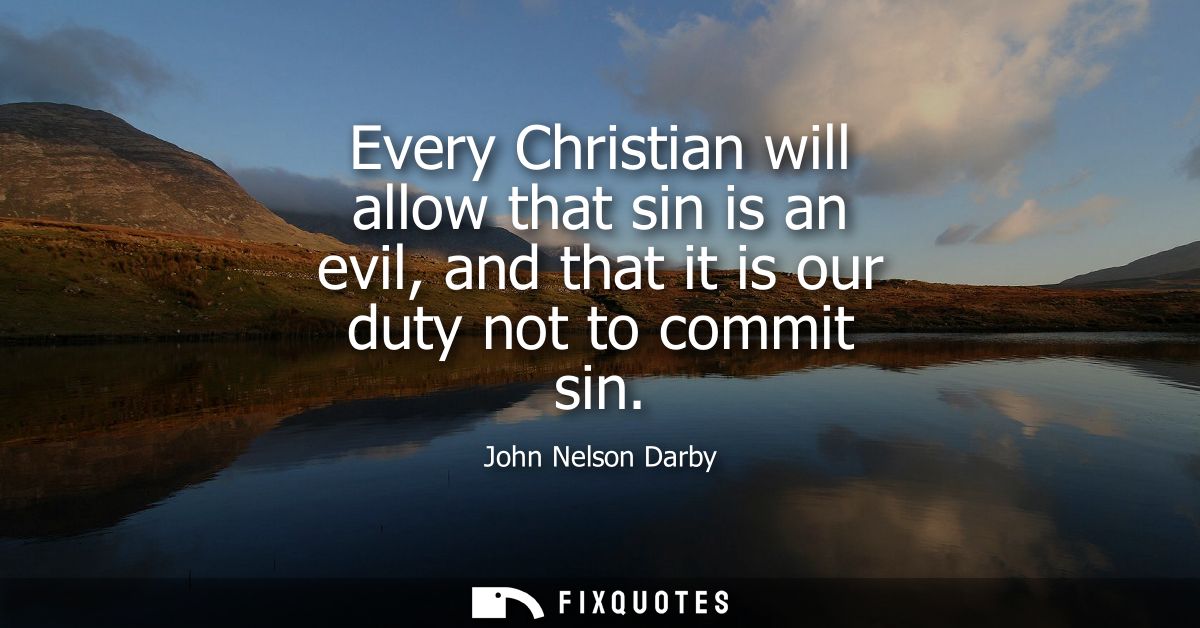
"Every Christian will allow that sin is an evil, and that it is our duty not to commit sin"
About this Quote
The sentence also performs a strategic narrowing. “Sin is an evil” and “it is our duty not to commit sin” sounds obvious, even comforting, but it quietly shifts the conversation from messy interior motives to enforceable obligations. Duty language re-centers faith as a matter of moral clarity and compliance. That makes it useful as a setup for the sharper, more controversial ideas Darby is associated with: a highly systematized theology, strict boundaries around true belief, and an insistence on separating the “faithful” from the world’s compromises. Start with the truism, then build the fence.
Context matters: Darby emerged in a 19th-century Protestant world anxious about institutional decay and spiritual lukewarmness. In that environment, stating the obvious isn’t redundant; it’s a loyalty test and a reset button. The subtext is less “avoid sin” than “stop rationalizing.” He’s not primarily offering pastoral nuance. He’s establishing a baseline from which any concession to ambiguity can be treated as moral drift-and, by extension, theological drift.
Quote Details
| Topic | Faith |
|---|---|
| Source | Help us find the source |
| Cite |
Citation Formats
APA Style (7th ed.)
Darby, John Nelson. (2026, January 18). Every Christian will allow that sin is an evil, and that it is our duty not to commit sin. FixQuotes. https://fixquotes.com/quotes/every-christian-will-allow-that-sin-is-an-evil-10449/
Chicago Style
Darby, John Nelson. "Every Christian will allow that sin is an evil, and that it is our duty not to commit sin." FixQuotes. January 18, 2026. https://fixquotes.com/quotes/every-christian-will-allow-that-sin-is-an-evil-10449/.
MLA Style (9th ed.)
"Every Christian will allow that sin is an evil, and that it is our duty not to commit sin." FixQuotes, 18 Jan. 2026, https://fixquotes.com/quotes/every-christian-will-allow-that-sin-is-an-evil-10449/. Accessed 14 Feb. 2026.