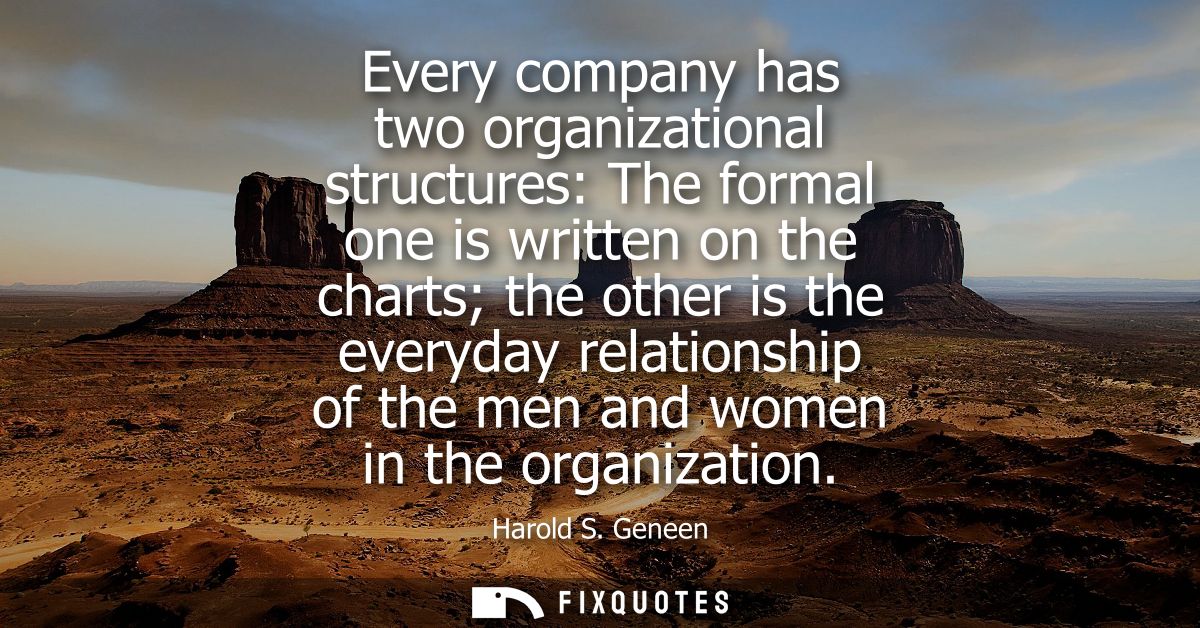
"Every company has two organizational structures: The formal one is written on the charts; the other is the everyday relationship of the men and women in the organization"
About this Quote
The specific intent is practical. If you want outcomes, you don’t manage boxes; you manage relationships. Work moves through whoever has credibility, information, and the ability to unblock decisions, not necessarily whoever has the title. The subtext is almost cynical: power is social before it’s procedural. A vice president with no allies is a decorative object; a veteran assistant with everyone’s ear can be a switchboard for the entire enterprise. Geneen is pointing to the company’s shadow architecture: the hallway conversations, the quiet negotiations, the unofficial translators between departments, the reputations that determine whose email gets answered.
Context matters: mid-century conglomerate capitalism, with sprawling divisions and distant headquarters, made the gap between “formal” and “real” especially dangerous. The larger and more complex the organization, the more the informal structure becomes the operating system. Ignore it and you get compliance theater, sandbagged numbers, and decisions that look rational on paper but die in the human circuitry of the workplace.
What makes the quote work is its plainness. No buzzwords, just an observation that lands like a managerial diagnostic: if you can’t map the relationships, you don’t understand the company you’re running.
Quote Details
| Topic | Management |
|---|---|
| Source | Help us find the source |
| Cite |
Citation Formats
APA Style (7th ed.)
Geneen, Harold S. (2026, January 15). Every company has two organizational structures: The formal one is written on the charts; the other is the everyday relationship of the men and women in the organization. FixQuotes. https://fixquotes.com/quotes/every-company-has-two-organizational-structures-9960/
Chicago Style
Geneen, Harold S. "Every company has two organizational structures: The formal one is written on the charts; the other is the everyday relationship of the men and women in the organization." FixQuotes. January 15, 2026. https://fixquotes.com/quotes/every-company-has-two-organizational-structures-9960/.
MLA Style (9th ed.)
"Every company has two organizational structures: The formal one is written on the charts; the other is the everyday relationship of the men and women in the organization." FixQuotes, 15 Jan. 2026, https://fixquotes.com/quotes/every-company-has-two-organizational-structures-9960/. Accessed 4 Apr. 2026.