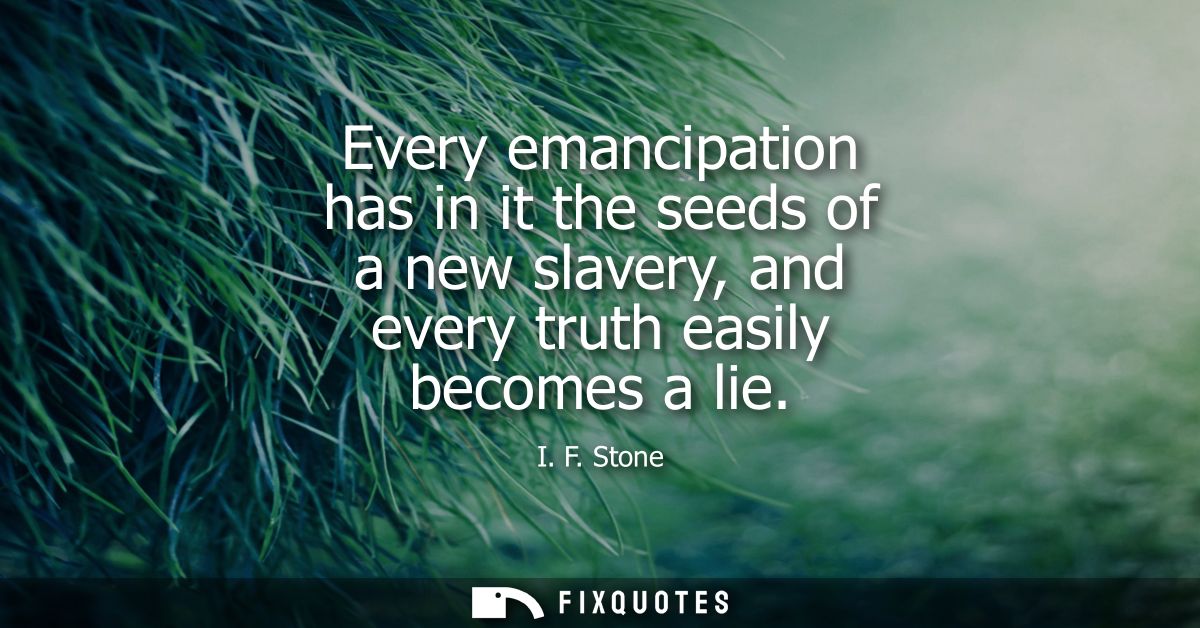
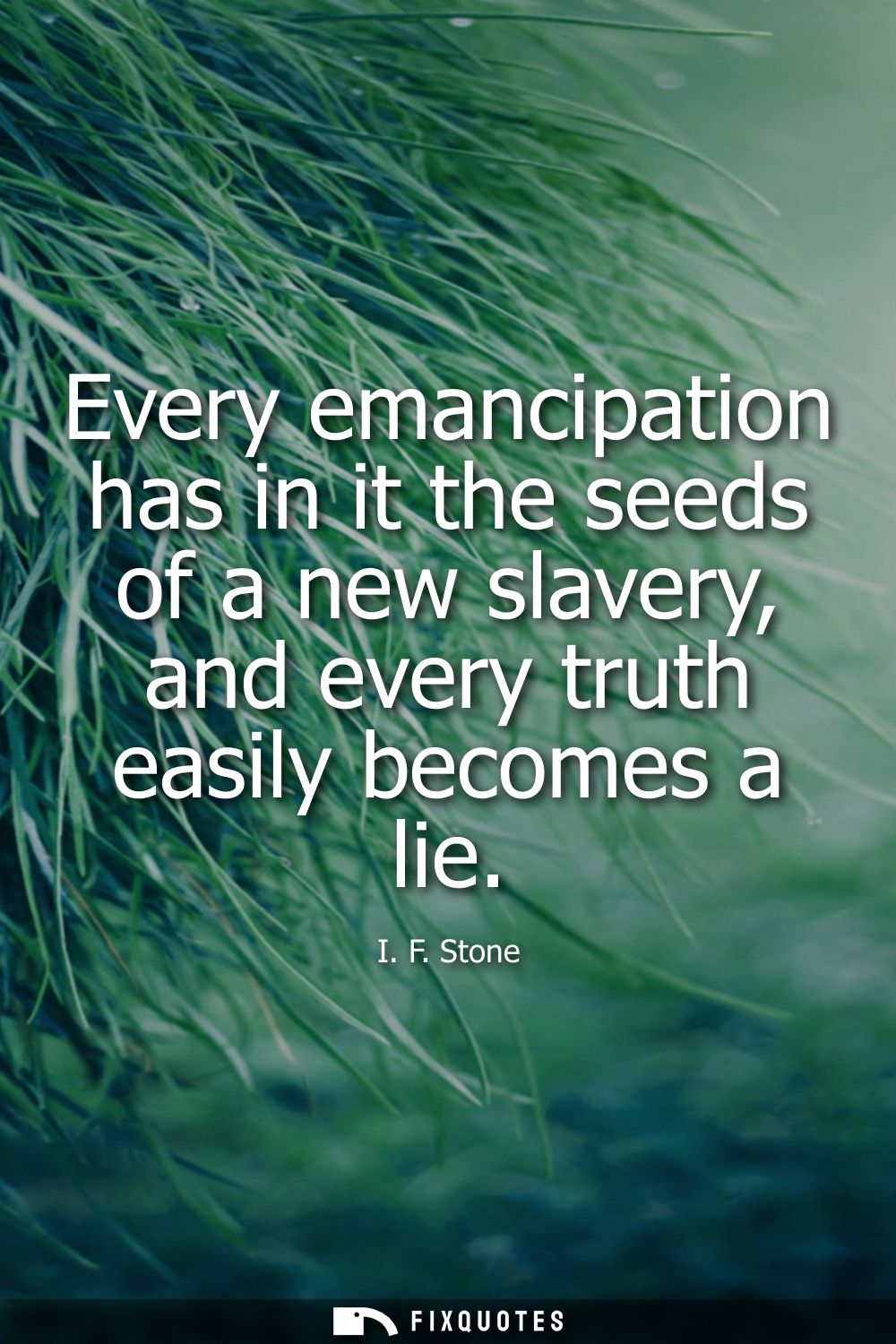
"Every emancipation has in it the seeds of a new slavery, and every truth easily becomes a lie"
About this Quote
The second clause sharpens the blade. “Every truth easily becomes a lie” isn’t relativism; it’s a critique of how “truth” gets institutionalized. A fact can be accurate and still function as propaganda once it’s repeated without context, used to justify new exclusions, or treated as a moral blank check. Stone’s journalistic sensibility is audible here: truths don’t merely get refuted; they get overextended, simplified, weaponized.
Context matters. Writing in the shadow of the New Deal state, World War II, the Cold War, McCarthyism, and Vietnam, Stone saw how anti-fascism could feed surveillance, how anti-communism could become a civil religion, how “security” could swallow dissent. The quote’s intent is less poetic than procedural: keep asking who benefits, who pays, and what freedoms are being traded away in the name of freedom itself. It’s a mandate for skepticism as civic hygiene.
Quote Details
| Topic | Freedom |
|---|---|
| Source | Help us find the source |
| Cite |
Citation Formats
APA Style (7th ed.)
Stone, I. F. (2026, January 16). Every emancipation has in it the seeds of a new slavery, and every truth easily becomes a lie. FixQuotes. https://fixquotes.com/quotes/every-emancipation-has-in-it-the-seeds-of-a-new-112808/
Chicago Style
Stone, I. F. "Every emancipation has in it the seeds of a new slavery, and every truth easily becomes a lie." FixQuotes. January 16, 2026. https://fixquotes.com/quotes/every-emancipation-has-in-it-the-seeds-of-a-new-112808/.
MLA Style (9th ed.)
"Every emancipation has in it the seeds of a new slavery, and every truth easily becomes a lie." FixQuotes, 16 Jan. 2026, https://fixquotes.com/quotes/every-emancipation-has-in-it-the-seeds-of-a-new-112808/. Accessed 24 Mar. 2026.