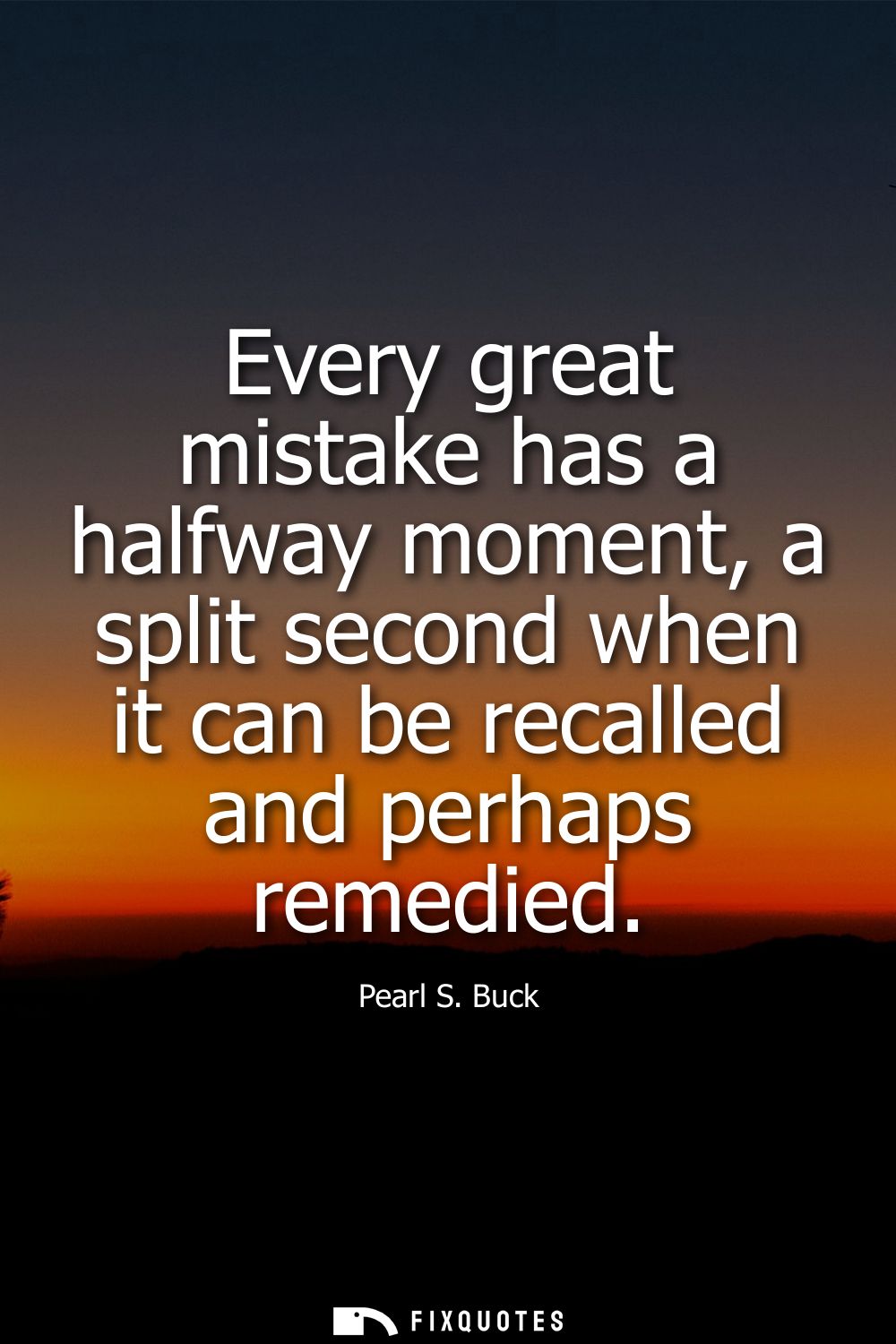
"Every great mistake has a halfway moment, a split second when it can be recalled and perhaps remedied"
About this Quote
Buck wrote as a novelist deeply attuned to moral consequence inside domestic and social life, where catastrophe is rarely cinematic. In her work, lives tilt because of a withheld truth, a rushed decision, a prideful silence. This quote captures that narrative logic: the point of no return is almost always preceded by a point of return that feels too small to matter. That is why "recalled" is such a shrewd verb. It`s not only about changing course; it`s about retrieving a better self - memory, conscience, responsibility - before it slips out of reach.
Culturally, the line reads like an antidote to fatalism. It argues for vigilance over grand resolutions: the decisive moral test is not the big speech, but the microsecond when you sense you`re about to harden into the wrong person and can still choose softness, honesty, restraint.
Quote Details
| Topic | Learning from Mistakes |
|---|---|
| Source | Help us find the source |
| Cite |
Citation Formats
APA Style (7th ed.)
Buck, Pearl S. (2026, January 16). Every great mistake has a halfway moment, a split second when it can be recalled and perhaps remedied. FixQuotes. https://fixquotes.com/quotes/every-great-mistake-has-a-halfway-moment-a-split-85403/
Chicago Style
Buck, Pearl S. "Every great mistake has a halfway moment, a split second when it can be recalled and perhaps remedied." FixQuotes. January 16, 2026. https://fixquotes.com/quotes/every-great-mistake-has-a-halfway-moment-a-split-85403/.
MLA Style (9th ed.)
"Every great mistake has a halfway moment, a split second when it can be recalled and perhaps remedied." FixQuotes, 16 Jan. 2026, https://fixquotes.com/quotes/every-great-mistake-has-a-halfway-moment-a-split-85403/. Accessed 25 Mar. 2026.